

When a security incident hits, the first few minutes are chaos. Your immediate reaction can mean the difference between a controlled, manageable event and a full-blown catastrophe that spirals out of control. The key isn't to avoid panic—it's to have a rock-solid plan that tells you exactly what to do when that panic sets in. Responding to an incident effectively isn't about guesswork; it's about having a clear, pre-defined strategy to immediately contain the threat, assess the extent of the damage, and kick off the recovery process. This guide provides in-depth, valuable information for handling a security breach.
Why a Plan Is Your Best Defence

We've all felt it. That jolt of adrenaline when a security alert turns out to be the real deal. In that moment, your gut might be screaming at you to pull every plug and shut everything down. But here's the thing: a panicked reaction can be just as destructive as the attack itself. You could end up wiping out the very evidence you need to understand what happened and how to fix it.
This is precisely why a structured incident response plan isn't just a 'nice-to-have'—it's a non-negotiable, especially for any small business serious about ISO 27001 certification. The standard explicitly requires a formal process for managing information security incidents. This isn't about improvising under fire; it's about executing a well-rehearsed playbook.
The Dangers of Winging It
Without a plan, chaos reigns. You'll have team members taking contradictory actions, crucial evidence getting deleted, and communication with customers and stakeholders falling apart. The result? A tarnished reputation, a much longer recovery time, and significantly higher costs. The data doesn't lie: organisations with a tested incident response plan drastically cut the financial fallout from a breach.
Think about it. It's 2 AM and you spot weird outbound traffic from your main file server. Without a plan, your first instinct is probably to just shut it down. With a plan, you know the procedure: isolate the server from the network, don't power it off. This simple, pre-planned action preserves its memory for forensic analysis while stopping the threat from spreading further.
A cyberattack doesn't end when the systems are back online. The true test of your resilience is how well you learn and adapt. Every incident is a lesson, and turning those hard-won lessons into a stronger security posture is what it's all about.
Your Immediate Priorities When Crisis Hits
Once an incident is confirmed, your focus has to narrow instantly to a few critical priorities. These initial steps are the foundation of any effective response and tick all the right boxes for frameworks like ISO 27001.
Your immediate goals are simple but crucial:
- Activate the Plan: This is the official starting gun. Formally declare an incident and get your pre-assigned response team on the case.
- Contain the Bleeding: Your most urgent technical task is to stop the problem from getting worse. Isolate the affected systems or network segments to prevent the threat from moving laterally across your environment.
- Preserve the Evidence: Make sure logs, system images, and other digital forensic evidence are secured. This is absolutely vital for figuring out the root cause and is essential for any potential legal or regulatory follow-up.
- Get a Quick Read: Start to understand the scope. Which systems are hit? What data is at risk? Who needs to know what, and when?
Having a detailed guide, like a comprehensive computer incident response plan, can make all the difference. It transforms a potential disaster into a managed process, ensuring that even under immense pressure, your team follows a logical and effective sequence of actions to minimise damage and get you back to business faster.
Building Your Incident Response Team
Let's be blunt: when a security incident hits, your response plan is useless if nobody knows who's in charge. That moment of chaos—when everyone looks around wondering "What now?"—is when a minor issue spirals into a full-blown crisis. You need absolute clarity on who does what, and you need it instantly.
For a small business, this doesn't mean hiring a dedicated army of security analysts. It's about being smart and assigning the right responsibilities to the capable people you already have on your team. This is about defining roles before the pressure is on, so you eliminate the confusion that can cripple your response in those critical first minutes.
Defining Your Core Roles
Forget fancy titles that don't mean anything in a crisis. In the heat of the moment, you need function-driven roles that are crystal clear. A small but mighty Incident Response Team (IRT) really just needs to nail three key functions.
-
The Incident Coordinator: Think of this person as the quarterback. They aren't in the weeds fixing the technical glitch; they're managing the entire response. They make sure everyone's talking to each other, decisions get made, and the plan is actually being followed. They are the single source of truth.
-
The Technical Lead: This is your hands-on expert. They’re the one leading the charge to figure out what happened, how far it spread, and how to stop the bleeding. Their job is to contain the threat, kick it out of your systems, and get everything back online safely.
-
The Communications Lead: Every word matters during an incident. This person manages all of it. They handle internal updates to keep staff in the loop, draft any external statements for customers, and—critically—talk to the regulators if you have to report it under Australia's Notifiable Data Breaches (NDB) scheme.
Giving people these roles ahead of time is incredibly empowering. It gives them the authority to act fast without getting stuck waiting for a dozen approvals, a bottleneck that can turn a small problem into a business-ending disaster.
Mapping Roles to Your Small Business Structure
The best part about this model is how flexible it is. You don't need to hire a "Chief Incident Coordinator." You just map these essential functions onto the roles you already have in your business. A great Incident Coordinator could be your Operations Manager or even the CEO—someone who gets the whole picture and isn't afraid to make a tough call.
The most effective incident response teams aren't defined by their size, but by their clarity of purpose. A three-person team with clearly defined roles and authority will outperform a 20-person team operating in chaos every time.
To make this really practical, let’s look at how you can map these IRT roles to the people you likely already have.
Incident Response Team Roles for Small Businesses
Here’s a simple way to think about assigning these critical responsibilities to common roles within a typical Australian small business. This table helps you move from theory to a practical, documented team structure.
| IRT Role | Primary Responsibilities | Potential Small Business Title |
|---|---|---|
| Incident Coordinator | Manages the overall response, coordinates team efforts, makes executive decisions, and ensures the response plan is followed. | CEO, General Manager, Operations Manager |
| Technical Lead | Leads the technical investigation, contains the threat, performs forensic analysis, and manages system recovery. | Senior Developer, IT Manager, External IT Consultant |
| Communications Lead | Manages all internal and external communication, drafts statements, and handles regulatory reporting (e.g., to the OAIC). | Marketing Manager, Office Manager, Head of Customer Service |
| Support Members | Provide assistance as needed, such as legal counsel, HR support for employee-related issues, or administrative help. | External Legal Advisor, HR Coordinator, Administrative Assistant |
This simple structure creates clear lines of authority and ensures every critical part of responding to an incident is covered. It’s how you transform a group of individuals into a coordinated unit ready to act.
The final, crucial step is to document these roles, make sure everyone knows what's expected of them, and run through a few drills. This preparation isn't just about ticking a box for ISO 27001 compliance; it’s about building the kind of real-world resilience that keeps your business standing when things go wrong.
Navigating the Incident Response Lifecycle
When a security incident hits, it’s not a single, chaotic moment. It's a process. The best way to think about it is less like a frantic sprint and more like a well-rehearsed relay race, where each stage hands off smoothly to the next. Understanding this lifecycle—from the first sign of trouble to the final lessons learned—is what separates a controlled response from pure panic. It's also a cornerstone of ISO 27001.
To make this real, let’s follow a scenario every small business dreads: a ransomware attack. Picture a small consulting firm in Melbourne. One morning, they discover their shared server files are being encrypted, and a ransom note has appeared. How they react in the next few hours, guided by a clear lifecycle, will determine if this is a minor hiccup or a full-blown catastrophe.
Phase 1: Detection and Triage
This is ground zero. Detection is simply how you first realise something is wrong. For our Melbourne firm, it was the blatant sign of encrypted files. But often, the clues are much more subtle. You have to be listening for the quiet signals.
Effective detection means having your alarms set and knowing what they sound like. These can be things like:
- Odd user behaviour: An employee suddenly accessing files at 3 a.m. from an IP address you don’t recognise.
- Suspicious network traffic: A server starts talking to a known malicious domain for no good reason.
- Sudden performance hits: A key application slows to a crawl without an obvious cause.
- Unexpected system changes: New admin accounts appearing out of nowhere or your security software being mysteriously disabled.
Once an alarm goes off, triage begins immediately. This is the rapid-fire assessment to figure out what you’re dealing with. Not every alert is a code-red emergency. Your team needs to quickly ask: Is this a real threat? How critical are the affected systems? What's the potential damage to the business?
For the consulting firm, encrypted client files on their main server is an undeniable critical, high-priority incident.
Phase 2: Containment
Now that you've confirmed a serious incident, the immediate goal is to stop the bleeding. Containment is all about preventing the threat from spreading further. It’s a delicate balancing act. You have to move fast, but rash moves—like yanking a power cord out of the wall—can destroy critical evidence you'll need later.
In our ransomware scenario, containment would mean taking a few decisive actions:
- Isolate the server: Get it off the network. Now. This instantly stops the ransomware from crawling over to other computers or servers.
- Hunt for other infected systems: Are any other workstations showing signs of encryption? If so, they need to be disconnected from the network as well.
- Block malicious connections: If your firewall logs show the server communicating with a specific external address, block that IP immediately to sever the attacker's control.
The golden rule of containment is to isolate, don't obliterate. Disconnecting a machine from the network keeps its memory (RAM) intact, which might hold vital clues about the attacker. Powering it down completely erases that evidence for good.
Phase 3: Eradication and Recovery
With the threat contained, it’s time to switch gears. Your focus now is on kicking the attacker out for good and getting back to business as usual.
Eradication means completely removing the threat from your environment. This is more than just deleting the ransomware. It’s about figuring out how the attacker got in and slamming that door shut. Did they exploit an unpatched server? Was it a phishing email that tricked an employee? You have to find the root cause, or they’ll just walk right back in. For our consulting firm, this means patching whatever vulnerability allowed the initial breach.
This flowchart shows the core roles you need to coordinate these complex phases.
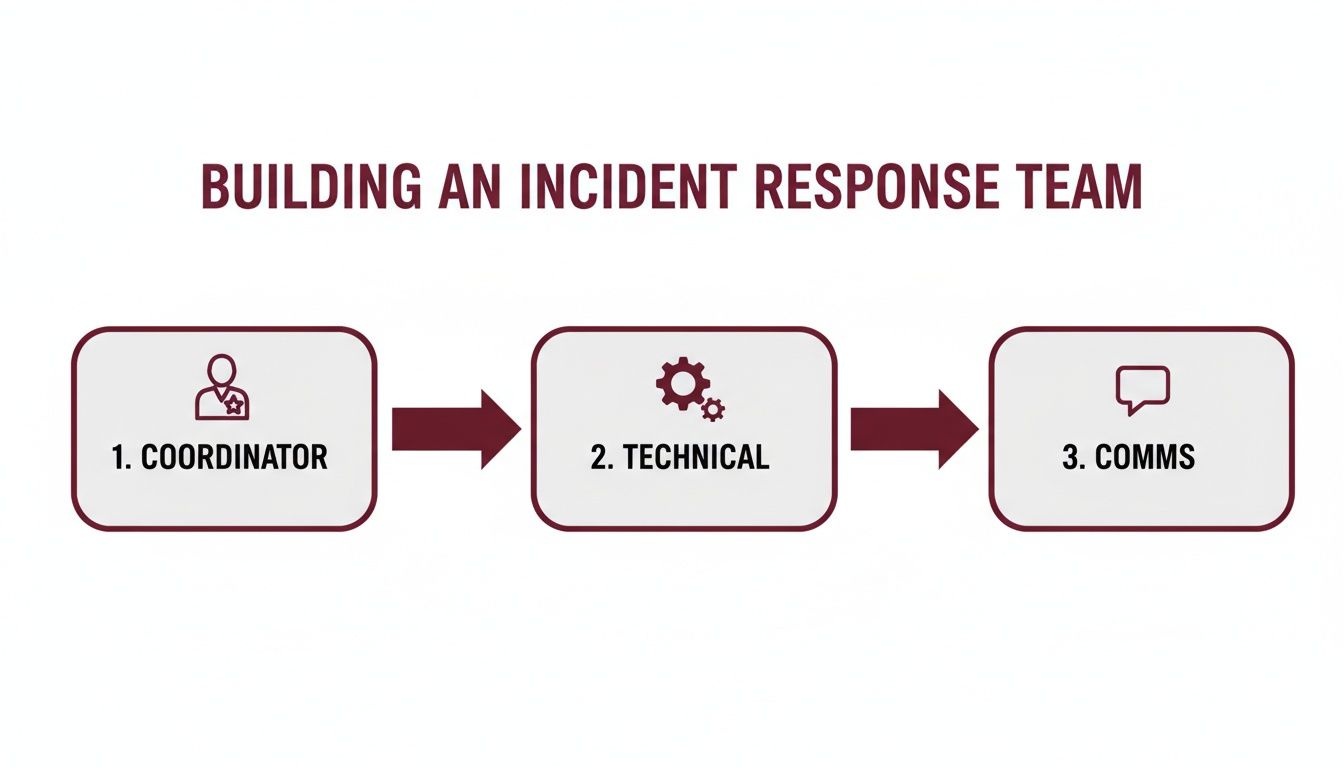
As you can see, a successful response hinges on a coordinated effort between a leader, technical experts, and someone managing communications.
Recovery is the careful process of bringing your systems and data back online. In almost every case, this means restoring from clean, verified backups. And the key word here is clean. You have to be 100% certain your backups weren't also compromised. The firm would need to completely wipe the affected server and restore everything from a backup taken before the incident.
This is exactly why ransomware is such a brutal threat. In Australia, it’s become the most disruptive form of cybercrime. The Australian Cyber Security Centre (ACSC) responded to 138 ransomware incidents in a single reporting period, with the average cost for a small business jumping 14% to $56,600. Those aren't just numbers; they're a stark reminder of why a solid recovery plan is non-negotiable.
A good incident response plan works hand-in-glove with a business continuity and disaster recovery plan, ensuring the whole organisation can bounce back. By following a documented lifecycle, you turn a potentially devastating event into a manageable process—proving your resilience to customers, partners, and ISO 27001 auditors alike.
Mastering Crisis Communication and Reporting
What you say during an incident—and just as importantly, when you say it—is every bit as critical as the technical fix. Let's be blunt: a clumsy, confusing, or delayed message can do more damage to your reputation than the breach itself. Mastering crisis communication means controlling the narrative with honesty and precision, building trust when it matters most.
This isn't just fluffy PR. It's a core part of your ISO 27001 obligations and, here in Australia, a legal necessity. You absolutely need a clear playbook for who to tell, what to say, and when. A well-handled communication plan can turn stakeholders into allies and regulators into partners, stopping a bad situation from spiralling into a catastrophe.

Developing Your Communication Plan
First things first: you need to establish a clear communication hierarchy. Who finds out what, and in what order? If you don't have this mapped out, you’re asking for trouble. Imagine your employees hearing about a data breach on the nightly news or, even worse, your biggest client finding out via a stray post on social media. That’s how you get chaos and instantly evaporate trust.
A solid communication plan usually breaks down into tiers for different audiences:
- Internal Stakeholders: Your incident response team, the leadership group, and eventually all staff need concise, factual updates. This is crucial to stop rumours and misinformation from spreading like wildfire internally.
- External Stakeholders: This group covers your customers, suppliers, and key business partners. The messages here must be carefully crafted—be transparent, but don't cause unnecessary panic or give away sensitive operational details.
- Regulators and Legal Bodies: For certain incidents, you are legally obligated to report the breach. This is a formal process with very strict timelines and specific requirements.
In a crisis, clear and rapid communication is everything. To keep things coordinated, especially if your team is spread out, it’s worth looking into various remote team communication tools that can help keep everyone on the same page.
Navigating Australia's Notifiable Data Breaches Scheme
For any Australian business, getting your head around the Notifiable Data Breaches (NDB) scheme is completely non-negotiable. Overseen by the Office of the Australian Information Commissioner (OAIC), this legislation means you must notify affected individuals and the OAIC if a data breach you suffer is likely to result in serious harm.
What counts as "serious harm"? The definition is deliberately broad, covering everything from physical and financial damage to psychological, emotional, or reputational harm. If you lose customer data with names, addresses, and credit card details, you're almost certainly in reporting territory.
The clock starts ticking the second you even suspect a notifiable breach has occurred. You have 30 calendar days to get to the bottom of it and figure out if you need to report. Don't drag your feet; failing to comply can bring on some hefty financial penalties.
Responding to an incident under the NDB scheme isn't just a technical task; it's a legal and ethical one. Your goal should be to act swiftly, assess accurately, and communicate clearly to protect those affected and meet your obligations.
The urgency here is backed by some pretty stark numbers. Data breaches in Australia have surged, with researchers logging 71 claimed incidents through October—a 48% increase over the previous year. A shocking 71% of these were driven by ransomware, which really shows how aggressive the threat landscape has become. This has all contributed to the OAIC noting 1,113 notifiable data breaches, a 25% rise and the highest number since the scheme began.
Communicating with Your ISO 27001 Certification Body
If you're already certified for ISO 27001 or working towards it, a major security incident adds another name to your call list: your certification body. I know it feels counterintuitive to call up your auditor and tell them about a security failure, but transparency is absolutely vital to keeping your certification.
Think of your auditor as a partner in your security journey, not an adversary. Proactively telling them about an incident and showing them how you're following your documented response plan is a sign of maturity and control. It proves your Information Security Management System (ISMS) actually works when the pressure is on.
When you reach out, be ready to give them:
- A clear, concise summary of what happened.
- An overview of the steps you’ve already taken to contain and eradicate the threat.
- Your plan for the post-incident review and the corrective actions you'll be implementing.
This kind of proactive communication shows you’re in control and committed to the continuous improvement that sits at the very heart of ISO 27001. It turns a potential compliance nightmare into a powerful demonstration of your business's resilience.
Turning Incidents into Lasting Improvements
The real work of incident response doesn't end when the crisis is over. Once your systems are back online and the dust has settled, the most important phase begins: transforming a painful security incident into a powerful lesson that makes you stronger. This post-incident review is where you build genuine resilience, a cornerstone of the ISO 27001 standard.
This isn't about pointing fingers. A successful review is a completely blame-free process focused on one thing: strengthening your defences. You're there to dissect what happened, not who was at fault. By treating every single incident as a learning opportunity, you prove to auditors, partners, and customers that you have a mature, proactive security posture. It’s how you guarantee you won't get hit by the same attack twice.
Conducting a Blame-Free Lessons Learned Session
The magic of a productive post-incident review lies in creating a space where people feel safe. Your team needs to be able to speak openly about what they saw and where they struggled, without any fear of being blamed. The conversation must stay laser-focused on weaknesses in your systems, gaps in your processes, and holes in your technology—not on individual slip-ups.
Honestly, a blame culture just makes people hide mistakes, which is the absolute last thing you want. The goal here is to dig up honest, actionable insights that will directly feed back into improving your security controls and your incident response plan.
Asking the Right Questions
To get the most out of your review, you need to guide the discussion with some sharp, open-ended questions. These aren't just about recapping a timeline; they're designed to get to the root cause of your vulnerabilities.
Try framing your conversation around these key areas:
-
Processes and Procedures:
- Where did our documented response plan actually slow us down or fail us?
- Was everyone crystal clear on their roles and responsibilities when things got chaotic?
- Did our communication plan work, or did we leave key people in the dark?
-
Technology and Tools:
- What one technical control, if we had it, could have stopped this incident in its tracks?
- Did our monitoring tools give us a clear, early warning? If not, why did they miss it?
- Were there any tools that let us down or that we desperately wished we had?
-
People and Training:
- Did the team have the right skills and training to deal with this specific kind of incident?
- What single piece of knowledge or training would have made us faster at containing and recovering?
- How can we better prepare our people for something like this happening again?
The ultimate goal of a post-incident review isn't just to write a report on what went wrong. It's to walk away with a concrete list of corrective actions, each with a clear owner and a firm deadline. This is what turns a "lessons learned" session from a chat into real, tangible security improvements.
This process is more critical now than ever. The Australian Cyber Security Centre (ACSC), for example, responded to over 1,200 cybersecurity incidents in a single year—an 11% increase that shows just how relentless the threats are. For a small business, the hit is especially painful, with the average cost of an incident now at $56,600. You can dig deeper into these trends and the top cyber incidents in Australia to get a clearer picture of the risks out there.
By meticulously breaking down every event, you build a much stronger defence. These insights should directly feed into updates for your security policies, justify new investments in better tools, and shape your ongoing team training. This is the very heart of continuous improvement and a vital part of managing corrective action for ISO 27001 certification.
Your Questions, Answered
Getting started with incident response, especially when you're navigating ISO 27001 compliance here in Australia, naturally brings up a lot of questions. We've helped hundreds of small businesses prepare for the unexpected, and these are some of the most common things we get asked.
How Often Should We Actually Test Our Incident Response Plan?
Look, for most small businesses, a full test at least once a year is a solid baseline. But don't just set it and forget it. You should also run a test whenever something significant changes – like a new IT system, a major shift in your team, or a new way you do business.
It doesn't have to be a massive, all-hands-on-deck simulation. Honestly, one of the most powerful things you can do is a simple tabletop exercise. Just get the response team in a room and talk through a realistic scenario. It’s a fantastic, low-stress way to find holes in your plan, make sure everyone knows their role, and build the muscle memory you'll need when the pressure is on.
What's The Biggest Mistake You See Small Businesses Make?
Hands down, the most damaging mistake is simply a lack of preparation. So many businesses only start thinking about their response strategy after an incident has already hit. I’ve seen it time and again – this reactive scramble leads to chaos, bad decisions made under pressure, and a much bigger mess to clean up.
When you're making it up as you go, you risk destroying crucial evidence, extending your downtime, and watching the costs spiral. Having a documented, tested plan isn't just a good idea; it's the single most important thing you can do to protect your business.
An incident response plan isn’t about trying to predict every single type of attack. It’s about creating a dependable process so your team can act with confidence and clarity, no matter what comes at them.
Do We Really Need To Buy Specialised Incident Response Software?
While big-ticket items like enterprise-grade Security Information and Event Management (SIEM) systems are powerful, they are absolutely not a requirement for an effective response. You can build an incredibly solid foundation using tools you probably already have.
Get the fundamentals right first. It's all about process, not just products.
- Simple, Clear Documentation: Can everyone find and understand the plan in a crisis?
- A Dedicated Comms Channel: A secure chat group or a pre-set conference line is perfect.
- Your Existing Logs: You’d be surprised what you can find in the logs from your firewall, servers, and main business apps.
Nail the process first. You can always layer in more advanced tools as you grow.
Is Having an Incident Response Plan Mandatory for ISO 27001?
Yes, 100%. It’s non-negotiable. The standard specifically calls it out in Annex A control A.16.1.7, which covers 'Information security incident management planning and preparation'.
To get certified, you must have a formal, documented process in place. This includes having a written plan, clearly assigned roles, and set procedures for how you report, respond to, and ultimately learn from security incidents. Without a solid plan, you simply won’t pass your audit.
Ready to build an incident response plan that not only protects your business but also paves the way for ISO 27001 certification? Anitech has over two decades of experience helping Australian small businesses achieve compliance with a 100% success rate. Let us simplify the process for you. Visit us at https://iso-27001.com.au to learn how we can help.
Recent Comments