

Quick Summary: This guide demystifies risk and compliance for small businesses, explaining how proactive risk management and regulatory compliance are two sides of the same coin. Learn to build an integrated program using frameworks like ISO 27001, turn compliance burdens into a competitive advantage, and avoid common pitfalls for lasting security.
Think of running your business like sailing a ship across the ocean. A robust risk and compliance framework is essential for a safe journey. Risk management is you in the crow's nest with binoculars, actively scanning the horizon for icebergs, storms, or pirates—anything that could stop you from reaching your destination.
Compliance, on the other hand, is making sure your ship meets all the maritime laws. It’s about having the right number of lifeboats, the correct navigation lights, and a properly certified crew. You don't do it because you might hit an iceberg; you do it because it's the law.
They aren't two separate jobs. They are two sides of the same coin, working together to keep your voyage safe and successful.

Risk and Compliance: Why You Can’t Have One Without the Other
At its heart, the difference between risk and compliance boils down to being proactive versus being reactive. Too many businesses treat them as separate checklists, run by different teams. This is a huge mistake. It creates duplicated work, wastes money, and leaves dangerous gaps in your defences.
Understanding how they work together is the first step to building a business that can weather any storm.
Risk management is all about looking ahead. It’s the process of asking, "What could go wrong here?" and then putting smart, practical measures in place to stop it from happening. It’s about protecting your goals.
Compliance is about following the rules of the road—the laws, regulations, and industry standards that apply to your business. These are the mandatory things you must do. Getting this wrong can lead to hefty fines, legal trouble, and a reputation that’s hard to rebuild.
How Good Risk Management Makes Compliance Easy
Here’s the secret: a solid risk management program naturally takes care of most of your compliance obligations. It stops being a frantic box-ticking exercise.
When you’re actively looking for and controlling your business risks, you'll find you’re already doing what the regulations require.
Let's say your risk assessment flags the danger of a data breach involving customer information. To manage that risk, you might implement stronger password policies and two-factor authentication. Guess what? You've just managed a critical business risk and met a core requirement of privacy laws like the Australian Privacy Act. Simple.
By focusing on the 'why' (the risk of a breach) instead of just the 'what' (the specific rule), compliance becomes a natural side effect of running your business well.
This shift in thinking is exactly what frameworks like ISO 27001 are built on.
The Payoff of an Integrated Approach
For a small business, bringing risk and compliance together under one roof just makes sense. The benefits are real and immediate:
- You Work Smarter, Not Harder: A single process to spot risks and map them to your legal duties means no more doubling up on work.
- You Save Money: One unified program is far cheaper to run than two separate ones. No contest.
- You Make Better Decisions: When leadership has a single, clear picture of all potential threats, they can steer the company with more confidence.
- You Win More Business: Proving you have a mature handle on risk and compliance builds incredible trust. It opens doors to bigger clients who won’t work with anyone who can't meet their high security standards.
This integrated mindset is the engine behind standards like ISO 27001. It’s not just a checklist of rules; it's a complete system for managing your information security risks. As we’ll see, a powerful risk management strategy is the foundation for lasting compliance, turning what feels like a burden into a genuine competitive advantage.
The Compliance Squeeze: Navigating Australian Business Regulations
Let's be honest, navigating the maze of Australian business regulations is tougher than ever. For a long time, many small businesses could fly under the radar, but those days are well and truly over. Ignoring risk and compliance isn't just risky anymore—it's a direct threat to your reputation, your contracts, and ultimately, your bottom line.
If you think compliance is just a headache for the big end of town, think again. New laws create a powerful ripple effect, and that wave is crashing right into the supply chains of larger companies. That means it’s crashing right into small and medium-sized businesses like yours. This isn't just about ticking boxes; it's about staying in business.
The Real-World Cost of Getting it Wrong
The stakes—both financially and operationally—have been raised dramatically. Regulators are losing their patience, and they now have much bigger sticks to wield. For any small business owner, this should be a massive wake-up call.
Take Australia's upcoming Scams Prevention Bill. From February 2025, it’s forcing banks, telcos, and digital platforms to conduct mandatory scam risk assessments and report incidents within 24 hours. The fines for failing to do so are eye-watering, hitting up to AUD 50 million. This is just one piece of a much larger puzzle of 2025 compliance changes, which also includes new psychosocial hazard laws and incoming anti-money laundering rules. The message is clear: the enforcement gloves are off, and if your business is connected to these sectors, you're in the splash zone.
Supply Chain Scrutiny is the New Standard
It’s not just the government you need to worry about. Your biggest clients are now being forced to police their own suppliers. And that means they're policing you.
A perfect example is the Australian Prudential Regulation Authority's (APRA) CPS 230 standard. Starting in July 2025, this forces big financial institutions to get serious about the operational resilience of every critical third-party supplier they use.
In simple terms: if you provide a service to a bank, an insurer, or a superannuation fund, your security and compliance weaknesses are now their problem. If you don't measure up to their new, stricter standards, you could be cut from their supply chain in a heartbeat.
This top-down pressure is something small businesses simply can't afford to ignore. Your clients' compliance headaches are now yours. For a deeper dive, our guide on how ISO 27001 aligns with Australian data privacy laws is an essential read.
Flip the Script: Turn a Threat into Your Advantage
This all sounds pretty intimidating, but there's a huge opportunity hiding in plain sight. The businesses that get on the front foot and tackle these demands head-on will leave their competitors in the dust.
Instead of seeing this tangled web of rules as a burden, think of it as a blueprint for building a stronger, more resilient, and more trustworthy business. This is where having a proper framework makes all the difference.
- Show You're Serious: A structured approach demonstrates to major clients and regulators that you take your obligations seriously.
- Build Unshakeable Trust: A certified and compliant business is a safe bet, making you the obvious choice for high-value contracts.
- Gain a Real Competitive Edge: While your rivals are scrambling to catch up, you'll already be meeting the high standards the market now demands.
By truly understanding this new reality, you can do more than just survive—you can thrive. A unified framework like ISO 27001 gives you a clear, proven roadmap to navigate the rules, win over demanding clients, and turn what feels like a weakness into your greatest competitive strength. It’s proof that you’re ready for business in Australia, today and tomorrow.
Building Your Integrated Risk and Compliance Program
So, how do you turn the big ideas of risk and compliance into a practical, working program? It can feel like a massive undertaking, but it doesn't have to be. Using the ISO 27001 framework as your blueprint, you can build an effective Information Security Management System (ISMS) in clear, manageable steps.
This isn’t just about ticking boxes for an auditor. It’s a logical path to making your business genuinely more secure and resilient. It’s about creating a system that truly protects your most valuable assets. Let's walk through exactly how to make this happen.
First Things First: Define Your Scope
Before you do anything else, you need to decide what your ISMS will protect. This is what we call defining the scope. For a small business, trying to protect everything, everywhere, all at once is a surefire way to get bogged down and achieve nothing. You have to be strategic.
Think about the crown jewels of your business. What information, if it were stolen, lost, or compromised, would cause the most damage? This could be your customer database, sensitive financial records, or your unique intellectual property. Your scope should laser-focus on the people, processes, and technology that touch this critical information.
A well-defined scope keeps your efforts focused and your resources concentrated where they matter most. It makes the entire risk and compliance process achievable, not overwhelming.
Once you know what you're protecting, you can move on to figuring out what you're protecting it from.
The modern compliance landscape is a minefield, with escalating pressures from new legislation, the threat of hefty fines, and intense scrutiny from customers and partners in your supply chain.
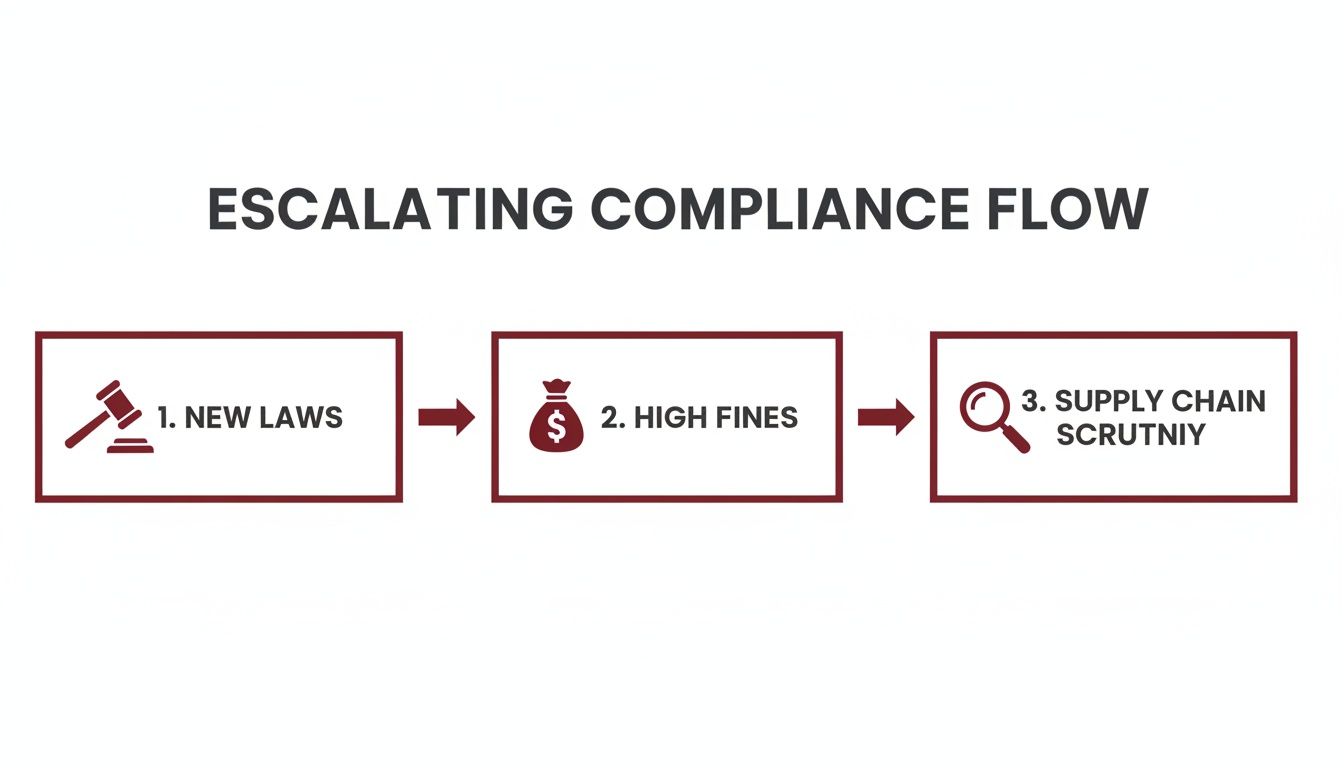
This constant pressure from the outside world translates directly into business requirements on the inside, making a structured response essential for survival.
Next, Run a Meaningful Risk Assessment
The risk assessment is the engine that drives your entire ISMS. It's simply the process where you identify potential threats to your valuable information, figure out how likely they are to happen, and estimate the potential damage if they do.
Forget complicated formulas and confusing jargon. At its heart, a risk assessment just answers three simple questions:
- What could go wrong? (e.g., A salesperson loses a company laptop full of client data).
- How bad would it be if it did? (e.g., We could face a massive fine and lose the trust of our biggest client).
- How likely is it to happen? (e.g., Our team travels constantly, so the likelihood is pretty high).
By writing these risks down, you create a clear, prioritised action list. This lets you spend your limited security budget and effort on the threats that pose the biggest danger to your business—not the ones that just sound scary.
Select Your Controls and Create Key Documents
With your risk assessment done, you now have a custom-made list of threats you need to deal with. This is where you turn to ISO 27001’s Annex A, which is essentially a catalogue of 93 potential security controls you can use.
You don't need to implement all of them. The whole point is to select only the controls that directly fix the specific risks you just identified. For example, if you identified the risk of data loss from stolen laptops, you’d probably select controls around encryption and mobile device security. Simple.
Your choices are then recorded in a crucial document called the Statement of Applicability (SoA). This document lists every single control in Annex A and explains three things:
- Whether you’ve decided to implement it.
- Why you made that decision (your justification).
- The current status of its implementation (e.g., 'In place', 'Planned').
The SoA is one of the first things an auditor will ask to see. It’s your proof that the program you’ve built is deliberate, thoughtful, and perfectly tailored to your business needs. As your program matures, you might even find that tools like AI legal software can help you stay on top of regulatory requirements more efficiently.
Assigning Roles and Responsibilities
Finally, a program is nothing without people to run it. For a small business, this doesn't mean you need to hire a whole security team. It just means giving clear responsibilities to the people you already have.
Assigning ownership of risk and compliance tasks is critical. Without clear roles, important security duties inevitably fall through the cracks. Here’s a typical breakdown for a small business getting started with ISO 27001.
Key Roles in an ISO 27001 Risk and Compliance Program
| Role | Primary Responsibility | Key ISO 27001 Tasks |
|---|---|---|
| Business Owner / CEO | Ultimately accountable for information security. Provides leadership, budget, and resources. | Signs off on the ISMS policy, reviews management reports, and champions security culture. |
| IT Manager / Technical Lead | Manages the hands-on implementation and operation of technical controls. | Deploys firewalls, manages user access, ensures data is backed up, and handles antivirus software. |
| Office Manager / HR Lead | Often handles the 'people' side of security, like policies and training. | Manages security awareness training, employee onboarding/offboarding security checklists, and policy communication. |
| All Employees | Responsible for following security policies and reporting incidents in their day-to-day work. | Adheres to the acceptable use policy, reports suspicious emails, and protects company assets. |
Clearly documenting these roles ensures everyone knows what part they play in protecting the business. It shifts security from being just an "IT problem" into a shared responsibility that’s woven into the company culture. By following these steps, you can create a robust framework that slots right into your daily operations.
And remember, ISO 27001 doesn't have to live in a silo. To learn more about how different frameworks can work together, check out our guide to integrated management systems.
Common Pitfalls in Risk Management and How to Avoid Them
It’s one thing to start a risk and compliance journey with the best intentions; it's another thing entirely to avoid the common hurdles that trip up so many small businesses. Getting this right isn't just about ticking boxes—it's about building a genuine shield for your business, not just a program that looks good on paper. Let's walk through some of the hard-won lessons so you can nail your risk and compliance strategy from the get-go.
So many businesses fall into the trap of treating a framework like ISO 27001 as a one-time project. It's not a trophy to hang on the wall and admire. To be effective against threats that are constantly changing, your security program needs constant attention, monitoring, and tweaking.
The 'Set and Forget' Mentality
Getting certified is a huge milestone, but it's not the finish line. I’ve seen it happen time and again: a company works incredibly hard to achieve ISO 27001 certification, hangs the certificate in the reception area, and then promptly lets its processes slide. Six months down the track, a former employee’s old login is used to walk right into their system and steal sensitive data. That certificate on the wall offered zero protection because the living processes behind it had been abandoned.
To stop this from happening to you, your Information Security Management System (ISMS) has to become part of the very fabric of your business. It needs to breathe.
- Schedule Regular Reviews: Lock in quarterly or bi-annual reviews of your risk assessments, security controls, and policies. Put it in the calendar and treat it as sacred.
- Weave it into Operations: Security shouldn't be a separate task. It needs to be part of your day-to-day, especially when bringing new staff on board or, even more critically, when they leave.
- Always Be Improving: Use your internal audits and management reviews as genuine opportunities to find weak spots and patch them up before a real threat comes knocking.
This simple shift in mindset turns compliance from a static checklist into an active, powerful defence.
Documentation Nobody Reads or Uses
Here’s another classic mistake: creating stunningly detailed security policies that do nothing but gather digital dust in a forgotten corner of your shared drive. If your team never looks at it, your documentation is worthless. It's just shelfware—useless for guiding what people do day-to-day and completely useless when a real security incident kicks off.
The entire point is to create documentation that is both useful and used.
Your security policies should be practical guides for your team, not dense legal documents designed only to impress an auditor. If your staff can't understand and apply them, they have failed.
To make your documentation actually work:
- Keep it Simple: Write in plain, everyday language. Use flowcharts, checklists, and diagrams to break up dense blocks of text.
- Make it Easy to Find: Put everything in one central spot that’s a breeze to search. Make sure every single employee knows where it is.
- Train, Don't Just Tell: Firing off an email with a link to a new policy is a waste of time. Run short, engaging training sessions to explain the key points and, most importantly, the "why" behind them.
Ineffective 'Tick-the-Box' Training
Speaking of training, that generic, soul-crushing annual security presentation does next to nothing. This "tick-the-box" approach rarely changes what people actually do. Your team will click through the slides, pass a ridiculously easy quiz, and forget everything they were meant to have learned by lunchtime. It might satisfy a compliance requirement on paper, but it does absolutely nothing to lower your real-world risk.
The cybersecurity landscape here in Australia is a harsh reminder of why this is so important. Cybersecurity is now the top compliance priority for a reason. We’re dealing with a backdrop of 47 million data breaches and a record 1,113 notifications to the OAIC—that’s a 25% jump from 2023. For CIOs and business owners, especially those who work with government, this isn't just a number; it’s a clear and present danger that demands a proper system for managing cyber threats. Have a read of the APRA system risk outlook if you want to understand the regulatory pressure that’s building.
How to Measure Success and Maintain Compliance
Getting your ISO 27001 certification is a huge achievement, but it’s the starting gun, not the finish line. A truly effective risk and compliance program isn’t a one-off project; it's a living, breathing part of how you do business. Let’s look at how you keep your program healthy, prove its value, and make sure it’s genuinely protecting you.
The real key is to move past simple pass-fail thinking. To measure success, you need to track meaningful Key Performance Indicators (KPIs). These are the hard numbers that show your security posture is actually getting stronger and that your investment is paying dividends.

Setting Meaningful Security KPIs
Forget vague, feel-good metrics. You need specific, measurable data points that tell the real story about your security effectiveness. Strong KPIs help you spot trends, justify your security budget, and demonstrate your commitment to clients and regulators.
It’s the difference between saying "we have antivirus" and proving its effectiveness. It's not just about doing backups; it's about measuring how quickly you can get back up and running.
Here are a few powerful KPIs to get you started:
- Time to Patch Critical Vulnerabilities: How long does it take your team to fix a high-severity security flaw once it’s been found? Your goal should be to constantly shrink this window of exposure.
- Percentage of Staff Passing Phishing Tests: What percentage of your team correctly spots and reports simulated phishing emails? This is a direct measure of how well your security awareness training is landing.
- Mean Time to Detect (MTTD) & Mean Time to Respond (MTTR): How quickly do you notice a security incident, and how fast do you act to shut it down? These are the metrics that define your resilience when things go wrong.
- Number of Days Without a Security Incident: While it’s never a guarantee, this is a great high-level indicator of your overall security health.
By tracking metrics like these, you shift the conversation from "Are we compliant?" to "How effective are our defences?". This is the language of mature risk management.
Tracking your performance is essential for understanding where your program is working and where it needs attention. Here’s a quick look at some vital metrics you should consider for your ISMS.
Essential Metrics for Your ISO 27001 ISMS
| Metric Category | Example KPI | Why It Matters |
|---|---|---|
| Vulnerability Management | Time to Patch Critical Vulnerabilities | Measures how quickly you close known security gaps, reducing the window for attackers. |
| User Awareness | Phishing Simulation Click-Through Rate | Directly tests the effectiveness of your security training and your team's vigilance. |
| Incident Response | Mean Time to Detect (MTTD) | Shows how quickly your security tools and team can identify a potential breach in progress. |
| Access Control | Number of Dormant User Accounts | Helps identify and remove unnecessary access points that could be exploited. |
| System Availability | Percentage of System Uptime | Demonstrates the resilience of your infrastructure against disruptions, a core goal of security. |
These KPIs give you a concrete way to measure progress and report on the health of your security program to leadership, turning abstract concepts into tangible results.
The Power of Continuous Improvement
Your Information Security Management System (ISMS) can't be static. It has to evolve as your business grows and as new threats emerge. The twin engines that drive this evolution are regular internal audits and management reviews.
Don't think of these as dreaded formalities. They are strategic opportunities—your chance to find and fix weaknesses before an attacker does.
Internal Audits and Management Reviews
An internal audit is your practice run. It’s a systematic check to make sure your controls are actually working as designed and that your team is following the procedures you wrote down.
A management review is where leadership gets involved. They assess the audit findings, review your KPIs, and make strategic decisions about the future of the security program.
This cycle of measuring, reviewing, and adjusting is what keeps your risk and compliance efforts sharp and relevant. It ensures your initial investment delivers real, lasting value. This diligence goes beyond just security frameworks; it applies to all areas where you face obligations, like navigating strict Australian Tax Office (ATO) regulations and maintaining solid tax compliance.
This focus on constant maintenance has never been more critical. The Office of the Australian Information Commissioner (OAIC) recently reported 1,113 notifiable data breaches—a shocking 25% jump from the previous year. With so many of these breaches stemming from inadequate security, it’s a stark reminder of how a structured framework like ISO 27001 provides the controls needed to fight back.
Frequently Asked Questions About Risk and Compliance
Let's be honest, diving into the world of risk and compliance can feel like learning a new language. If you're running a small business, it’s easy to get bogged down in the jargon. We get it.
To cut through the noise, we've answered some of the most common, real-world questions we hear from business owners just like you who are looking at ISO 27001. No fluff, just straight answers to help you make smart decisions.
How Long Does ISO 27001 Certification Take for a Small Business?
This is usually the first question on everyone's mind. For most small businesses in Australia, getting from the starting line to ISO 27001 certified typically takes somewhere between 6 to 12 months.
Of course, this isn't a hard-and-fast rule. The final timeline really depends on where you're starting from. Things that can shift the timeframe include:
- Your Business Size and Complexity: A five-person consultancy has a much simpler road ahead than a 50-person tech company with intricate data systems.
- Existing Security Maturity: If you've already got some solid security policies and practices in place, you're not starting from scratch. You might be closer to that 6-month mark.
- Resource Availability: The more focused time and people you can dedicate to the project, the quicker you'll get there.
The journey itself has clear stages. It starts with a gap analysis (to see where you stand now), moves into implementing the necessary controls, followed by an internal audit (a dress rehearsal), and finishes with the formal external audit by a certification body.
Is ISO 27001 Too Expensive for a Small Business?
It’s easy to look at the initial numbers and see a cost. A much smarter way to look at it is as a strategic investment in your business’s future. Yes, there are upfront expenses for things like expert guidance, maybe some new software, and the audit itself. But the return on that investment is huge.
Think about the catastrophic costs it helps you prevent. We're talking about the eye-watering fines for non-compliance, the financial and reputational nightmare of a data breach, and the slow bleed of losing clients who demand certification.
ISO 27001 certification isn't just a defensive shield; it's a powerful tool for growth. It unlocks opportunities that are simply unavailable to your competitors.
Beyond defence, certification actively opens doors to new revenue. For many small businesses, it’s the non-negotiable ticket to winning lucrative government contracts or becoming a trusted link in a large corporate supply chain. It gives your customers confidence, tightens up your operations, and ultimately makes your business far more resilient and valuable.
What Is the Difference Between a Risk Assessment and a Compliance Audit?
This is a fantastic question, and the distinction is crucial. Getting this right is key to understanding how risk and compliance work together. The simplest way to remember it is by their focus: one is forward-looking, and the other looks back.
A risk assessment is your proactive, internal health check. It's where you gaze into the crystal ball to figure out what could go wrong with your information security. You’re actively hunting for threats, weighing up how likely they are to happen, and calculating the potential damage to your business. Think of it as strategic planning for security.
A compliance audit, on the other hand, is a formal, retrospective check-up. It looks in the rearview mirror to verify that you actually did what you said you would do. An external auditor usually handles this, and their job is to confirm that you’re sticking to the specific controls and procedures laid out in a standard like ISO 27001.
To put it simply:
- Risk Assessment: What are our biggest security dangers on the horizon?
- Compliance Audit: Did we follow our own security rules last year?
Your risk assessment lays the foundation for a smooth compliance audit. You can't prove you’re compliant if you haven't first figured out which risks you need to be compliant against. They are two sides of the same coin, both essential for a strong risk and compliance program.
Recent Comments