

A risk management framework (RMF) is essentially your organisation’s game plan for dealing with uncertainty. It’s a structured approach—a collection of policies, procedures, and guidelines—that helps you consistently identify, assess, and handle potential threats.
Think of it as moving your business from constantly putting out fires to proactively fireproofing the building. It’s about building a consistent, repeatable, and aligned process that makes your entire organisation more resilient. This is not just a defensive tactic; it's a strategic imperative for any business aiming for sustainable growth in an unpredictable world. A well-constructed framework doesn't just prevent losses; it unlocks new opportunities by giving leadership the confidence to take calculated risks. It fosters a culture where every team member understands their role in managing uncertainty, transforming risk from a source of fear into a manageable business variable. This systematic approach is the cornerstone of building a truly adaptive and robust enterprise, capable of thriving amidst change.
Building Your Business on Solid Ground

Trying to run a business without a plan for managing risk is like trying to build a skyscraper without blueprints. You might get a few floors up, sure, but sooner or later, things will get wobbly and the whole structure could come crashing down. A risk management framework is that essential blueprint for your business, giving you the foundation needed to navigate choppy waters safely. It provides the architectural integrity required to support long-term growth and withstand unexpected shocks. Without this foundational structure, strategic decisions are made in a vacuum, operational vulnerabilities remain hidden, and the organization is perpetually exposed to preventable crises.
This isn't some dusty policy document that sits on a shelf. An effective RMF is a living, breathing system that weaves itself into your daily decisions. Its real job is to embed a risk-aware mindset into your company culture, making sure everyone from the CEO to the newest hire understands their role in protecting the business. It transforms risk management from an isolated, periodic exercise into a continuous, integrated component of organizational life. This cultural shift is profound; it encourages proactive problem-solving, enhances cross-departmental communication, and empowers employees to make better, more informed choices in their day-to-day work. The framework becomes the common language through which different parts of the organization discuss and address uncertainty, ensuring a cohesive and aligned response to potential threats and opportunities.
The True Purpose of a Framework
It’s easy to think risk management is just about stopping bad things from happening. And while that’s a big part of it, a truly great framework does more—it gives you the confidence to chase opportunities and make bold decisions. By understanding the potential downsides, you can take calculated risks that fuel real growth. It is a strategic enabler, not just a protective shield. When an organization has a deep understanding of its risk landscape, it can more accurately price its products, enter new markets, and invest in innovation, knowing that the potential negative outcomes have been identified, assessed, and are being actively managed. This clarity provides a significant competitive advantage.
A structured framework helps you answer some fundamental questions with clarity:
- What are our biggest threats? It forces you to look past the obvious and consider everything from cybersecurity and financial risks to operational hiccups and reputational damage. This comprehensive view prevents dangerous blind spots and ensures that resources are allocated to the most significant areas of exposure.
- How much risk can we stomach? It helps you define your organisation's "risk appetite," setting clear boundaries for your team. This critical step ensures that the level of risk being taken is consistent with the strategic objectives and stakeholder expectations, preventing the organization from taking on too much, or too little, risk.
- Who owns which risk? It assigns clear responsibility, so there’s no confusion or finger-pointing when a problem arises. This accountability is crucial for effective risk management, as it ensures that each identified risk has a dedicated owner responsible for monitoring it and implementing mitigation strategies.
By creating a common language and a standardised process, an RMF gets your entire team on the same page. It turns risk management from a vague idea into a practical, everyday part of how you operate. This shared understanding breaks down silos between departments and fosters a collaborative approach to tackling challenges. When everyone speaks the same risk language, communication is more efficient, decisions are more consistent, and the organization's overall resilience is significantly enhanced.
Moving From Chaos to Control
Without a framework, managing risk is often a messy, inconsistent affair. The marketing team might have one way of looking at threats, while the finance department has another. This scattered approach creates a patchy, unreliable picture of your company’s overall exposure and leaves you with dangerous blind spots. It's pure "fire-fighting" mode, and it's exhausting. Decisions are made reactively, resources are wasted on low-priority issues, and the organization lurches from one crisis to the next without any sense of strategic direction in its risk management efforts. This ad-hoc approach is not sustainable and inevitably leads to significant, often preventable, losses.
An RMF brings order to that chaos. It establishes a methodical, enterprise-wide structure for managing risks, ensuring you focus your energy on the threats that could actually derail your strategic goals. It provides a systematic and disciplined process for identifying, assessing, responding to, and monitoring risks across the entire organization. This structure ensures that risk management is consistent, comprehensive, and aligned with the business's overarching objectives. The framework acts as a central nervous system, coordinating the risk management activities of various departments into a cohesive and effective whole.
A risk management framework is the bridge connecting your high-level business strategy to your day-to-day operations. It ensures that while you're busy pursuing your goals, you’re also actively managing the roadblocks that could stop you from getting there.
This systematic approach is the bedrock of long-term resilience. Instead of being blindsided by the unexpected, your organisation develops the foresight to see trouble coming and the agility to respond effectively. It builds institutional muscle memory for dealing with uncertainty. For anyone serious about building this kind of structure, it's worth getting familiar with established guidelines. You can learn more about the principles and guidelines in our comprehensive overview of the ISO 31000 risk management standard. Ultimately, this isn’t just a defensive play; it’s a strategic tool for lasting success, enabling the organization to navigate the complexities of the modern business environment with confidence and purpose.
Choosing the Right Framework for Your Business
Picking the right risk management framework can feel a bit like choosing a new language. Some, like ISO 31000, are almost a universal dialect – they’re based on broad principles that you can apply just about anywhere. Others, such as the NIST Risk Management Framework (RMF), are highly specialised and procedural, almost like a technical jargon designed for specific industries like government or defence contracting. This choice is pivotal because the framework you select will shape your organization's entire approach to risk, influencing culture, processes, and technology decisions for years to come.
The real trick is to look past the acronyms and get a feel for the philosophy behind each one. Your decision shouldn't be about what’s popular; it needs to be a hard-nosed assessment of your company's actual needs, regulatory pressures, and day-to-day operational realities. A framework that is perfect for a large financial institution might be overly bureaucratic and cumbersome for a nimble tech startup. The key is to find the best fit for your unique context, considering factors like your industry, size, complexity, and strategic objectives.
When you get this right, a framework stops being a compliance chore and becomes a genuine strategic tool. It integrates seamlessly into your business operations, providing valuable insights and driving better decision-making. The goal is to find a system that not only puts out today's fires but also has the flexibility to grow with your business, adapting to new challenges and opportunities as they arise. A well-chosen framework is a long-term investment in organizational resilience and performance.
Getting to Know the Major Players
While there's a whole alphabet soup of frameworks out there, three tend to dominate the conversation. Each comes at risk from a slightly different angle, and understanding their core purpose is the first step to finding a good fit. These frameworks have been developed and refined over many years by leading professional bodies and government agencies, and each represents a deep body of knowledge and best practice in the field of risk management.
-
ISO 31000: Think of this as the universalist. It's a set of guidelines, not something you get certified in, designed to be flexible enough for any organisation, any size, any sector. Its main game is weaving risk management into the very fabric of your governance and decision-making. Its principle-based approach emphasizes integration and continuous improvement, making it a powerful tool for building a sustainable risk-aware culture.
-
COSO ERM Framework: This one grew out of the world of financial reporting and internal controls. Because of that, COSO's Enterprise Risk Management (ERM) framework is brilliant at connecting risk management directly to business objectives and performance. It helps you draw a straight line from a risk to its potential impact on your strategic goals, making it particularly popular with boards and senior executives who are focused on strategy execution.
-
NIST RMF: Here’s the cybersecurity specialist. Developed by the U.S. National Institute of Standards and Technology, it gives you a detailed, step-by-step process for managing information security and privacy risks. It’s the law for U.S. federal agencies and the gold standard for anyone handling sensitive data, providing a rigorous and repeatable methodology for securing critical information systems.
Each of these offers a powerful lens for viewing and managing risk. The best one for you simply depends on what you’re trying to build and what you need to protect. Understanding the nuances and strengths of each is essential for making an informed decision that will serve your organization well into the future.
Comparing the Core Philosophies
To make a smart choice, you need to understand what each framework prioritises. Is your biggest headache aligning risk with your company strategy, or is it building a digital fortress around your data? The core philosophy of a framework dictates its structure, its language, and its focus, so this alignment is critical for successful implementation.
Think of it like this: ISO 31000 teaches you the principles of good cooking. COSO ERM gives you a recipe book for hitting specific business targets. And NIST RMF provides the detailed kitchen safety and sanitation code you have to follow to stay in business.
Let's dig a bit deeper. ISO 31000 is all about fostering a risk-aware culture. It’s flexible and steers clear of rigid rules, which makes it perfect for organisations that want to embed smart risk-thinking into everything they do. Its emphasis on leadership and commitment aims to make risk management everyone's responsibility, not just the job of a specialist department.
COSO, on the other hand, is laser-focused on performance and hitting your objectives. It provides a structured approach for integrating risk management with strategy setting and performance management. It’s the ideal framework for leadership teams who want to see exactly how their risk activities are protecting their bottom-line results and creating value for stakeholders.
Finally, the NIST RMF is all about process, procedure, and control. It’s a nuts-and-bolts guide to securing information systems, with a detailed, seven-step process that covers everything from preparation and categorization to continuous monitoring. It’s the go-to for businesses in heavily regulated industries or those with sprawling, complex IT environments. For a more detailed look at how these frameworks stack up, our guide on different risk management frameworks offers some extra perspective.
Comparison of Key Risk Management Frameworks
To help you visualise the differences, this table lays out the core focus and ideal use case for each of the big three frameworks. Seeing them side-by-side clarifies their distinct strengths and intended applications, making it easier to match a framework to your organization's specific needs and priorities.
| Framework | Primary Focus | Core Principles | Ideal For |
|---|---|---|---|
| ISO 31000 | Universal guidelines for managing any type of risk across an entire organisation. | Leadership, integration, customisation, continuous improvement. | Any organisation seeking to embed a risk-aware culture and improve decision-making. |
| COSO ERM | Linking risk management directly to business strategy and performance objectives. | Governance & culture, strategy & objective-setting, performance, review. | Publicly-listed companies, financial institutions, and organisations focused on strategic performance. |
| NIST RMF | A detailed, prescriptive process for managing cybersecurity and privacy risk. | Prepare, categorise, select, implement, assess, authorise, and monitor information systems. | U.S. government agencies, defence contractors, and any organisation handling sensitive or critical data. |
Looking at them side-by-side really highlights their different personalities. Your choice ultimately comes down to whether your biggest need is cultural, strategic, or technical. Each framework provides a robust and well-tested approach, but their effectiveness depends entirely on how well they align with your organization's context and goals.
How to Choose the Right Framework
Don’t rush this decision. It takes a bit of honest self-reflection about where your organisation is right now. Get your leadership team in a room and ask these questions to steer the conversation. A thorough and thoughtful selection process is the first and most important step towards a successful implementation.
-
What’s our number one goal here? Are you trying to sharpen strategic decision-making (COSO)? Build a foundational risk culture from the ground up (ISO 31000)? Or are you scrambling to meet tough cybersecurity compliance rules (NIST)? Your main objective will narrow the field pretty quickly. Clarity on your primary driver is essential.
-
What do our regulators expect? If you're a government contractor or in the defence supply chain, the NIST RMF might not be a choice—it could be a requirement. In the same way, financial services firms often gravitate towards COSO because of its deep roots in internal controls. The regulatory environment is a non-negotiable factor.
-
How mature is our organisation? A small business just dipping its toes into risk management will likely find the principles-based approach of ISO 31000 far more manageable. A larger, more complex organisation with a dedicated risk team might be ready for the detailed demands of NIST or COSO. Be realistic about your current capabilities.
-
What industry are we in? Healthcare and tech companies sitting on mountains of sensitive personal data will find the security-first approach of the NIST RMF invaluable. A manufacturing company, however, might get more value from COSO's focus on operational efficiency and strategic goals. Your industry's specific risk profile is a key determinant.
The Hybrid Approach: A Smart Strategy
It’s crucial to remember that this isn't an all-or-nothing decision. You don't have to pledge allegiance to just one framework. In fact, many of the most successful organisations adopt a hybrid approach, cherry-picking the best elements from multiple frameworks to build a system that fits them like a glove. This pragmatic approach recognizes that no single framework is perfect for every situation.
For instance, a company could use ISO 31000 as its high-level guide for creating a risk-aware culture and governance model. This provides the overarching principles and structure. At the same time, its IT department could be implementing the granular controls and processes from the NIST RMF to lock down its cybersecurity threats, addressing a specific, high-stakes risk area with a specialized tool. This allows the organization to benefit from the broad, principle-based guidance of one framework while leveraging the detailed, prescriptive controls of another.
This kind of blended strategy gives you the best of both worlds: high-level strategic alignment and deep, domain-specific protection. It’s a practical acknowledgement that a one-size-fits-all approach just doesn’t work in the real world of risk. By carefully selecting and combining elements, you can build a risk management framework that is tough, flexible, and perfectly in tune with your business, creating a customized solution that is more effective than any off-the-shelf model could be.
Putting Your Risk Management Framework into Action
A framework on paper is just a good intention. The real test is turning that blueprint into the day-to-day reality of your business. This is where theory meets practice, and abstract principles become a living, breathing system that actively protects and guides your organisation. The implementation phase is where the value of the framework is truly realized, and it requires careful planning, dedicated resources, and sustained effort.
Operationalising your risk management framework means weaving it into your company’s DNA. It’s about making risk-aware thinking second nature to how your teams make decisions, plan projects, and get their work done. This isn't a one-off project; it’s about establishing a continuous rhythm of identifying, analysing, and responding to uncertainty. It requires a fundamental shift in mindset and behavior at all levels of the organization, from the boardroom to the front line.
The first step is to demystify the whole process. So many organisations get stuck right here, intimidated by how complex it all seems. The key is to start with a focused, manageable approach that builds momentum. Breaking the implementation down into logical, achievable steps makes the process less daunting and increases the likelihood of success.
Identifying the Risks That Truly Matter
You can't manage what you don't see. The absolute foundation of any working framework is risk identification. This needs to be a collaborative and thorough process, moving beyond the obvious threats to uncover the hidden vulnerabilities that could really derail your operations. It involves looking at risks from multiple perspectives and engaging stakeholders from across the business to ensure a comprehensive view.
A fantastic way to start is by running structured risk workshops. Forget stuffy, lecture-style meetings; these should be engaging, interactive sessions that bring together a cross-section of your team. Get people from different departments in the room—sales, operations, IT, finance—because they each hold a unique piece of the risk puzzle. This diversity of perspectives is crucial for identifying a broad range of risks that might be missed by a more siloed approach.
During these workshops, get everyone brainstorming around a few key areas:
- Strategic Risks: What could stop us from hitting our long-term business goals? Think about a major competitor launch, a sudden shift in market demand, disruptive technologies, or changes in the political landscape.
- Operational Risks: What could throw a spanner in our daily business processes? This could be anything from a supply chain failure, a key system outage, losing a critical staff member, process breakdowns, or human error.
- Financial Risks: What could mess with our financial stability? This includes things like currency fluctuations, credit risk, unexpected cost blowouts, liquidity issues, or changes in interest rates.
- Compliance Risks: What could land us in hot water with laws, regulations, or standards? Think data privacy breaches, workplace safety violations, environmental regulations, or anti-corruption laws.
The goal isn't to list every nightmare scenario imaginable. It's about focusing on the risks that have a plausible chance of happening and would have a meaningful impact if they did. This initial filtering is important to keep the process manageable and focused on what truly matters to the organization's success.
This process chart gives you a high-level look at the journey from assessing your needs to selecting the right framework, which sets the stage for taking action.
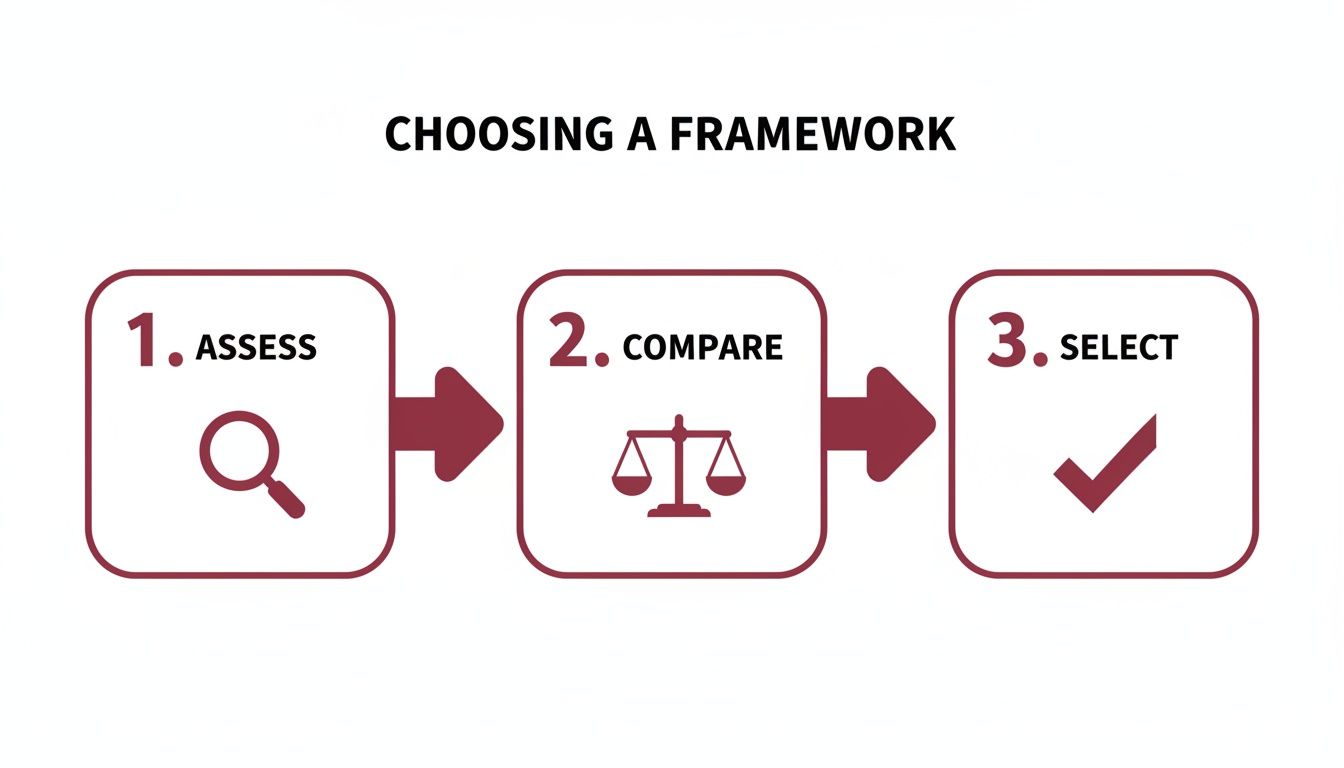
By systematically figuring out your needs, comparing the right models, and choosing the best fit, you lay a solid foundation for everything that comes next. This deliberate and thoughtful approach ensures that the subsequent steps of implementation are built on a strong and appropriate base.
Analysing and Prioritising Your Risks
Once you have a list of potential risks, it’s time to dig a bit deeper. A common and incredibly effective tool for this is the risk matrix. It helps you prioritise risks based on two simple factors: their likelihood (how probable it is that the risk will happen) and their impact (how bad the consequences would be). This simple two-dimensional analysis is a powerful way to bring order and objectivity to a potentially overwhelming list of concerns.
This analysis brings real clarity. It helps you separate the minor headaches from the genuine, mission-critical threats. You can then focus your limited resources—time, money, and people—where they will actually make a difference. This prioritisation step is what makes risk management practical and actionable, ensuring that effort is directed towards the threats that pose the greatest danger to the organization's objectives.
A risk matrix transforms a long list of worries into an actionable roadmap. It moves you from "what if?" to "what's next?" by highlighting the threats that demand your immediate attention.
This prioritisation is absolutely crucial. Without it, teams can get completely swamped, trying to fix every single risk with the same level of urgency. That just means nothing gets managed effectively. The matrix gives you the focus you need to act decisively, creating a clear set of priorities for the risk treatment phase and ensuring that the most significant exposures are addressed first.
Developing Effective Mitigation Strategies
With your priorities sorted, it's time to decide what to do about each significant risk. This is the "treatment" phase, where you figure out how to manage your exposure. You’ve generally got four paths you can take, often referred to as the "4 Ts" of risk treatment:
- Avoid (Terminate): You can choose to eliminate the risk by stopping the activity causing it. For example, if a new product line carries too much financial risk, you might just decide not to launch it. This is the most definitive response, but it may also mean forgoing potential opportunities.
- Mitigate (Treat): This is the most common approach. You put controls in place or take specific actions to reduce either the likelihood or the impact of the risk. A classic example is mitigating cybersecurity risk by installing firewalls, implementing multi-factor authentication, and training your staff on phishing awareness.
- Transfer (Share): You can shift the financial fallout of the risk onto someone else. Buying insurance is the perfect example—it transfers the financial consequences of a fire or flood to the insurer. Other examples include outsourcing certain functions or using contractual clauses to share risk with partners.
- Accept (Tolerate): For some risks, the cost of fixing them is actually higher than the potential damage. In these cases, you might make a conscious, informed decision to accept the risk and just have a solid contingency plan ready to go if it materializes. This is a valid strategy for low-impact, low-likelihood risks.
Developing a smart approach here is a core part of a wider https://iso-27001.com.au/risk-management-strategy/, ensuring your actions line up with your company’s big-picture goals. All these actions need to be documented in a risk register, which assigns a clear owner who is responsible for putting the controls in place and keeping an eye on them. This documentation and assignment of responsibility are critical for accountability and effective execution.
Establishing Continuous Monitoring and Reporting
A risk management framework is not a "set and forget" deal. The world changes, and so do risks, which means your framework has to be a dynamic, living thing. This requires a steady rhythm of continuous monitoring and reporting to make sure your controls are still working and your view of the risk landscape is up-to-date. Static risk assessments quickly become obsolete in a fast-moving business environment.
A powerful tool for this is developing Key Risk Indicators (KRIs). Think of KRIs as an early warning system, giving you a heads-up that a risk might be on the horizon. For instance, a KRI for a data breach could be a sudden spike in failed login attempts on your network. A KRI for supply chain disruption could be a rise in late deliveries from a key supplier. These metrics provide real-time data on your risk exposure.
These KRIs should feed into a dashboard that gives your leadership team a clear, at-a-glance view of the organisation's risk posture. A well-designed dashboard doesn't drown people in detail; it highlights the critical information needed to make smart, strategic decisions. It tells leaders what they need to know, not everything there is to know, enabling them to quickly identify emerging threats and assess the effectiveness of risk mitigation efforts.
As you implement your framework, making sure the data you use for your assessments is sound and secure is paramount. For some great insights into reliable data gathering, especially in the financial space, it's worth exploring secure data acquisition strategies.
The NBN Enterprise Risk Management Framework (ERMF) is a strong local example of all this in action. They structure risk management around a core four-step process: identify, measure, mitigate, and report. This process is backed by crucial enablers like clear governance, a defined risk appetite, and a risk-aware culture. It’s a great model showing that success relies on both a solid process and a supportive environment. By following these steps, you can turn your framework from a document into a powerful engine for building a more resilient and successful business.
Common Pitfalls That Derail Risk Management
Even the most carefully planned risk management programs can go off the rails. What starts with great intentions often becomes a bureaucratic chore that adds little real value. Many organisations launch with a burst of enthusiasm, only to watch their framework become a source of frustration, not strength. The path to effective risk management is littered with potential missteps that can undermine the entire initiative.
The good news is that most of these failures are avoidable. By understanding the common traps that others have fallen into, you can steer clear and build a framework that genuinely works as a powerful strategic asset, rather than just another document gathering dust. Awareness of these pitfalls is the first step in proactively designing a program that is resilient, practical, and truly valuable to the business.
The "Compliance-Only" Mindset
This is probably the biggest killer of effective risk management. When your only reason for doing this is to tick a box for an auditor or meet a regulatory requirement, the whole exercise loses its strategic purpose. It quickly devolves into a checklist, where the goal is simply looking good on paper, not actually reducing risk. The focus shifts from managing risk to managing the appearance of managing risk.
This "compliance-only" approach poisons the well. Your team starts to see risk management as a roadblock—a bureaucratic hassle invented by another department to slow them down. It becomes a grudge purchase, something to be endured rather than embraced. To beat this, you have to connect risk management directly to business performance and demonstrate its value in achieving organizational goals.
- Tie risks to real goals: Show your teams exactly how an unmanaged risk could stop them from hitting their targets, whether it's a sales quota, a product launch date, or an uptime guarantee.
- Frame it as an advantage: Explain how understanding risk allows the business to take smarter, more calculated chances to jump on new opportunities, making the organization more agile and competitive.
- Focus on value, not just rules: Talk about how the framework protects revenue, makes things run smoother, builds customer trust, and enhances brand reputation. Emphasize the tangible benefits.
Lacking Genuine Executive Buy-In
Getting a senior leader to sign off on a policy document is easy. Getting their genuine, active support is a completely different ball game. Real buy-in means they champion the framework in meetings, fight for the resources you need, and hold people accountable for managing their risks. It means they lead by example, integrating risk considerations into their own strategic decisions.
Without that, any risk initiative is dead in the water. It will lack the authority and resources necessary to succeed.
If leadership support is just for show, your people will pick up on it instantly. They'll see that risk management isn't a real priority. Requests for help get ignored, risk discussions get bumped from the agenda, and the whole framework slowly starves from neglect. It becomes a paper tiger—all growl and no bite, with no real influence on how the business operates.
Executive buy-in isn't a one-off approval; it's a continuous, visible commitment. It’s what gives a risk framework its teeth.
To get and keep this support, you have to speak their language. Show them the value with clear metrics and connect your work to the strategic goals they actually care about. Running a small pilot program in a critical part of the business can be a great way to show tangible results and build the case for a bigger rollout. Demonstrate early wins to build credibility and secure ongoing investment.
Overly Complex Frameworks
It's easy to get carried away and design a framework that’s far too complicated for your organisation. Some businesses, especially smaller ones, look at massive enterprise-level models and try to copy them, building a system with so many steps, controls, and reports that it collapses under its own weight. This desire to create a "perfect" system often leads to one that is completely impractical.
When a framework is too complex, your team won't understand it, let alone use it. It becomes a full-time job just to maintain it, and the effort involved massively outweighs any benefit. This complexity just leads to people tuning out, which means the data you get is poor and the system loses all credibility. Engagement plummets, and the framework becomes an object of ridicule rather than a useful tool.
The solution? Start simple and let it grow with you. Your first version should be lean, intuitive, and focused only on your most critical risks. You can always add more sophistication later as your organization's risk maturity develops.
- Use plain English and ditch the jargon. Make it accessible to everyone.
- Start with a simple risk matrix and a straightforward assessment process.
- Get the fundamentals right before you even think about adding more layers of complexity.
A simple framework that people actually use is infinitely better than a sophisticated one that everyone ignores. The goal is engagement and action, not theoretical perfection.
Poor Communication and Training
You could design the most brilliant risk management framework in the world, but if nobody understands why it exists or how to use it, it’s completely worthless. A classic mistake is failing to communicate the "why" and then skimping on practical training. Implementation without education is doomed to fail.
Without clear communication, your employees will just see another set of confusing rules being forced on them. They won't get their role in the process or see how it helps them or the business. This creates a vacuum that quickly fills with resentment and resistance. This is true in many business areas; for example, understanding and avoiding common tendering mistakes is crucial for success, and that only comes with clear guidance and training.
A solid communication and training plan isn't optional—it's essential. And it needs to be an ongoing effort, not a one-and-done email. It should be a continuous campaign to build and sustain awareness and capability.
Your plan must include:
- Explaining the "Why": Clearly lay out the business case for the framework and what you're trying to achieve. Connect it to the organization's mission and values.
- Defining Roles: Make sure everyone, from risk owners to frontline staff, knows exactly what’s expected of them. Clarity on roles and responsibilities is paramount.
- Providing Practical Training: Run hands-on sessions tailored to different roles, focusing on how to use the tools effectively in their specific context.
- Celebrating Wins: Share success stories and point out specific examples of how the framework is adding real value, such as preventing a potential incident or enabling a successful project.
Government benchmarks often highlight these very challenges. Comcover's Risk Management Benchmarking Program, which aligns with the Commonwealth Risk Management Policy, evaluates how well entities are doing. Recent findings showed that only 35% had fully mature governance. This proves that even with a clear policy, turning it into effective practice is a huge hurdle—one that strong leadership and communication are key to overcoming. You can explore more about how Australian government entities are maturing their capabilities in the full Comcover program overview.
Using Your Framework to Earn Certifications
Putting a solid risk management framework in place is so much more than an internal box-ticking exercise. It's a powerful strategic move that can open up new business opportunities and build incredible trust with your customers. Think of it this way: a well-oiled framework is your direct path to achieving crucial certifications like ISO 27001 or SOC 2, turning what feels like an operational cost into a genuine competitive edge. These certifications are often a prerequisite for doing business with larger enterprises or in regulated industries.
So many businesses treat risk management and certification as two separate, intimidating mountains to climb. The reality? They’re just two different trails leading to the same summit. All the disciplined work you pour into your framework—the risk assessments, the treatment plans, the continuous monitoring—is the very foundation auditors need to see. The framework provides the structure and evidence that form the backbone of any successful audit.

This connection is fantastic news because it means your journey to certification doesn’t start from a blank page. You get to lean on the processes and documents you’ve already created, which makes the whole audit process smoother, faster, and a lot less stressful. When you see this direct link, you start treating risk management not as a chore, but as a strategic investment that wins clients, enhances reputation, and keeps regulators happy. It shifts the entire perspective from a cost center to a value creator.
Connecting the Dots Between Risk and Compliance
Imagine your risk management framework as the engine of a car and certifications as the official roadworthy certificate. One directly powers the other. Standards like ISO 27001 are fundamentally built on the principles of managing risk. At the end of the day, an auditor's main job is to confirm that you have a systematic, repeatable, and effective process for identifying, evaluating, and treating information security risks. They are auditing your risk management system itself.
When an auditor walks in, they aren't looking for a perfect, risk-free organisation—that doesn't exist. What they are looking for is a mature, methodical approach to dealing with uncertainty. And guess what provides all that evidence? The documentation your RMF produces day in and day out: risk registers, assessment reports, treatment plans, and monitoring records.
Your risk register isn't just an internal spreadsheet; it's a primary exhibit for your audit. It proves to auditors that you have a deep, ongoing understanding of your threat landscape and are taking deliberate, documented steps to protect your data.
This evidence-based approach is what separates a smooth audit from a painful one. A well-kept framework means you can confidently answer an auditor’s questions by pointing to your established processes and documented results, showing them you’re on top of your game. It demonstrates that your security posture is not accidental but the result of a deliberate and thoughtful process.
How Your RMF Maps to ISO 27001 Clauses
Let's get practical. Several key clauses within the ISO 27001 standard are directly satisfied by the work you're already doing in your risk management framework. Understanding this mapping is the secret to a streamlined audit preparation, as it allows you to leverage your existing work and avoid redundant effort.
Here’s how your RMF activities line up with specific ISO 27001 requirements:
- Clause 6.1.2 Information security risk assessment: Your entire risk assessment process—from spotting threats and vulnerabilities to analysing their likelihood and impact—directly ticks this box. Your risk matrix and assessment reports are the key pieces of evidence here. The auditor will want to see that this process is consistent, repeatable, and comprehensive.
- Clause 6.1.3 Information security risk treatment: That risk treatment plan you developed? That’s your answer to this clause. It shows auditors exactly how you decided to avoid, mitigate, transfer, or accept each risk you found, and it provides the justification for your chosen course of action.
- Annex A Controls: Many of the 114 controls listed in Annex A are chosen and justified based on your risk assessment. Your framework provides the logic for why you implemented certain controls (like encryption or access control) and decided against others. Your risk treatment plan should explicitly link identified risks to the specific Annex A controls you've implemented to mitigate them.
By building your documentation around these principles from day one, you're essentially creating your audit evidence as you go. This proactive stance saves countless hours of scrambling for paperwork when the audit date is looming and ensures that your organization is in a state of continuous compliance readiness.
Streamlining Audits with Your Framework
A mature risk management framework changes the entire audit experience. You go from frantically digging through files and trying to reverse-engineer justifications to calmly guiding an auditor through your well-organised system of controls and proof. It transforms the audit from a stressful, adversarial event into a collaborative review of a well-run program.
This streamlined process gives you some real, tangible benefits:
- Reduced Preparation Time: A huge chunk of your audit prep is already done through the daily running of your RMF. You're collecting evidence continuously, not just in the frantic weeks before an audit. This "always-on" audit readiness dramatically reduces the pre-audit workload.
- Increased Auditor Confidence: When auditors see a systematic, documented process that is clearly embedded in the organization's operations, their confidence in your organisation's security shoots up. This often leads to a smoother, less adversarial audit with fewer non-conformities raised.
- Clear Justification for Controls: Your framework provides a clear and defensible reason for every security decision you've made. You can easily explain why certain controls are in place, linking them straight back to specific risks you've identified in your assessment. This demonstrates a thoughtful and risk-based approach to security.
Ultimately, this alignment proves that your security measures aren't just random. They are deliberate, risk-informed decisions made to protect what matters most. That’s a story that resonates powerfully with auditors, partners, and savvy clients. Viewing your risk management framework through this lens turns it into one of your most valuable assets for business growth and market differentiation.
Your Risk Management Questions Answered
As you start turning theory into practice, you’ll naturally run into some very real, practical questions. After all, building and maintaining a risk management framework isn't a one-and-done project—it's an ongoing journey of refinement and adaptation. Let's tackle some of the most common questions we hear from organisations, giving you clear answers to help you move forward with confidence.
Where Do I Even Begin with Building a Framework?
Your very first step, and honestly the most critical one, is to get genuine buy-in from your leadership. This means more than just a signature on a document. It’s about securing the authority, the budget, and the visible support you need to make this a real priority. Without that backing, any efforts you make will likely stall out due to a lack of resources and political will. You need a champion at the executive level.
Once you have the green light from the top, the next step is to define a manageable scope. It’s tempting to try and boil the ocean by tackling every single risk across the entire organisation at once, but that's a recipe for failure. Instead, start small. Focus on a specific business unit, a critical process like cybersecurity, or even a single high-stakes project. This allows you to show real value quickly, which builds the momentum and credibility you'll need to roll it out more broadly. A successful pilot project is your best tool for winning over skeptics and securing support for expansion.
How Often Should We Review Our Risk Framework?
Think of your framework not as a static document, but as a living system that has to adapt as your business and the world around it changes. As a rule of thumb, the entire framework—including its policies, procedures, and governance structure—should get a full, formal review at least annually. It's also smart to trigger a review anytime something big changes—think a new strategic direction, bringing in major new technology, a merger or acquisition, or a significant shift in the regulatory landscape.
That said, the day-to-day components need more frequent attention. Your individual risk registers, those detailed logs of threats and controls, should be looked at far more often. For fast-moving areas like cybersecurity or supply chain logistics, where the threat landscape can change overnight, a quarterly or even monthly review is vital. This is how you stay ahead of new threats and make sure your controls are still doing their job effectively. The frequency of review should be proportional to the velocity of change in the risk environment.
Can a Small Business Realistically Use a Framework Like NIST?
Absolutely. The key is adaptation, not blind adoption. A small business shouldn't even try to implement every single control from a massive framework like the NIST Cybersecurity Framework. That would be completely overwhelming and impractical, leading to a significant waste of limited resources.
Instead, treat it like a menu of best practices, not a rigid prescription. Start by focusing on the core functions that tackle your biggest risks, like 'Identify' and 'Protect'. You can borrow the logic and structure of the framework to guide your thinking without getting bogged down in enterprise-level bureaucracy. It’s all about scaling the implementation to fit your resources, your maturity, and your specific appetite for risk. This approach makes even the most robust frameworks useful and accessible for smaller teams, allowing them to benefit from world-class guidance in a way that is right-sized for their context.
The goal for a small business isn't to replicate a huge corporation's risk department. It’s to use the logic of an established risk management framework to make smarter, more informed decisions with the resources you actually have.
This simple shift in mindset turns a daunting framework into a practical toolkit. It's about leveraging the wisdom of the framework, not being enslaved by its every detail.
What Is the Difference Between a Risk and an Issue?
This is a really important distinction, and it's one that everyone in your organisation needs to grasp. Getting this right clarifies the whole point of what you're trying to do with risk management. Confusing the two terms can lead to a reactive, rather than proactive, approach.
-
A risk is a potential future event. It’s something that might happen and could knock you off course from achieving your objectives. It is defined by uncertainty. For example, "There is a risk our main cloud provider could have a major outage, which would impact our service availability."
-
An issue (or an incident) is a risk that has already happened. It’s a problem that’s landed on your plate right now and requires immediate attention. It is a certainty. To follow the example, "Our main cloud provider is having a major outage, and our customer services are down." This is no longer a risk; it is an issue that requires incident management.
Your risk management framework is all about proactively managing risks to stop them from becoming issues in the first place, or to reduce their impact if they do occur. It’s about looking down the road, anticipating problems, and dealing with them before they blow up. This is how you shift your organisation from a reactive state of constant fire-fighting to a proactive state of control, building genuine resilience from the ground up and securing a more predictable path to success.
Navigating the complexities of building a risk management framework and preparing for certifications like ISO 27001 can be a huge challenge. Anitech provides expert guidance to simplify the whole process, making sure your business not only gets compliant but also builds a stronger, more resilient foundation for whatever comes next. Learn how our ISO 27001 consulting services can help you.
Recent Comments