

For most Aussie business owners, risks and compliance feel like two completely different headaches. Risk is that unpredictable thing that keeps you staring at the ceiling at 3 AM. Compliance is the mountain of paperwork that seems to exist only to slow you down.
But what if they're not separate problems? What if they're two sides of the same coin, and getting them to work together could actually make your business stronger and more resilient?
Untangling Your Risks and Compliance Strategy

Trying to manage risks and compliance often feels like hacking your way through a dense jungle with no map. It’s confusing, it costs a fortune, and the rules of the game are always changing. This guide is your map. It’s here to help you cut through the mess and find a clear path forward.
Let’s start by looking at these ideas a bit differently. Instead of seeing risk as just a threat you need to dodge, think of it as a landscape of uncertainty. Sure, that landscape has its dangers, but it also hides opportunities for anyone who takes the time to understand it. A well-managed risk isn't just about a crisis you avoided; it’s a chance to build a tougher, smarter, and more competitive business.
Defining the Core Concepts
At its heart, risk management is all about identifying, assessing, and controlling threats to your business's money and operations. These threats can pop up from anywhere:
- Financial uncertainty: Think market swings, bad debts, or sudden cash flow problems.
- Legal liabilities: This could be anything from a data privacy breach to a workplace safety incident.
- Strategic management errors: Bad business calls, projects that go belly-up, or just failing to keep up with the times.
- Operational disruptions: Your supply chain breaks, a key piece of equipment fails, or your main IT system goes down.
- Cybersecurity threats: The scary stuff—data breaches, ransomware attacks, or phishing scams that trick your staff.
Compliance, on the other hand, is about playing by the rules. It's the 'rules of the road' for your specific industry here in Australia. This means following laws, regulations, standards, and even your own internal policies. It covers everything from workplace health and safety (WHS) laws to the Privacy Act.
The Critical Connection Between Risks and Compliance
The real magic happens when you stop treating risks and compliance like two separate jobs. Smart, proactive risk management is actually the engine that powers good compliance. Once you truly understand your risks, you can put controls in place that not only protect your business but also tick all your compliance boxes along the way.
This completely changes the game. Compliance is no longer a reactive, box-ticking chore. It becomes a genuine strategic advantage. Instead of panicking to meet a new regulation, you’re already prepared because your risk management framework saw the need for better data protection or more secure processes months ago.
A strong compliance posture is the natural outcome of a mature risk management program. It proves to customers, partners, and regulators that you are in control of your business and committed to operating with integrity.
For Australian businesses, the stakes are incredibly high. The regulatory environment has become a tangled web. In fact, compliance with federal regulations alone costs Aussie businesses a jaw-dropping $160 billion a year—that's around 5.8% of the nation's GDP. The complexity has exploded, with the number of federal regulations doubling since 2000. It's clear that a proactive strategy is no longer just a good idea; it's essential.
Building a Foundation of Trust
This integrated approach helps you build a business that can bounce back from anything, where compliance actually supports your growth instead of holding it back. It fosters a culture of accountability and ensures that every decision is made with a clear-eyed view of the potential consequences.
Getting the fundamentals right, like how you manage your data, is central to this. To create a foundation of trust for all your risk and compliance work, you might want to look at resources on building a robust data governance strategy. By tackling the challenges head-on with a unified plan, you can turn all that uncertainty into a serious competitive edge.
Why Do So Many Aussie Businesses Find Compliance So Hard?
If you feel like you're constantly playing catch-up with compliance, you're definitely not alone. The pressure is immense, and many Australian businesses are caught in a tangled web of ever-changing rules and escalating demands. This isn't just a feeling; it's a reality backed by some pretty stark numbers.
A recent PwC Global Compliance Survey painted a telling picture. It found that a grand total of zero percent of Australian organisations believe they’re at a leading level of compliance maturity. That’s a tough pill to swallow, especially when the global average sits at 7%. What's more, a huge 92% of Aussie leaders want to reach a mature or leading level, showing a clear, urgent gap between where businesses are and where they know they need to be. You can dig into these Australian insights over on the PwC website.
This data confirms what so many business owners feel day-to-day: the struggle is real. But to fix it, we first need to understand why this gap exists. It’s not one single problem but a perfect storm of challenges that make compliance feel so complex.
The Problem of Siloed Information
One of the biggest hurdles we see is the "silo effect." In many businesses, crucial information about risks and compliance is locked away in different departments. Finance is busy tracking financial risks, IT is focused on cybersecurity threats, and HR is managing employee policies. Everyone is doing their part, but they're often operating in their own little worlds.
This fragmentation creates dangerous blind spots. Without a single, unified view, it’s impossible to see how a risk in one area might domino into another. For example, a seemingly minor cybersecurity flaw in an IT system could easily spiral into a major data breach, leading to hefty financial penalties and a battered reputation. When your data is siloed, you can't connect the dots until it's far too late.
Fragmented Processes Are a Recipe for Inefficiency
Hand-in-hand with siloed data, you get fragmented processes. When each team cooks up its own method for managing compliance, you end up with a messy patchwork of inconsistent, overlapping, and inefficient workflows. This doesn't just chew up time and money; it dramatically increases the chance of something important slipping through the cracks.
Does any of this sound familiar?
- Manual Reporting Madness: Teams sink countless hours into manually pulling data from different spreadsheets to build compliance reports. It's a tedious process that's just asking for human error.
- Doubling Up on Work: The marketing team might run a privacy assessment for a new campaign, completely unaware that the IT team already assessed the very same platform.
- Inconsistent Defences: Security rules for one department might be worlds apart from another's, creating weak links in your company’s overall armour.
These disjointed efforts make building a strong, effective compliance program nearly impossible. Instead of a well-oiled machine, you’re left with a jumble of separate parts that don't quite fit together, creating friction that slows the whole business down. The complexity of compliance doesn't just feel like a burden; it actively hinders growth.
Many business leaders report that the sheer complexity of compliance is putting the brakes on innovation and efficiency.
Key Growth Drivers Negatively Impacted by Compliance Complexity (AU)
| Business Growth Driver | Percentage Reporting Negative Impact |
|---|---|
| Technology and Innovation | 76% |
| Customer Experience | 68% |
| Business Development and Strategy | 62% |
| Process Efficiency | 60% |
As the table shows, technology and innovation take the biggest hit, with over three-quarters of organisations feeling the negative impact. This highlights a critical disconnect: the very tools meant to drive a business forward are being held back by compliance challenges.
Bringing in New Tech Without a Compliance Plan
This leads us to another classic pitfall: adopting new technology without thinking about compliance from day one. In the race to get a competitive edge, new tools and systems are often rolled out with compliance treated as an afterthought—something to be "bolted on" later. This reactive approach is almost always harder and far more expensive in the long run.
Integrating compliance at the design phase of any new project or technology rollout isn't a roadblock; it's a strategic necessity. Treating it as an afterthought guarantees rework, higher costs, and increased risk down the line.
When compliance isn't part of the initial conversation, businesses can find themselves locked into systems that are fundamentally non-compliant. Trying to retrofit security controls, privacy features, or reporting capabilities onto an existing platform is a genuine nightmare. It creates technical debt and operational headaches that could have been easily avoided with a bit of foresight, proving yet again how crucial it is to manage risks and compliance together.
Building a Practical Risk Management Framework
Alright, you know the challenges. Now, let’s get our hands dirty and build the solution.
Moving from theory to action can feel like a huge leap, but trust me, creating a solid risk management framework doesn’t require a team of consultants or a complicated software suite. It’s about building a practical, living system that actually works for your small business.
The goal here isn't to create a static document that gathers dust on a shelf. It’s to build something that helps you make better decisions every day. This means getting real about your unique risks, understanding the damage they could do, and putting sensible plans in place to handle them. Think of it as your business's early warning system, helping you manage risks and compliance before they become full-blown crises.
Starting with a Simple Risk Workshop
Your best intel on business risks won't come from a textbook; it'll come from the people on your team who live and breathe the business every day. The most effective first step is to tap into that collective knowledge. Forget the formal boardroom setup—just get your key people in a room for a collaborative risk workshop.
This is a blame-free zone. It's all about open brainstorming. Grab a whiteboard, some sticky notes, and kick things off with a few honest questions:
- What are the things that keep us up at night?
- What's the one thing that, if it broke, would bring our operations to a halt?
- Where are we most exposed to a data breach or a cyber attack?
- What kind of financial surprises could wreck our cash flow?
- Which of our customer-facing processes are most likely to fail under pressure?
When you bring your team into the conversation, you get a 360-degree view of the business. You’ll uncover operational, financial, and tech risks you might have completely missed on your own. Plus, this approach builds a shared sense of ownership—managing risk becomes everyone’s job.
Identifying and Assessing Your Unique Risks
Once you have a list of potential threats from your workshop, it's time to dig a bit deeper. You need to understand what each risk actually is and then figure out how much it could hurt your business. Not all risks are created equal, and this is where you start separating the minor headaches from the genuine business-killers.
A huge part of this is getting honest about your cybersecurity. Identifying your digital weak spots is non-negotiable. It’s worth exploring how expert Cybersecurity Risk Management services can give you an outside perspective, helping you build a resilient defence against modern threats that you might not even see coming.
For each risk you've identified, you need to assess two simple things:
- Likelihood: How likely is this to actually happen? You can use simple terms like Rare, Unlikely, Possible, Likely, or Almost Certain.
- Impact: If it does happen, how bad will it be? Think in terms of Insignificant, Minor, Moderate, Major, or Catastrophic.
Don't get bogged down trying to be scientifically precise. For a small business, a simple high, medium, or low rating for both likelihood and impact is a perfectly good place to start.
Creating a Simple Risk Matrix
Now you can take your assessed risks and make them visual with a risk matrix. It sounds technical, but it’s just a simple grid that helps you prioritise what to tackle first. It plots likelihood on one axis and impact on the other, instantly showing you which threats fall into the high-priority "red zone."
A risk matrix makes it crystal clear where to focus your limited time and money. The risks that are both highly likely and would have a major impact? Those are your top priorities, no question. The ones that are rare and have a low impact can wait.
A risk matrix transforms a long, intimidating list of potential problems into a clear, actionable roadmap. It’s the single most powerful tool for turning abstract worries into concrete priorities.
This step is the absolute cornerstone of effective risk management. It makes sure you're putting out the biggest fires first. For a more detailed look at this, check out our guide on how to build your guide to a resilient risk management strategy.
Developing Practical Mitigation Strategies
Okay, you know your priorities. What are you going to do about them? For every significant risk, you need a mitigation strategy—a plan to reduce either its likelihood of happening or the damage it would cause if it did. You’ve really only got four options:
- Avoid: Sometimes the best move is to just stop doing the risky thing. If a piece of software is notoriously vulnerable, you might decide to get rid of it entirely.
- Reduce: This is the most common approach. You implement controls to lower the risk. For example, you reduce the risk of a data breach by enforcing multi-factor authentication and running regular staff training.
- Transfer: You can shift the financial fallout of a risk to someone else. The classic example is buying insurance—the insurer takes on the financial impact of an incident.
- Accept: For those low-impact, low-likelihood risks, you might just decide to live with them. This is a perfectly valid strategy when the cost of fixing the problem is far greater than the potential damage.
You’ll want to document these decisions in a risk register. This is just a simple log—a spreadsheet works perfectly—that lists each risk, its assessment, the plan to deal with it, and who is responsible for seeing it through. This register becomes the living, breathing heart of your risk management program, keeping everyone accountable and your business protected.
Connecting Your Risk Plan to ISO 27001
The risk management framework you've just built isn't merely an internal exercise; it’s the bedrock for meeting world-class security standards. This is where all that hard work pays off and gets formally recognised. Let's connect the dots between your practical risk plan and ISO 27001, the global benchmark for information security.
Many small business owners hear "ISO 27001" and immediately picture a mountain of paperwork filled with dense, technical jargon. But that’s not really what it’s about.
At its heart, ISO 27001 is just a logical, structured way to handle information security risks—which is exactly what you've already started doing. This cycle of identifying, assessing, and treating risks is the engine that drives the whole standard.
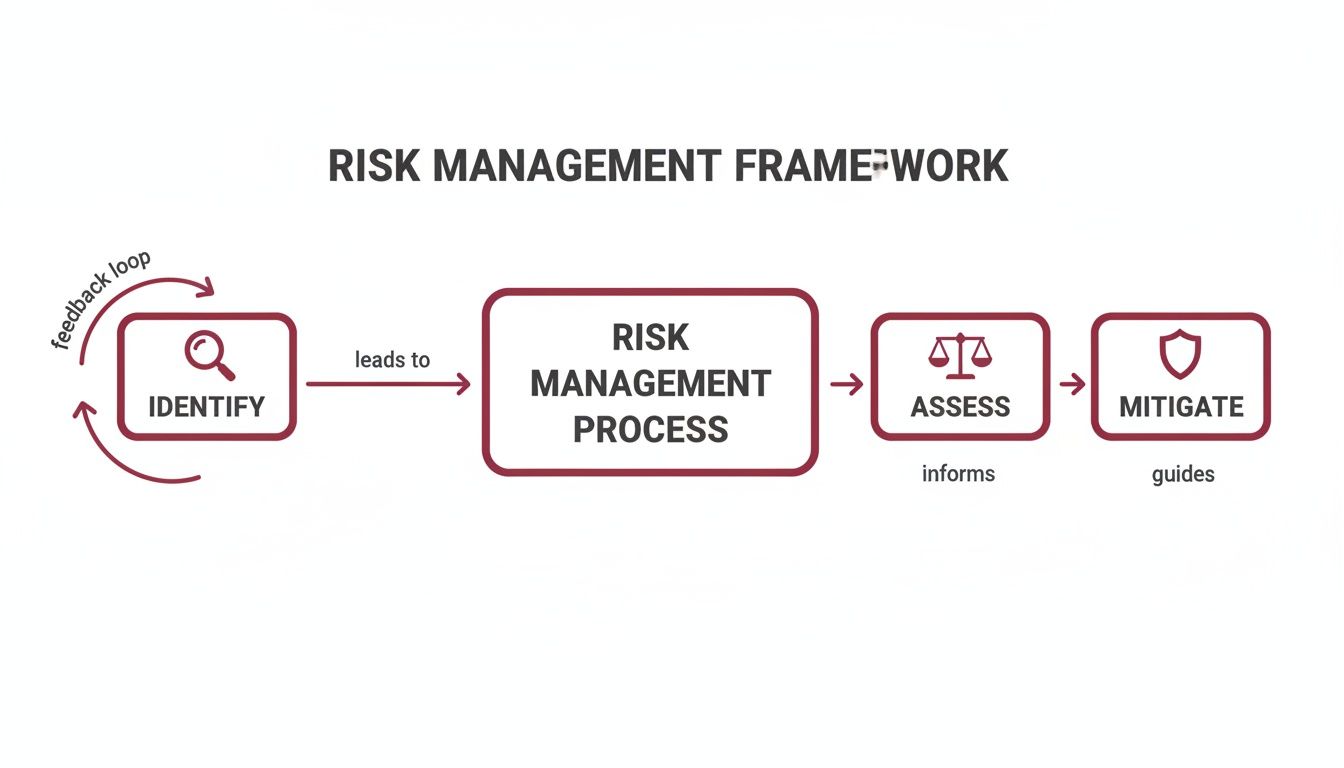
As you can see, risk management isn't a one-and-done task. It's a continuous loop where each step informs the next, creating a constantly improving shield for your business.
From Your Workshop to ISO Clauses
Your risk management activities don't just happen to look like ISO 27001 requirements; they map directly to them. The standard gives you the "what," and your framework provides the "how."
Think back to that risk workshop you ran. That session where you got everyone together to brainstorm what could possibly go wrong? You were actually fulfilling the core of ISO 27001 Clause 6.1.2. This clause simply says an organisation must "identify risks associated with the loss of confidentiality, integrity and availability" of its information.
That's it. Your simple risk assessment, where you figured out the likelihood and impact of each threat, is the very essence of the clause. You've already done the foundational work without even opening the standard.
Translating Risk Treatment into Annex A Controls
Once you prioritised those risks and decided on a plan—whether to avoid, reduce, transfer, or accept them—you were performing risk treatment. This process is the bridge that connects your risk assessment to the controls listed in ISO 27001 Annex A.
Annex A can look pretty intimidating. It’s a list of 93 potential security controls, and it’s easy to think you have to implement every single one. You don't.
Think of it as a catalogue of security solutions, not a mandatory checklist. You only pick the controls that make sense for the specific risks you've identified.
For example, say you flagged "unauthorised access to sensitive client data" as a high risk. Your treatment plan is to "reduce" that risk. To do that, you'd dip into Annex A and select relevant controls like:
- A.5.15 Access Control: A straightforward policy on who gets to see and touch what information.
- A.5.16 Identity Management: Making sure every user has a unique ID so you can track who does what.
- A.8.5 Secure Authentication: Enforcing strong passwords and, ideally, multi-factor authentication (MFA).
Your risk assessment gives you the why behind choosing these controls. Suddenly, compliance isn't a box-ticking chore anymore. It becomes a logical, risk-driven strategy to protect your business. To see how all these pieces fit together, you can dig deeper into the essentials of ISO 27001 compliance.
Mapping Your Framework to the Standard
To make this link crystal clear, I've put together a simple table showing how your everyday risk management activities feed directly into the formal ISO 27001 requirements.
The beauty of ISO 27001 is that it doesn't dictate how you should manage risk. It gives you a framework and trusts you to figure out the best methods for your business. This makes your existing process the perfect jumping-off point.
Here’s how your practical steps satisfy the formal compliance needs.
Mapping Risk Management Steps to ISO 27001 Requirements
| Risk Management Activity | Corresponding ISO 27001 Clause/Control | Simple Explanation for Small Businesses |
|---|---|---|
| Running a Risk Workshop | Clause 6.1.2 – Information security risk identification | This is your structured brainstorm session where you list everything that could possibly threaten your company's data. |
| Creating a Risk Matrix | Clause 6.1.2 – Information security risk assessment | This is you figuring out which threats are a five-alarm fire versus a minor headache by weighing their likelihood and potential impact. |
| Developing Mitigation Strategies | Clause 6.1.3 – Information security risk treatment & Annex A | This is your action plan. For each big risk, you decide how you're going to tackle it and pick the right tools (controls) from the Annex A catalogue. |
| Creating a Risk Register | Clause 8.2 & 8.3 – Information security risk assessment & treatment | This is your master document—the spreadsheet where you track every risk, its score, your game plan, and who’s responsible for it. |
As the table shows, you're much closer to achieving a recognised standard of risks and compliance management than you probably thought. The work you're already doing to protect your business is the work required to prove it.
Essential Controls for Australian Small Businesses
Getting started doesn't mean you need to tackle all 93 Annex A controls at once. That's a recipe for burnout. Your risk assessment is your guide to focus on what matters most.
For most Aussie small businesses, a handful of controls deliver the biggest security bang for your buck. Here are 7 to start with:
- A.5.1 Policies for Information Security: A simple, clear document spelling out your security rules. No jargon, just plain English.
- A.5.15 Access Control: Being ruthless about who can see and use your data. If they don't need it, they don't get it.
- A.5.23 Information Security for Use of Cloud Services: Setting clear ground rules for how your team uses platforms like Google Workspace or Microsoft 365 safely.
- A.8.2 Privileged Access Rights: Tightly locking down who has "admin" keys to your critical systems. This should be a very short list.
- A.8.9 Configuration Management: Making sure all your tech (laptops, servers, etc.) is set up securely from day one and stays that way.
- A.8.23 Web Filtering: Blocking access to malicious and dodgy websites to stop malware before it even gets a chance.
- A.5.24 Information Security Incident Management Planning and Preparation: Having a written plan for what to do when things go wrong. Because eventually, they will.
By prioritising these fundamentals, you’re tackling the most common and damaging threats head-on. Best of all, your risk framework gives you the perfect business case for doing it, showing that your security efforts are smart, strategic, and entirely risk-based.
Navigating the Emerging Risks of AI

When we talk about the future of risks and compliance, there's one topic that overshadows almost everything else: Artificial Intelligence. AI isn't just another app on your computer; it represents a fundamental change in how we do business. It has incredible potential to automate tedious compliance checks, spot fraud in real-time, and flag risks faster than any human ever could.
But with all that power comes a whole new category of complex risks, and frankly, most Australian businesses are not ready for it. Think of AI as a double-edged sword. On one side, you have amazing efficiency and insight. On the other, you have significant new threats.
For small businesses, this is a particularly tricky balancing act. You want to embrace the tools that give you an edge, but you likely don't have a dedicated team to poke and prod them for security flaws and compliance traps. The question is no longer if you'll use AI, but how you'll manage it without getting burned.
The Great Disconnect: AI Ambition vs. Security Reality
There's a huge gap I'm seeing everywhere between what business leaders want to do with AI and how prepared their security measures actually are. Many see the opportunity loud and clear, but they also have a nagging feeling that their current compliance and security frameworks are nowhere near ready. This isn't just a hunch; it's a real and widespread concern.
A recent Salesforce survey of IT security leaders in Australia and New Zealand put a number on this feeling. A massive 75% admitted their existing security setups need a total overhaul to deal with AI-related threats. You can check out the full ANZ IT security findings on Salesforce.com. This data really highlights the tension between adopting AI and managing the risks and compliance that come with it.
This disconnect is a ticking time bomb. Without a clear plan, businesses are at risk of sleepwalking into serious compliance breaches.
Navigating Australian AI-Specific Hurdles
For anyone running a business in Australia, AI brings a unique set of challenges to the table. These aren't just theoretical problems—they're real-world compliance issues with very real penalties.
Here are the big ones to watch out for:
- Data Privacy Obligations: The Australian Privacy Act is no joke. It has strict rules on handling personal information. If you feed customer data into an AI model without their full consent or without properly de-identifying it, you could be facing a major breach.
- Ethical Implications: How can you be sure your AI isn't biased? Imagine using an AI tool to sift through job applications. If it hasn't been trained properly, it could easily start discriminating against certain groups, landing you in a world of legal and ethical trouble.
- Accuracy and Explainability: This is a big one. Can you explain why your AI made a certain decision? If an AI model rejects a customer's loan application, you can bet they (and the regulators) will want to know the reason. "Black box" AI systems, where the logic is a mystery, are a massive compliance headache waiting to happen.
Simply plugging in a new AI tool and hoping for the best is not a strategy. You need a deliberate approach to make sure its use is safe, fair, and legally sound here in Australia.
Adopting AI without a clear governance framework is like handing the keys to your business to a brilliant but unpredictable new employee. The potential for greatness is there, but so is the potential for disaster if clear rules and boundaries aren't established from day one.
Getting ahead of this new frontier requires proactive thinking. As cyber criminals start using AI to launch attacks, you need to understand your defences. We cover this in more detail in our article on safeguarding your digital fortresses from AI-powered cyber threats.
Your First Steps Toward Responsible AI Adoption
Feeling a bit overwhelmed? Don't be. You don't need to become an AI guru overnight. It's all about taking a few practical, common-sense steps to start building a strategy. The aim here is to build your confidence and capabilities piece by piece.
Here are three things you can do right now to get started.
1. Create a Simple Ethical AI Usage Policy
This doesn't need to be a 50-page legal epic. Start with a single page that sets out clear, simple rules for your team. It just needs to answer the basic questions about how AI is allowed to be used in your business.
Your policy should cover:
- Approved Tools: Make a list of the specific AI apps that are okay to use for work. This stops people from using random, unvetted tools that might leak company data.
- Data Handling Rules: Be explicit. State what information can and cannot be put into AI models. A good rule of thumb: "No personal customer data or confidential company numbers should ever be pasted into a public AI chatbot."
- Transparency: Insist that any AI-generated content (like marketing copy) is checked by a human for accuracy and tone before it ever sees the light of day.
2. Start with Low-Risk, High-Impact Applications
Don't jump in the deep end by using AI for your most critical financial forecasting or sensitive HR reviews. Begin with tasks where the potential fallout is low but the efficiency gains are high. This lets your team get a feel for the tech in a safe, controlled way.
Great places to start include:
- Internal Knowledge Management: Use an AI search tool to help your team find information buried in internal wikis or policy documents.
- Drafting Initial Content: Let AI create a rough first draft of an internal memo or a few social media posts. The key is that a human always has the final say.
- Summarising Information: Use AI to turn long reports or meeting transcripts into quick, scannable bullet points. It’s a huge time-saver.
3. Appoint an AI Point Person
Give one person on your team the responsibility of being the go-to contact for all things AI. It doesn't have to be their full-time job. You just need a clear owner who is tasked with keeping up with new tools and emerging risks.
This person can vet new AI apps before they're rolled out and make sure your usage policy stays current. Having someone accountable turns "our AI strategy" from a vague idea into a managed business process.
By taking these measured steps, you can start tapping into the benefits of AI without exposing your business to unnecessary risks and compliance headaches.
How to Prepare for Audits and Prove Compliance
An audit notice can land with a thud, feeling like a pop quiz you’re not ready for. But what if you saw it differently? An audit isn’t a trap. It’s your chance to show off all the hard work you’ve put into your risks and compliance program and prove you’ve built a solid, trustworthy business.
The secret to walking into an audit with confidence isn't about a frantic, last-minute cram session. It’s about building simple, consistent habits of documentation and record-keeping so that proving your compliance is just a matter of showing your work.
Adopt an Audit-Ready Mindset Every Day
The easiest way to ace an audit is to act like you could have one tomorrow. This simple shift in mindset turns compliance from a dreaded annual event into a normal part of how you do business. You’re embedding good practices into your daily rhythm, so when the auditors call, you’re not starting from zero.
Think of it like keeping your workshop tidy. A little cleanup each day means you’re always ready for visitors. Let it all pile up, and a surprise visit turns into an all-night panic. The exact same thing applies to your compliance records.
An auditor's goal isn't to find perfection; it's to see transparency and control. They want to see a living, breathing risk management system, not a flawless but dusty document sitting on a shelf.
Good, organised records are your best friend. They tell the story of your commitment to managing risk, making the auditor’s job—and yours—a whole lot easier.
Essential Documentation and Record-Keeping
When an auditor arrives, they're looking for one thing: proof. Your documentation is that proof. It’s the hard evidence that backs up everything you say. Vague promises won’t fly; you need organised, accessible records that show you have a system.
Make sure you’re keeping clear logs and records for these key areas:
- Policy Reviews: Keep a version history for your important policies (like your Information Security Policy). It should be easy to see when each was reviewed, what changed, and who signed off on it.
- Access Control Logs: You need to be able to show who has access to what. That means keeping records of when user access was given, changed, or removed—especially for your most critical systems.
- Employee Training Records: A simple register showing which staff members have done their security and compliance training, and when, is gold. It’s clear proof that you’re building a security-conscious culture.
- Incident Response Records: Write down every security incident, even the small ones. Note what happened, how you handled it, what you learned, and what you did to stop it from happening again.
- Risk Register Updates: Your risk register needs to look like a living document. Auditors love to see a clear history of regular reviews, proving you’re actively managing your risks, not just listing them and walking away.
Keeping these records doesn’t need to be a huge chore. For a small business, a well-organised folder structure on a secure shared drive works perfectly. Consistency is what matters.
A Quick-Start Audit Preparation Checklist
When you get that audit notification, run through this checklist. It will help you get your ducks in a row and spot any last-minute things you need to sort out.
- Gather Key Documents: Pull together the latest versions of your main policies, your risk register, and your Statement of Applicability (if you're going for ISO 27001).
- Review Access Logs: Do a quick check on who has admin rights to your most sensitive systems. Does everyone on that list really still need it?
- Verify Training Completion: Scan your training records. Is anyone’s security awareness training overdue? Get it sorted, fast.
- Check Your Incident Log: Make sure your incident log is up to date and that every significant incident has a clear "lessons learned" action item attached.
- Brief Your Team: Give your key people a heads-up. Let them know what’s coming and remind them to be honest and direct if the auditor asks them questions.
- Prepare a Quiet Room: Have a meeting room ready for the auditors with power and Wi-Fi. It’s a small touch, but it shows you're organised and taking this seriously.
Common Pitfalls That Catch Businesses Out
Even the most well-intentioned businesses can trip up over the same few things during an audit. Knowing what they are is half the battle.
- Inconsistent Documentation: This is the big one. You can have the world's best policy on paper, but if your logs and records don't show you’re actually doing it, an auditor will consider it worthless.
- Poorly Defined Responsibilities: If no one knows who’s supposed to be reviewing the access logs, chances are, no one is. Make sure every single task in your risks and compliance framework has a specific person’s name next to it.
- The "Set and Forget" Mentality: Treating your risk assessment as a one-and-done project is a classic mistake. Auditors need to see that you’re continuously reviewing and improving things.
- Lack of Management Buy-In: An auditor can spot this from a mile away. If your leadership team isn't visibly involved and championing the process, it completely undermines the credibility of your whole program.
Steer clear of these common mistakes, and you'll present a much stronger, more believable case to any auditor. You’ll show them that compliance isn’t just a project for you—it’s baked into your company’s DNA.
Your Questions on Risk and Compliance, Answered
Let's be honest, wrapping your head around risk and compliance can feel like a lot when you're already spinning a dozen other plates. To help clear things up, here are some straight answers to the questions we hear most often from Australian small business owners.
Where on Earth Do I Start With All This?
The best starting point isn't some expensive software or a massive document. It’s a whiteboard, your key people, and an open conversation.
Get your team in a room for a simple risk workshop. Just start brainstorming what could go wrong across the business – think tech, money, operations, the lot. Don't overcomplicate it. Just identify the top three to five things that genuinely keep you up at night. Focus on creating simple, practical controls for only those risks to begin with. Getting this first step right is the foundation for everything else and lines up perfectly with the core idea of ISO 27001.
Do I Really Need ISO 27001 Certification?
Legally? No, it's not mandatory for every business in Australia. But in practice, it’s fast becoming the ticket to play, especially if you handle sensitive client data or want to land contracts with bigger companies or government agencies.
Even if you decide not to go for the full-blown certification just yet, using the ISO 27001 framework as your roadmap for managing risk is a brilliant move. It gives you a proven structure for building solid security and shows partners, customers, and regulators that you take this stuff seriously.
Think of the ISO 27001 framework as the recipe for a five-star meal. You can follow the recipe to cook something amazing (build strong security) without necessarily entering a cooking competition (getting certified).
We Can't Afford a Compliance Officer. What Do We Do?
You don't need one! For a small business, the secret is making compliance a shared responsibility, not one person’s headache.
The trick is to weave compliance tasks into the roles your team members already have. This makes it part of the daily grind, not some scary, separate project. For example:
- The person who handles your IT can own the security controls and check the access logs.
- Your office manager can be in charge of keeping the privacy policy fresh and tracking staff training.
- Whoever manages the finances can keep an eye out for financial risks and make sure you’re sticking to the rules.
Use simple checklists and set a regular catch-up – maybe once a quarter – to check in on your risk and compliance status. This keeps everyone on the same page and helps build a culture where protecting the business is just part of how you operate.
Ready to turn compliance from a chore into a competitive advantage? At Anitech, we specialise in making ISO 27001 straightforward for Australian small businesses just like yours. Let's chat about how you can achieve certification with confidence. Contact us today for a free consultation.
Recent Comments