

Effective security and monitoring isn’t just a technical task you tick off a list; it’s the digital immune system for your business. It is a proactive, two-part strategy for information security management: building strong defences (security) and then installing the sensors (monitoring) that give you 24/7 visibility into what’s happening across your entire network. This combination of security controls and continuous vigilance is absolutely essential for keeping your valuable information assets safe and achieving regulatory compliance.
What Security and Monitoring Really Means for Your Business
Let's ditch the jargon for a minute. Imagine a shopkeeper who not only locks the front door every night but also installs security cameras, motion sensors, and a silent alarm. The locks are the security measures—the static defences designed to keep intruders out. But the cameras and alarms? That’s the monitoring. They provide real-time awareness, alerting the owner to suspicious activity the moment it happens. This continuous surveillance is the core of a robust security posture.
The exact same principle applies to your digital operations. Your firewall, antivirus software, and access controls are the locks on your digital doors. Without effective monitoring, though, you’re flying blind. You wouldn't have a clue if someone was trying to pick the lock, or worse, had already slipped inside until it was far too late. Effective security monitoring provides the situational awareness needed to detect and respond to threats promptly.
The Shift from Reactive Panic to Confident Control
For any small business aiming for ISO 27001 certification, this distinction is crucial. The standard demands proof that you have a living, breathing system to maintain security over time. It’s not enough to just build the walls; you have to show that you're actively watching them through continuous monitoring of your information systems.
This proactive stance completely changes how you manage risk. Instead of scrambling to react to a data breach after the damage is done, you can spot and neutralise threats in their infancy. As businesses adopt new technologies, for example, understanding the potential cybersecurity issues associated with AI tools is a key part of robust security planning and risk assessment.
A strong security and monitoring strategy is the heart of modern risk management. It transforms your security posture from a checklist of static controls into a dynamic system that adapts to new threats, providing the continuous insight needed to protect your organisation.
Why Continuous Insight Matters
This constant awareness is precisely what auditors look for and what genuinely protects your business. It gives you tangible evidence that your security controls aren't just theoretical ideas but are actually working, day in and day out. This kind of vigilance allows you to:
- Detect threats early: Spot unusual activity—like unauthorised access attempts or strange data transfers—before they can escalate into a full-blown incident. This is the foundation of effective threat detection.
- Respond faster: Quickly pinpoint the source and scope of a threat, slashing the time it takes to contain it and minimising the damage. In fact, reports show that organisations with solid monitoring can cut their incident response times by up to 40%.
- Demonstrate compliance: Hand auditors detailed logs and reports that serve as concrete proof of your ongoing security diligence, a key aspect of information security governance.
Ultimately, integrating security and monitoring shifts your entire organisation from a state of reactive panic to one of confident control. It puts you back in the driver's seat of your cybersecurity management.
The Three Pillars of a Strong Security and Monitoring Framework
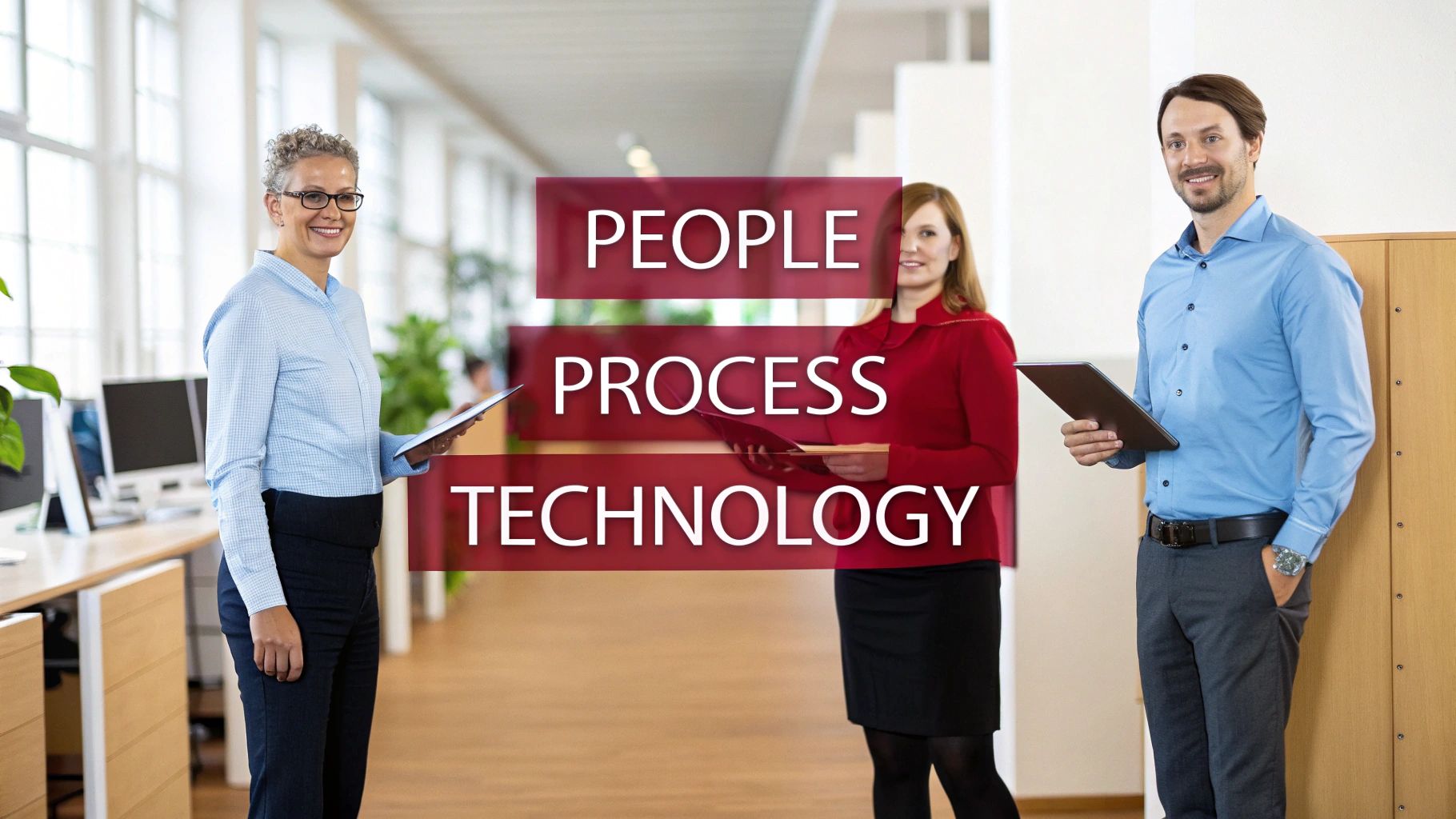
Building a robust security and monitoring framework isn't as daunting as it sounds. At its heart, every successful security program stands on three simple, interconnected pillars: People, Processes, and Technology. For a small business, nailing this balance is the secret to creating an operation that's resilient, compliant, and genuinely secure.
Think of it as a blueprint for success in cybersecurity. It ensures your security investments are strategic, not scattered. If you neglect one pillar, the whole structure becomes wobbly. A state-of-the-art tool is worthless without a skilled person to run it or a clear process to follow when an alert flashes.
Let's break down each pillar and see how they lock together to form a cohesive defence.
Pillar 1: People – Your First Line of Defence
Technology is great at spotting weird activity, but it’s your team that provides the real-world context and makes the final judgement call. The 'People' pillar is all about assigning clear roles, building security awareness, and empowering your staff to be vigilant guardians of your digital world. A well-trained team is crucial for network security monitoring.
This means deciding who is responsible for watching which systems, who digs into alerts, and who has the authority to declare an incident. In a small business, this won't be a dedicated security team; it might be an IT manager or a tech-savvy employee with designated responsibilities.
The whole point is to eliminate guesswork and create accountability. Everyone needs to understand their part in the security chain, whether it's spotting a phishing email or escalating a critical system alert. That human element is simply irreplaceable in information security.
Pillar 2: Processes – The Rulebook for Resilience
Processes are the documented, repeatable actions that turn your security ambitions into everyday habits. They are the routines that guarantee consistency and give auditors solid proof of your operational diligence. Without well-defined processes, your monitoring efforts are just organised chaos. These processes form the core of your security operations.
Effective security monitoring isn't about having the most expensive tools; it's about having the most consistent and well-practised routines. Processes ensure that vigilance becomes a predictable, measurable part of your business operations.
A few key processes form the backbone of any strong monitoring framework:
- Log Management and Review: Systematically collecting, storing, and regularly analysing logs from critical systems to spot unusual patterns or unauthorised activity.
- Vulnerability Scanning: Routinely scanning your networks and applications for known weaknesses, then having a formal process to prioritise and patch them. This is a key part of vulnerability management.
- Access Reviews: Periodically checking who has access to what, ensuring permissions are appropriate for each user's role, and revoking privileges that are no longer needed.
These routines are absolutely fundamental for ISO 27001 compliance and building a truly proactive defence. They demand a forward-thinking mindset, which is crucial for finding weaknesses before an attacker does. You can dive deeper into this with our guide on proactive threat hunting techniques.
Pillar 3: Technology – The Eyes and Ears of Your Network
Technology gives you the visibility you need to make your monitoring program work. These are the tools that automate the heavy lifting—collecting and analysing massive amounts of data to flag suspicious events that a human could never spot in real-time. These tools are the foundation of effective network monitoring.
For a small business, picking the right technology is a balancing act between capability and cost. The threat landscape is always growing. For example, South Africa recorded over 19 million cyber attacks in just the first quarter of 2023, a massive 41% increase from the previous period. That statistic alone highlights the critical need for structured security.
Essential tools for an SMB typically include:
- SIEM (Security Information and Event Management): A central dashboard that gathers log data from all over your network, connects the dots between events, and generates alerts for suspicious activity.
- IDS/IPS (Intrusion Detection/Prevention System): A system that watches your network traffic for malicious behaviour and can either alert your team (IDS) or actively block the threat (IPS).
- EDR (Endpoint Detection and Response): Think of this as antivirus on steroids. It monitors laptops, servers, and other devices for signs of a compromise and gives you the tools to investigate and respond.
By thoughtfully weaving together People, Processes, and Technology, you create a powerful, multi-layered defence system. It’s a system that not only protects your business but also stands up to the toughest scrutiny of any compliance audit.
Connecting Your Security Monitoring to ISO 27001 Controls
When it comes to an ISO 27001 audit, your security monitoring program is where the rubber really hits the road. For any IT manager or compliance officer, this is the moment of truth. It's not enough to just have controls; you need to prove they're working, day in and day out. This is the core of regulatory compliance.
This is all about building a clear, undeniable bridge between your daily operational tasks and the specific demands of the standard. Passing an audit isn't about a last-minute scramble. It’s about methodically showing an auditor that your security measures are alive, effective, and consistently enforced. Your monitoring practices are the source of that proof, generating the logs, alerts, and reports that tell a story of diligence.
From Everyday Actions to Audit-Ready Evidence
Every time your team reviews server logs, analyses network traffic, or investigates a security alert, you're actually fulfilling an ISO 27001 control. The trick is to document these actions and map them back to the right clauses. Doing this turns routine tasks into a powerful compliance checklist.
Think about it this way: a simple, daily review of failed login attempts directly supports controls around access management. Once you formalise this process, you create a repeatable, auditable trail. Suddenly, you're not just secure in theory; you're proving you're vigilant in practice. To really get this right, specialised training like a Cyber Security Governance, Risk, and Compliance Professional course can make all the difference.
Mapping Monitoring to Key Annex A Controls
Let's make this connection crystal clear. How do specific monitoring activities align with some of the most critical Annex A controls? This practical mapping gives you a roadmap for turning your security efforts into solid, audit-ready evidence. Of course, for a full breakdown, it's always a good idea to familiarise yourself with the complete list of ISO 27001 controls.
The table below provides a straightforward guide, linking common monitoring tasks directly to their corresponding ISO 27001 objectives and showing exactly what kind of evidence you'll need to present to an auditor.
Mapping Monitoring Activities to Key ISO 27001 Annex A Controls
This table demonstrates how specific security monitoring practices directly satisfy the requirements of critical ISO 27001 Annex A controls, providing a clear roadmap for achieving compliance.
| ISO 27001 Control | Control Objective | Required Security Monitoring Activity | Example Evidence for Auditors |
|---|---|---|---|
| A.5.15 Access Control | To ensure authorised users have access to information and to prevent unauthorised access. | Regularly monitoring and reviewing user access logs, including successful and failed login attempts across all critical systems. | Reports from your SIEM or logging tool showing a review of access attempts over the last 90 days, with flagged anomalies investigated. |
| A.8.16 Monitoring Activities | To detect anomalous activities and potential information security incidents. | Implementing network intrusion detection systems (IDS) and endpoint detection and response (EDR) to monitor for malicious traffic and behaviour. | Dashboards from your IDS/EDR showing detected threats, alerts generated, and the corresponding response actions taken by your team. |
| A.5.31 Logging | To produce, collect, protect and analyse log information related to user activities, exceptions, faults and information security events. | Centralising logs from servers, applications, and network devices. Ensuring logs are protected from tampering and retained for a defined period. | A documented log management policy, along with sample logs and proof that they are stored securely with restricted access. |
| A.8.23 Web Filtering | To manage access to external websites to reduce exposure to malicious content. | Using a web filtering solution to monitor and block access to known malicious or inappropriate websites based on company policy. | Configuration settings from your web filter and reports showing blocked access attempts to malicious domains over a specific period. |
The strength of your compliance case ultimately rests on the quality of your evidence. Well-documented, consistent monitoring activities are the most credible proof you can offer that your Information Security Management System (ISMS) is actually working.
By taking this structured approach, you demystify the entire audit process. You're no longer just doing security; you're actively proving it. This shift in perspective is what separates businesses that just scrape by from those that pass their certification audits with confidence.
A Realistic Implementation Roadmap for Australian SMBs
Getting a proper security and monitoring program off the ground can feel daunting, especially for Australian small and medium-sized businesses (SMBs) where every dollar and minute counts. The trick isn't to boil the ocean. It's about taking a measured, phased approach that builds momentum and gets you real results without breaking the bank or your team.
This roadmap breaks the journey into three simple stages. Think of it as a clear path to building a security posture that not only protects you but also gets you ready for ISO 27001 certification.
Phase 1: Laying the Foundation
Before you can defend your castle, you need to know what you’re defending and why. This first phase is all about getting crystal clear on your priorities. If you skip this, you’ll end up wasting time and money on shiny tools that don’t actually solve your biggest problems. This initial step is crucial for effective risk management.
Start with a no-nonsense risk assessment. Pinpoint your most critical information assets—the crown jewels. What data, if it got out, would genuinely hurt your business? This might be client lists, financial records, or your secret sauce intellectual property.
Once you know what matters most, you can set clear monitoring goals. You're trying to answer specific questions, like:
- Who is touching our sensitive files?
- Is there any weird activity on our network?
- Are we keeping up with critical security patches?
Getting this right from the start means every action you take from here on is targeted and effective.
Phase 2: Smart Implementation
With your priorities straight, it's time to get the right tools and processes in place. For an SMB, efficiency is everything. You don’t need a complex, enterprise-level behemoth; you need smart, right-sized tools that fit your business and budget. This phase is all about deploying your security architecture.
Look to affordable, cloud-native tools first. Services from providers like AWS or Azure pack a serious security punch on a pay-as-you-go model, which is perfect for a growing Aussie business.
The aim here isn't to buy every security gadget on the shelf. It’s about picking a few core tools that give you maximum visibility into your biggest risks, and then building simple, repeatable processes around them.
This is also where you write things down. Create straightforward guides for your team on how to handle logs, what to do when an alert pops up, and how to run routine security checks. This isn't just busywork; it's the hard evidence you’ll need for your ISO 27001 audit. This simple flow shows how these steps create a clear evidence trail for your auditor.
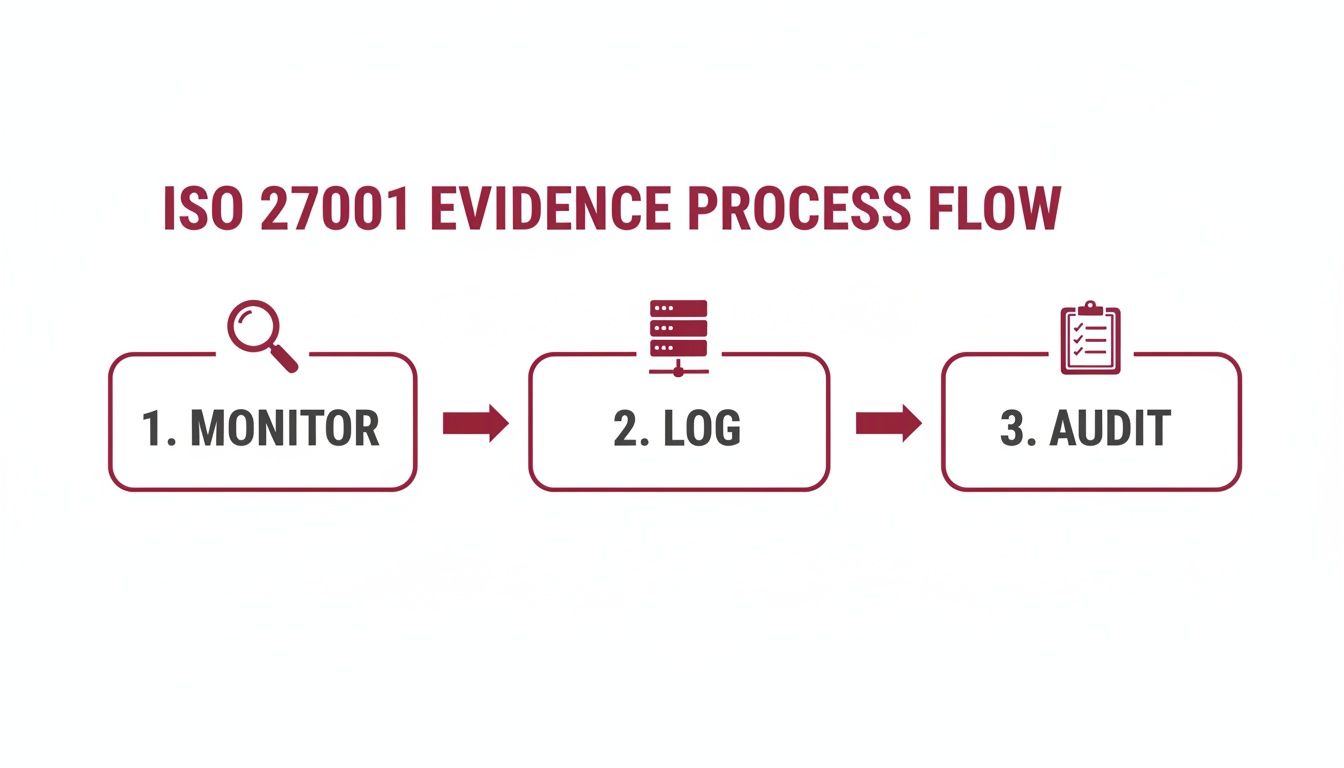
As you can see, daily monitoring feeds into your logs, which in turn gives you the concrete evidence needed to sail through an audit.
Phase 3: Continuous Improvement and Practice
Security isn’t a set-and-forget project; it's a living, breathing part of your business. This final phase is about making sure your security and monitoring efforts become second nature and stay sharp over time. This stage focuses on ongoing security assessment.
Get into a rhythm of regular reviews. Block out time each month or quarter to look through your security logs, check who has access to what, and chat about any incidents that came up. This creates a powerful feedback loop that helps you fine-tune your approach and stay ahead of new threats.
Most importantly, you need to practice your incident response plan. Run drills where you walk through different scenarios—what if we get hit by ransomware? What if we have a data breach? This muscle memory is invaluable. When a real incident hits, your team will know exactly what to do, which minimises the chaos and limits the damage. In fact, many organisations find their incident response times can drop by as much as 40% after getting their ISO 27001 processes dialled in.
Following this three-phase roadmap helps Australian SMBs build a security program that is robust, affordable, and compliant. For businesses looking for expert guidance, the next step is understanding the path to 27001 certification.
Turning Monitoring Data Into Action and Audit-Ready Evidence
A great security and monitoring system is a data-generating machine. But raw data on its own is just noise. The real magic happens when you turn that noise into decisive action, creating a powerful link between monitoring, incident response, and your audit process. This is where threat intelligence becomes actionable.
Every single alert your system generates is the starting gun for your incident response plan. It gives you the critical head start needed to contain a threat before it can cause real damage.
Think of it like a smoke detector in your office. The alarm itself doesn’t put out the fire; it’s the signal that triggers a well-rehearsed evacuation and calls the fire brigade. An alert about suspicious activity on your network is the exact same thing—it’s your chance to turn a potential crisis into a controlled, manageable event.
From Alert to Action: The Incident Response Lifeline
When your environment is properly monitored, you have the clarity to act swiftly and with purpose. Imagine an alert flags an unusual login to a critical server from an unexpected location at 3 AM. Without monitoring, that breach might go completely unnoticed for weeks, giving an attacker free rein.
But with a solid system in place, that single alert kicks off a planned sequence of actions:
- Immediate Notification: The right people are automatically pinged with the initial details of the incident.
- Investigation: The team dives into the log data to quickly verify the threat, figure out its scope, and identify the compromised account.
- Containment: The account is locked down, and the compromised system is isolated from the network to stop the threat from spreading.
This kind of rapid, coordinated response is only possible when your monitoring gives you timely, accurate information. It’s what stops a small problem from spiralling into a catastrophe.
The true value of security monitoring isn't just in the threats it finds; it's in the speed and confidence with which it allows you to respond. It turns your incident response plan from a theoretical document into a practical, real-world defence mechanism.
The Gold-Standard Evidence for Your Audit
Beyond fending off immediate threats, your monitoring data serves another crucial purpose: it becomes undeniable proof of your security diligence. When an ISO 27001 auditor comes knocking, they don’t just want to see your policies; they want evidence that you’re actually following them, day in and day out.
The logs, reports, and incident tickets generated by your security and monitoring activities are precisely that evidence. They create a rich, detailed history that demonstrates your controls aren't just well-designed but are operating effectively. This audit trail proves you are actively managing risks, investigating anomalies, and living up to your security commitments.
This approach delivers real returns. With small businesses facing a 300% higher risk of cyber-attacks, robust systems are no longer a luxury. By implementing comprehensive measures covering everything from employee training to incident analysis, some organisations have achieved 99% compliance in audits. You can find out more about the tangible benefits of certification on the GIZ website.
Ultimately, by turning data into action, you create a powerful cycle. You strengthen your security, minimise operational risk, and build a library of evidence that makes your certification audit a straightforward validation of all your hard work.
How Anitech Makes Your ISO 27001 Journey Painless
Let’s be honest, the road to ISO 27001 certification can feel like a mountain of a climb. If you’re like most small business owners, you’re already stretched thin. Juggling tight budgets, lacking a dedicated security expert on staff, and facing the sheer dread of an audit can make the whole thing feel impossible. That’s where a good partner comes in.
At Anitech, we’re not just consultants who hand over a pile of documents and wish you luck. We’re in the trenches with you, guiding your business from the starting line right through to the final audit. We’ve worked with countless Australian small businesses, so we get the unique pressures you’re under. Our job is to create a strategy that works for you—one that’s realistic, effective, and built to last.
From Overwhelmed to In Control
We start by taking the mystery out of the whole process. Our focus is on building a solid security and monitoring framework that’s actually the right size for your company, not a one-size-fits-all solution designed for a massive corporation. We’ll help you pick the right tools that don’t blow your budget, create simple processes your team can actually follow, and turn complex compliance jargon into straightforward, doable tasks.
Here’s how we help:
- A Plan That Fits You: We design and build a system that supports your business goals, not just one that ticks a bunch of compliance boxes.
- Getting You Audit-Ready: We’ll be right there with you, helping gather the right evidence and coaching your team so you can walk into the audit feeling prepared and confident.
- A Partner for the Long Haul: Certification isn't the end goal. We aim to build a truly resilient security culture that protects your business and adds value long after you've framed the certificate.
Think of it this way: with Anitech, ISO 27001 stops being a headache and starts becoming a business asset. We take the risk and stress out of the equation so you can get back to what you’re passionate about—growing your business.
Tapping into our experience means turning a compliance requirement into a real competitive advantage. It's about building a fundamentally secure business that customers trust and that opens up bigger and better opportunities. Let us show you the way.
Got Questions? We've Got Answers
Diving into security and monitoring for ISO 27001 can feel a bit overwhelming, especially when you're running a small business in Australia. Let’s cut through the noise and tackle some of the most common questions we hear.
How Much Does This Actually Cost for a Small Business?
The good news? You don't need a bottomless budget to get started. The cost really comes down to what your business needs and how much you want to manage yourself.
You can start with powerful open-source tools like Wazuh or Security Onion that have no licensing fees. The trade-off is that they demand a fair bit of technical know-how to get running and maintain properly.
Alternatively, cloud-native tools from AWS (think CloudWatch and GuardDuty) or Azure (like Sentinel) are fantastic. They work on a pay-as-you-go model, so the cost scales as your business grows. For businesses wanting to completely hand over the reins, a fully managed service can range from a few hundred to a couple of thousand dollars a month, but it takes the entire operational headache off your plate. It all starts with a solid risk assessment so you only pay for what you truly need.
If I Can Only Monitor One Thing, What Should It Be?
While everything is connected, if you have to pick one thing to nail for ISO 27001, focus on user access and privileges. It’s the linchpin for so many of the standard’s core controls.
Basically, you need to know who is accessing your critical systems, when they're doing it, and what they're doing once they're inside.
Keep a laser focus on things like failed login attempts, someone trying to elevate their permissions, or access to sensitive files late on a Friday night. This not only helps you spot hackers using stolen credentials but also catches potential insider threats. Plus, having these logs is rock-solid proof for auditors that you’re serious about protecting your data.
Do I Really Need a 24/7 Security Team to Get Certified?
Absolutely not. A 24/7 Security Operations Centre (SOC) is overkill for most small businesses and is definitely not a requirement for ISO 27001 certification.
The standard simply asks that you can spot and respond to security incidents in a timely way that makes sense for your business.
For a small to medium-sized business, this is perfectly achievable with:
- A well-organised on-call roster for your IT person or team to handle alerts after hours.
- Smart automated alerts that ping the right people via email or SMS when something critical happens.
- A clear incident response plan that everyone knows how to follow.
The auditors expect your security measures to be proportionate to your size and risk. You can absolutely meet the requirement without the huge expense of a round-the-clock SOC.
Ready to stop worrying about compliance and start building a genuinely secure business? Anitech specialises in guiding Australian small businesses through the entire ISO 27001 journey. Let us make it straightforward and successful for you.
Recent Comments