

Let’s get one thing straight: a security incident plan isn’t just another bit of paperwork for your ISO 27001 audit. It's the playbook that will decide whether your business survives a cyber-attack or becomes a cautionary tale. It’s what separates a calm, controlled response from outright chaos when things go wrong. In today's digital landscape, the question is no longer if a security incident will happen, but when. For businesses of all sizes, especially small to medium-sized enterprises (SMEs), being prepared is not just a best practice; it's a fundamental requirement for survival.
Without a plan, you're essentially improvising during a crisis, a high-stakes gamble that very few businesses can afford to take. A well-structured security incident plan transforms potential chaos into a manageable, step-by-step process. It provides clarity, defines roles, and outlines the precise actions needed to contain a threat, minimize damage, and restore operations as quickly as possible. This guide will walk you through the essential components of creating a robust and practical security incident plan, one that not only satisfies compliance requirements like ISO 27001 but also builds genuine resilience into the core of your organization.
Why an Incident Plan Is Your Business Lifeline

The conversation is no longer about if you'll face a security incident, but when. For Australian businesses, that’s not a scare tactic; it’s a statistical reality. Putting off creating a formal plan is one of the biggest risks you can take. Cyber threats are evolving at an unprecedented rate, with attackers employing increasingly sophisticated methods to breach defenses. From ransomware and phishing to denial-of-service attacks and insider threats, the potential vectors of compromise are numerous. A security incident plan is your strategic defense against this evolving threat landscape.
Picture this scenario: It's 8 AM on a Tuesday morning. You receive a panicked call from a staff member. A ransomware message has appeared on every screen, locking you out of all your critical systems—client data, financial records, operational software, everything. Every minute of downtime is costing you money, eroding customer trust, and potentially violating regulatory obligations. What do you do?
If you don't have a plan, the answer is simple: chaos. Panic spreads as your team scrambles, with nobody sure who to call or what the first step should be. Conflicting decisions get made on the fly, driven by adrenaline rather than strategy. In the confusion, you might even make the breach worse by inadvertently destroying forensic evidence or showing the attackers just how unprepared you are, making you a more attractive target for future attacks.
The Real Cost of Being Unprepared
The damage from a poorly handled incident can be catastrophic and multifaceted. The Australian Cyber Security Centre (ACSC) is now receiving over 84,700 cybercrime reports a year—that's one every six minutes. For a small business, the average cost per incident has jumped 14% to $56,600, and that figure doesn't even touch on the long-term, often immeasurable, hit to your reputation. You can dig into some of the top cyber incidents in Australia for a clearer picture of the real-world consequences.
A security incident plan takes that chaotic mess and turns it into a structured, manageable process. It’s your map for navigating the storm with confidence, providing a clear path forward when visibility is at its lowest. This plan is not merely a technical document; it is a business continuity tool that encompasses technical procedures, communication strategies, and legal considerations, ensuring a holistic response to any security event.
From Chaos to Control: A Real-World Contrast
Imagine two small businesses, both hit by the same clever phishing attack that compromises their email systems and gives attackers access to sensitive company data.
-
Business A (No Plan): The CEO hears about the issue through the grapevine when a client calls to complain about a strange invoice. The IT guy, under immense pressure, starts pulling servers offline without a clear strategy, causing more disruption to operations than the attack itself. Meanwhile, the customer service team is left completely in the dark, giving vague, confusing, and contradictory answers to clients who are reporting weird emails. Days later, they're still trying to figure out the full scope of the breach, how much data was lost, and what their legal obligations are. The reputational damage is severe, and the financial cost of extended downtime and recovery spirals out of control.
-
Business B (With a Plan): An employee spots the suspicious email and immediately reports it to the designated Incident Coordinator, just as the plan dictates. The plan is activated instantly. The Technical Lead isolates the affected email accounts to contain the threat and prevent further spread. Simultaneously, the Communications Lead rolls out a pre-approved message to inform staff about the situation and provides key clients with a transparent update, reassuring them that the issue is being handled professionally. The legal team is engaged to assess regulatory notification requirements.
The difference is night and day. Business B gets back to normal operations exponentially faster, minimises its financial losses, and actually protects its reputation with clear, honest, and timely communication. Their security incident plan didn't just solve a technical problem; it turned a potential disaster into a manageable, documented, and controlled event.
A security incident plan is the ultimate risk management tool. It replaces uncertainty with a clear set of actions, empowering your team to protect the business when it matters most. It’s not about stopping every single attack, but ensuring you're still standing when one inevitably gets through. This proactive stance is the cornerstone of modern cybersecurity resilience.
More Than Just a Box to Tick for ISO 27001
Yes, if you're pursuing ISO 27001 certification, a documented security incident management process is non-negotiable. It's a core requirement of the standard. Auditors won't just glance at a document; they’ll want to see evidence that your plan is practical, has been tested through drills or simulations, and is understood by your team. They will look for records of past incidents and the lessons learned from them.
But if you view your plan as just a compliance hurdle to clear, you’re missing the fundamental point. Its real value is in building genuine, long-term business resilience. A well-crafted and regularly tested plan gives you:
- Financial Protection: A swift, coordinated response dramatically cuts the costs associated with downtime, recovery efforts, potential regulatory fines, and legal fees.
- Reputation Management: Handling a breach with transparency and professionalism shows customers, partners, and stakeholders that you take their security seriously, building trust even in the midst of a crisis.
- Operational Resilience: It's your blueprint for getting back on your feet quickly, minimising disruption to your core business functions and keeping the company moving forward.
- Legal and Regulatory Compliance: It ensures you meet your obligations under schemes like the Notifiable Data Breaches (NDB) scheme in Australia, avoiding costly penalties.
This guide is all about turning theory into action. We’ll walk you through, step-by-step, how to build a practical incident plan that doesn’t just satisfy auditors but becomes your business's ultimate defence mechanism, a critical component of your overall risk management strategy.
Assembling Your Incident Response Dream Team
A security incident plan isn't some dusty document that lives in a folder on a shared drive. It’s a dynamic playbook, and like any good playbook, it needs a team on the field ready to execute it flawlessly when the pressure is on. Without clearly defined roles and responsibilities, even the best-written plan will fall apart in the chaos and confusion of a real incident.
For a small business, this isn't about hiring a new, dedicated security department. It's about looking at the talented people you already have and strategically assigning them the right responsibilities based on their skills and position within the company. This group, your Incident Response Team (IRT), becomes your first line of defence, tasked with steering the ship through the storm with a steady hand and a clear head.
When it comes to your ISO 27001 audit, the formation of this team is a non-negotiable element. Auditors need to see that you haven't just listed names on a page, but have genuinely empowered a cross-functional team to act decisively and follow a documented process.
Defining Key Roles Within Your Existing Team
Let’s be realistic. In a small business, one person often wears multiple hats, and that’s completely fine and expected. What truly matters is clarity. Forget vague corporate titles; we need to define roles based on the specific functions that need to be performed during a crisis.
Every small business IRT really only needs three core functions covered to be effective:
-
The Incident Coordinator: Think of this person as the quarterback or the project manager of the incident response. They don't need to be the most technical person in the room, but they must be exceptionally organised, calm under pressure, and a brilliant communicator. They own the plan, officially declare when an incident is happening, coordinate the team's efforts, and keep the entire response on track and documented.
- Who is this in my business? Often, this is your office manager, a general manager, or a senior project manager. They’re already pros at juggling multiple tasks, communicating with different stakeholders, and keeping everyone aligned toward a common goal.
-
The Technical Lead: This is your boots-on-the-ground problem-solver. They have the technical chops to dig into the issue, analyze the logs, figure out what’s happening at a system level, and take the necessary steps to contain the damage and eradicate the threat. They’ll be the one isolating a compromised machine, analyzing network traffic, or digging through system logs to find the root cause.
- Who is this in my business? It could be your in-house go-to IT person, a trusted external IT contractor or managed service provider (MSP), or even a particularly tech-savvy employee who knows your core systems inside and out.
-
The Communications Lead: When things go wrong, controlling the narrative is everything. This person handles all communications, both internally to staff and externally to clients, partners, or regulators if needed. Their job is to deliver clear, accurate, and timely updates to prevent panic, stop the spread of misinformation, and protect the company's reputation.
- Who is this in my business? This is almost always a business owner, CEO, or a marketing or public relations manager—someone who instinctively understands the value of trust, brand integrity, and stakeholder management.
Defining these roles before a crisis hits is the single biggest factor separating a coordinated, effective response from a complete shambles. When people know their job and have the authority to act, they perform decisively and with confidence.
Don't Just Assign Roles—Train Your People
Putting names next to roles in a document is only half the battle. Your team needs to feel confident and prepared to carry out their duties. You don’t need to spend a fortune on complex, full-scale simulations. Start simple with tabletop exercises—just get the team in a room and walk through a hypothetical scenario. What would you do first? Who calls who? What information is needed?
And remember, security is a team sport that extends beyond the IRT. Your entire staff is your human firewall, and they’re often the ones who will spot something fishy first. Regular, practical training on how to spot phishing emails, use strong passwords, and avoid social engineering isn't just a nice-to-have; it's one of the best security investments you can make. To get this right, it's worth looking into specialised cybersecurity training for employees that's built for the Australian business landscape and its specific threats.
What Actually Counts as an "Incident"?
Now that you have your team, you need to draw a clear line in the sand. You must define what actually counts as a security incident for your business. Without this critical definition, you’ll either have people raising the alarm for every minor technical hiccup, causing alert fatigue, or, far worse, ignoring a serious threat because they weren't sure if it "counted."
Your scope defines the specific triggers that kick your formal incident response plan into action. And it’s not just about cyber-attacks. An incident, in the context of information security, is any event that threatens the confidentiality (preventing unauthorized disclosure), integrity (preventing unauthorized modification), or availability (preventing disruption of access) of your important information assets.
Sorting Minor Glitches from Major Crises
To make this practical and actionable, you need to help your team understand the difference between a small, manageable issue and a full-blown emergency. This classification helps the Incident Coordinator decide whether to sound the alarm and activate the full IRT or handle it through normal day-to-day IT support processes.
Here’s a simple, effective way to break it down into severity levels:
-
Low-Impact Event: An isolated issue with very little potential for damage or disruption. This can usually be sorted out by one person without a big fuss or formal escalation.
- Real-world example: An employee gets a single, obvious phishing email and deletes it without clicking anything. The response is a quick, informal reminder to the team to stay sharp and report any similar attempts.
-
Security Incident: This is where the IRT gets formally activated. It’s an event that poses a real and credible risk to your data, systems, or operations and needs a coordinated response to investigate, contain, and resolve.
- Real-world example: A key salesperson reports their company laptop was stolen from their car. This triggers the plan: the Technical Lead remotely wipes the device, forces a password reset on all their accounts, and the Incident Coordinator begins documenting the event and assessing what sensitive data might have been on it.
-
Major Crisis: The big one. This is a severe incident that threatens the entire business, carries significant financial or reputational risk, and will likely require bringing in outside help like legal counsel, forensic investigators, or regulators.
- Real-world example: Ransomware tears through your network, encrypting all your client files and grinding your entire business to a halt. This is an all-hands-on-deck emergency that requires immediate and sustained attention from the entire IRT and senior leadership.
By setting these clear boundaries and definitions, you empower your entire team to react with the right level of urgency. It ensures that your valuable resources and energy are focused where they're needed most—a core principle of risk management that your ISO 27001 auditor will definitely be looking for in your security incident plan.
Crafting Your Incident Response Playbook
Okay, you've got your Incident Response Team (IRT) picked out and their roles are clearly defined. Now for the crucial part: building the playbook. This is the heart of your security incident plan—a clear, detailed, step-by-step workflow that tells your team exactly what to do from the moment an alarm bell rings to the final all-clear and post-incident review.
Having a solid playbook means no more guesswork when the pressure is on. It’s about ensuring your response is fast, consistent, coordinated, and effective, not chaotic and ad-hoc. This isn't just good practice; a structured, repeatable process for handling threats is precisely what ISO 27001 auditors look for to see that you're taking security management seriously and have operationalized your policies.
Before you can even write the first page of that playbook, you need the right foundations in place. It all starts with getting the people and the parameters right, as discussed in the previous section.
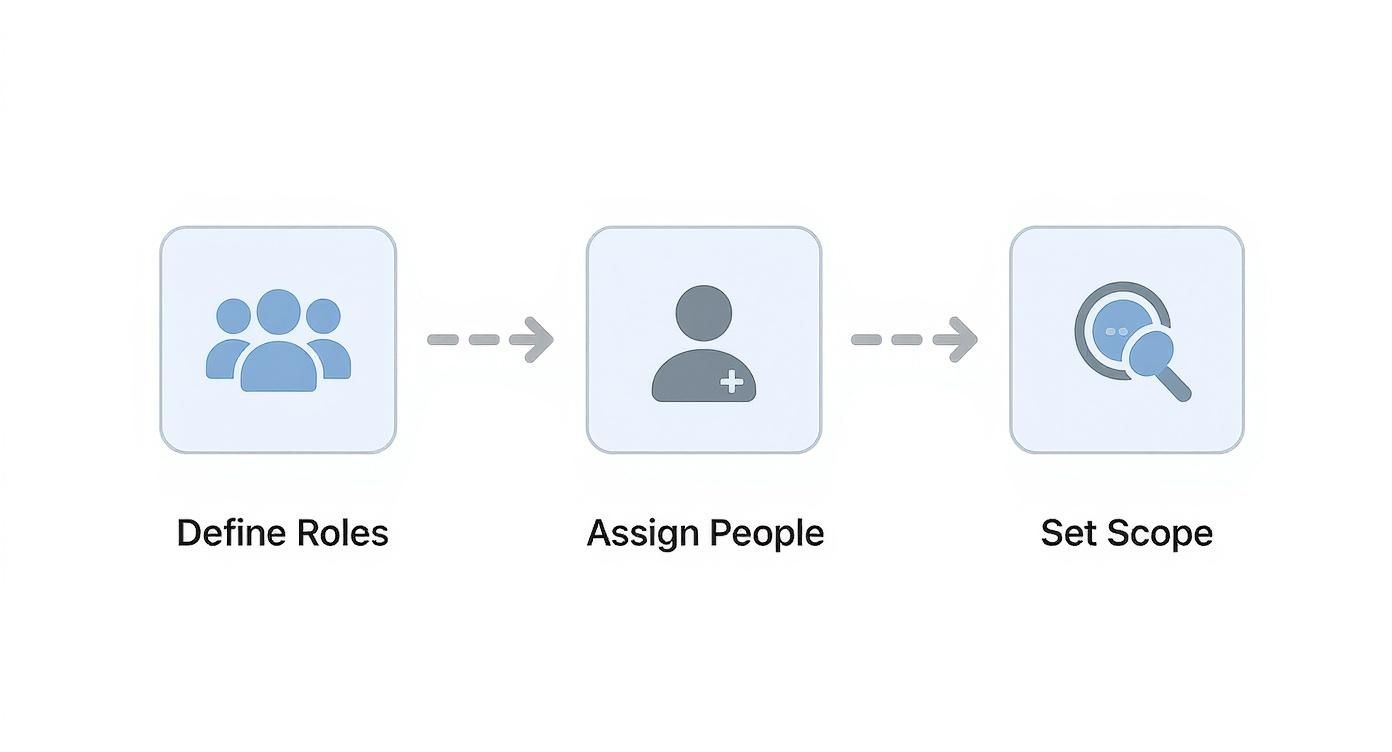
As you can see, a winning playbook is built on the back of a team with crystal-clear responsibilities and a scope that everyone understands from day one. With this foundation, you can then build out the specific procedures for handling incidents.
The Six Phases of Incident Response
Forget thinking of incident response as a single, frantic action. It’s a continuous cycle, a structured process that moves from preparation to analysis. Most of the respected cybersecurity frameworks out there, including those from NIST (National Institute of Standards and Technology) and SANS Institute, which heavily influence ISO standards, break the process down into six distinct phases. Knowing these inside and out helps you build a comprehensive plan that truly covers all your bases.
-
Phase 1: Preparation: This is all the homework you do before an incident hits. It's about developing and maintaining the plan, training your team, running drills, and ensuring your security tools (like firewalls, antivirus, and monitoring systems) are properly configured, patched, and ready to go. A prepared team is a calm and effective team.
-
Phase 2: Identification: How do you even know something’s wrong? This phase is about detecting and validating potential incidents. It involves spotting the anomalies—maybe an alert from your firewall, an unusual login attempt from a foreign country, performance degradation on a critical server, or an employee reporting a dodgy email—and then analyzing the evidence to determine if it's a false alarm or a real threat.
-
Phase 3: Containment: Once you've confirmed an incident, your first and most urgent job is to stop the bleeding. Containment is all about isolating the affected systems or accounts to stop the threat from spreading across your network like wildfire. This might involve disconnecting a computer from the network, disabling a user account, or blocking malicious IP addresses at the firewall.
-
Phase 4: Eradication: With the immediate danger walled off, it’s time to get the intruder and their tools out of your environment for good. This means deleting the malware, disabling the compromised accounts, patching the security vulnerabilities that let them in in the first place, and hardening systems to prevent reinfection.
-
Phase 5: Recovery: This is where you carefully bring your systems back online safely and restore normal operations. It might involve restoring data from clean, verified backups, rebuilding servers from scratch, or closely monitoring systems for any signs of residual malicious activity to ensure the threat is truly gone.
-
Phase 6: Lessons Learned: After the dust has settled and normal operations have resumed, this might just be the most important phase for long-term improvement. Your IRT gets together for a blame-free post-mortem meeting to unpack what happened, what went right, what went wrong, and where you dropped the ball. This feedback loop is pure gold for making your plan, your tools, and your team stronger for the next time.
For a deeper dive into the specific procedures that go into these steps, it’s worth checking out some guides on modern incident management procedures to help shape your team's tactical response.
Why Incident Classification is a Game-Changer
Let's be honest, not all incidents are created equal. A single bit of adware found on a non-critical laptop is a problem, for sure. But it’s a world away from a sophisticated ransomware attack that’s just taken your entire server farm and customer database hostage. This is exactly why you need a formal system for incident classification.
By setting up a clear system to grade incidents by their severity and potential impact, you give your Incident Coordinator the power to match the level of response to the level of the threat. It stops you from overreacting and throwing every resource at a minor glitch, while ensuring that a genuine crisis gets the immediate, all-hands-on-deck attention it desperately needs.
A clear classification matrix is one of the most powerful things you can show an ISO 27001 auditor. It proves you have a methodical, risk-based approach to handling incidents, not just a one-size-fits-all panic button. It demonstrates maturity in your security program.
This is especially critical here in Australia. The threat landscape is getting tougher and more complex, with the Office of the Australian Information Commissioner (OAIC) reporting a staggering 25% jump in notifiable data breaches, the majority of which stemmed from malicious or criminal attacks. Classifying threats effectively isn't just a "nice-to-have" anymore; it's an essential part of modern risk management.
Building a Practical Classification Matrix
For most small to medium-sized businesses, a simple three-level system is perfect. It's easy to understand, quick to apply when things get heated, and provides enough granularity to guide an appropriate response. Think of it as your triage system for security events. Here’s a sample matrix you can pinch and adapt for your own incident plan.
Sample Incident Classification Matrix for Small Businesses
A straightforward matrix like this helps your Incident Coordinator quickly determine the right level of response, ensuring resources are used wisely and efficiently.
| Severity Level | Description | Example Scenarios |
|---|---|---|
| Low | A minor event with limited potential impact on business operations or data confidentiality. Usually handled by one person or through standard IT support without calling in the entire IRT. | – A single employee reports a basic phishing email they didn't click on. – Your antivirus software blocks and quarantines a known, low-risk virus from a single workstation. – A non-critical internal server goes offline for a short period due to a small configuration error. |
| Medium | A confirmed security incident that poses a real risk to your data, systems, or day-to-day operations. This requires activating the IRT for a coordinated, documented response. | – A key employee's company laptop is lost or stolen. – Suspicious logins are spotted on a user account that has access to sensitive client files. – An employee clicked a phishing link and entered their password before they realised their mistake and reported it immediately. |
| High | A major breach or crisis-level event. This is an immediate and severe threat to the business's finances, reputation, or ability to function and requires an all-hands, top-priority response. | – A ransomware attack has successfully encrypted critical company servers or shared drives. – You have confirmed proof of unauthorised access to, and exfiltration of data from, your main customer database. – A social engineering attack tricked an employee into making a large, fraudulent bank transfer to an attacker. |
This matrix becomes the go-to decision-making tool for your Incident Coordinator. When a new potential threat pops up, their first move is to check it against these criteria to classify it. This simple, initial step dictates the entire response that follows—the urgency, the resources allocated, and the communication required.
To get a head start on documenting these workflows effectively, our incident response plan template can help you lay out your classification levels and response procedures in a clear, structured format that auditors will appreciate.
Mastering Crisis Communication and Documentation
When you're in the thick of a security incident, the technical fixes are only half the battle. How you communicate—or fail to communicate—can have a much bigger and more lasting impact on your business's future. I've personally seen a bungled, delayed, or dishonest response destroy years of hard-won customer trust, while a transparent, empathetic, and timely one can, paradoxically, actually strengthen customer loyalty.
This is where your incident plan needs to be more than just a technical playbook; it must become your masterclass in crisis management. Getting communication and documentation right isn’t just good PR, it’s a core requirement for information security standards like ISO 27001 and, more importantly, a legal necessity under Australian privacy laws.
Your goal here is to turn potential chaos into a controlled, well-documented, and legally defensible response. This means having pre-approved communication templates and clear protocols ready to go, so your Communications Lead isn’t trying to write critical updates from scratch while the digital building is on fire.
Building Your Communication Strategy
Effective crisis communication is all about getting the right message to the right audience at the right time through the right channel. A one-size-fits-all email blast just won't cut it and can often do more harm than good. Your communication strategy has to be nuanced, catering to several distinct groups, each with completely different needs, concerns, and levels of technical understanding.
Your plan should have clear, separate communication streams and pre-drafted templates for:
- Internal Stakeholders (Your Staff): Your team is your first and most vital audience. They need clear, honest, and frequent updates to stop rumours from spreading, reduce panic, and ensure they know how to answer client queries with a consistent, approved voice.
- External Stakeholders (Clients and Partners): These groups need reassurance that you are aware of the situation, have it under control, and are actively working to protect their interests and data. For them, transparency is everything. It's the key to maintaining their trust during a difficult time.
- Regulators and Authorities: For certain types of incidents, particularly those involving personal information, you have legal obligations to report the breach. This requires formal, fact-based communication that meets very specific legal standards and deadlines.
With the sheer frequency and scale of modern cyber-attacks, this level of preparation is no longer optional. The ASD’s Australian Cyber Security Hotline recently saw a 16% jump in activity, averaging 116 calls every single day. At the same time, ReportCyber logged 84,700 cybercrime reports, and Distributed Denial of Service (DDoS) attacks skyrocketed by an unbelievable 280%. The threat is real and growing.
Navigating the Notifiable Data Breaches Scheme
For any Australian business with an annual turnover of over $3 million (and many smaller businesses that handle sensitive information), your obligations under the Notifiable Data Breaches (NDB) scheme are non-negotiable. Overseen by the Office of the Australian Information Commissioner (OAIC), the scheme forces your hand: if you experience a data breach involving personal information that is likely to result in serious harm to individuals, you must notify those affected individuals and the OAIC as soon as practicable.
Your security incident plan must explicitly outline the process for how you'll assess a breach against the NDB criteria. This isn't a gut-feel decision to be made on the fly in the heat of a crisis. It requires a calm, methodical assessment of the type of data involved, the circumstances of the breach, and the potential for harm.
Your plan needs to spell out who has the authority to make the final call on notification, which is almost always done in close consultation with legal counsel. Just as important is documenting this entire decision-making process—that's what proves your due diligence and compliance to an auditor or regulator.
To really round out your response, you need to think beyond immediate notifications and build an effective crisis PR strategy. This helps you manage the public narrative, protect your brand's reputation, and hold onto public trust when you need it the most.
The Art of Meticulous Documentation
If communication is the public face of your incident response, then meticulous documentation is its unshakable backbone. For an ISO 27001 auditor, the rule is simple and absolute: if it isn’t written down, it never happened. Meticulous, contemporaneous record-keeping is your ultimate proof that you followed your plan, acted responsibly, and met your legal and regulatory obligations.
Your team, especially the Incident Coordinator, has to be disciplined about logging every single action, decision, and discovery from the moment an incident is declared. This "incident log" becomes the single source of truth for your entire response, providing a detailed timeline of events.
Make sure your incident log template includes fields to capture:
- Timestamps: Log the exact date and time for every single entry. No exceptions. This is critical for establishing a timeline.
- Actions Taken: What did you actually do? Be specific. (e.g., "Isolated server XYZ from the production network by disabling its virtual network adapter.")
- Decisions Made: What did you decide, and more importantly, why? (e.g., "Decided against an immediate full shutdown of the email server to preserve volatile memory for forensic analysis.")
- Discoveries: What new information did you find during your investigation? (e.g., "Identified malware signature ABC on the compromised host, matching the 'EvilMalware' family.")
- Communications: Who did you talk to, when, and what was said? (e.g., "Notified CEO Jane Doe of initial containment status at 14:30 via phone call.")
This log is absolutely invaluable. It will fuel your post-incident review, support any potential insurance claims you might make, and provides the concrete, timestamped evidence of due diligence that auditors and regulators demand.
Preserving Evidence for Forensic Analysis
In the heat of the moment, the natural instinct is to just clean up the mess as fast as possible to restore service. You must resist that urge. This can be a critical, unrecoverable error. Deleting malware, wiping a compromised machine, or rebooting a server can destroy crucial digital evidence you need to understand how the attackers got in, what they did, and what data they accessed.
Your plan must include crystal-clear instructions on evidence preservation. This usually means creating a forensic image—an exact, bit-for-bit copy—of an affected system's hard drive and memory before you even think about starting the eradication and recovery phases.
This evidence is vital for several reasons:
- Root Cause Analysis: To figure out "patient zero" and patch the vulnerability so the same attack doesn't happen again next week.
- Legal Action: If you decide to pursue legal action against the attackers or need to cooperate with law enforcement.
- Regulatory Reporting: To give authorities like the OAIC the accurate information they require about the scope and nature of the breach.
By mastering the twin disciplines of clear, proactive communication and rigorous, detailed documentation, you elevate your security incident plan from a simple technical checklist to a powerful tool for business resilience and risk management. It’s this structured, professional approach that transforms a chaotic event into a manageable process, satisfying auditors, regulators, and stakeholders alike.
Putting Your Plan to the Test for Continuous Improvement
So, you’ve built your security incident plan. You’ve defined the roles, mapped out the six phases of response, and even drafted the communication templates. Congratulations, that's a huge step. But right now, it’s just a document. A theory.
An untested plan is nothing more than a set of well-intentioned ideas that might completely fall apart under the immense stress and pressure of a real crisis. The procedures that seem logical on paper might be impractical in reality. The contact list might be out of date. The team might be unsure of their specific responsibilities when the clock is ticking.
To turn that document into a living, battle-ready strategy, you have to put it through its paces. This isn't about passing a test; it's about proactively finding the weak spots, the ambiguities, and the bottlenecks in a safe, controlled environment so you can fix them before an attacker finds them for you. This commitment to testing, learning, and refining is the very essence of continuous improvement, and it's something any ISO 27001 auditor will be looking for as a sign of a mature security program.
Running Your First Tabletop Exercise
The best and most cost-effective way to pressure-test your plan is with a tabletop exercise. This is a powerful but simple simulation where you gather your Incident Response Team (IRT) in a meeting room and talk through a hypothetical incident, step by step, as if it were happening in real-time.
Think of it as a guided conversation or a role-playing game for your IRT, not a live-fire technical drill.
The goal is to see how your team actually uses the plan to make decisions. Does everyone know their role without hesitation? Are the communication channels clear and effective? Does the technical workflow make sense in practice? It’s a wonderfully low-stress way to reveal gaps, points of confusion, and areas where the plan is just too vague to be useful.
You don't need fancy, expensive software for this. All you really need is your IRT, a facilitator (this is often the Incident Coordinator or an external consultant), and a realistic, relevant scenario. The facilitator presents the initial situation and then periodically throws in new developments or "injects" to see how the team reacts, prompting them with questions like, "Okay, the media has just called your receptionist. What do you do now?" and "The attacker is demanding a ransom. Who makes the decision on whether to pay, and who do you need to call first?"
Tabletop exercises are invaluable. They build crucial muscle memory for your team and highlight ambiguities in your plan that look perfectly fine on paper but cause total paralysis in a real event. It's the most effective way to ensure your plan is a practical, usable tool, not just a document created to satisfy an auditor.
A Ready-To-Use Scenario for Your First Test
To get you started, here’s a classic (and highly effective) scenario you can adapt for your first tabletop exercise. It’s designed to test multiple parts of your plan at once, from the initial technical response to customer communications and decision-making under pressure.
Scenario Title: The Credential Compromise and Business Email Compromise (BEC)
- Part 1 (The Hook): "It’s 9:15 AM on a Wednesday. Our finance manager reports a suspicious email they received overnight, supposedly from our main bank, asking them to verify a large pending payment. They clicked the link and entered their login credentials into a convincing but fake portal before realising it looked strange. What is the very first thing the IRT does upon receiving this report?"
- Part 2 (The Escalation): "An hour later, your Technical Lead confirms that the finance manager’s email account is now automatically forwarding all incoming emails to an external address and is being used to send out hundreds of sophisticated phishing emails to your entire client list. The phone starts ringing with confused customers asking about strange invoices. What's your immediate containment strategy, and what does the Communications Lead do right now?"
- Part 3 (The Twist): "While investigating, the Technical Lead notices unusual login activity on your main SharePoint file server originating from the finance manager's account. It appears the compromised password was reused for multiple systems. There is evidence that several folders containing sensitive client contracts have been downloaded. What's your next move for eradication, recovery, and what are your obligations under the NDB scheme?"
This simple, three-part scenario forces your team to think about identification, containment, communication, escalation, and eradication all at once. It’s a perfect starting point for your testing regime.
The Power of a Blame-Free Post-Mortem
Whether it’s after a real incident or a simulated tabletop exercise, the most critical phase for improvement is what comes next: the "Lessons Learned" or post-mortem meeting. This is where real, lasting improvement happens.
There's one non-negotiable, golden rule for this meeting: it must be completely and utterly blame-free.
The goal is to understand what went wrong with the process, technology, or plan, not to point fingers at who was wrong. If people are afraid of being singled out or criticized, you will never uncover the real, systemic issues in your processes. You'll just get defensive answers and sugar-coating instead of the honest, constructive insights you need to get better.
Your post-mortem should be a structured discussion, not an unstructured venting session. A good facilitator will guide the conversation using a set of key questions designed to turn your findings into genuine, actionable improvements for the next iteration of your plan. This is a crucial part of demonstrating maturity in your incident response program to auditors and leadership.
Key Questions to Drive Improvement
During your lessons-learned session, focus the discussion around these types of questions. They’re designed to move beyond simple observations ("we were slow to respond") and get to the root causes of any issues you uncovered ("why were we slow? Because the contact list was out of date and we couldn't reach the on-call engineer").
-
Process Questions:
- What part of our plan was most helpful? What part was confusing, ambiguous, or hard to follow?
- Were there any moments where we weren't sure what to do next? Why did that happen?
- Did our incident classification matrix help us set the right priority level quickly and accurately?
-
People Questions:
- Did everyone on the IRT understand their role and responsibilities clearly, or was there overlap or confusion?
- Were there any gaps in skills or knowledge that we need to address with additional training?
- How well did we communicate with each other during the simulation? Were the communication channels effective?
-
Technology Questions:
- Did we have the monitoring tools and access privileges we needed to investigate and respond effectively?
- Are there any security controls or technologies we could add that would have detected this scenario earlier or prevented it altogether?
- Was our supporting documentation (like network diagrams, system inventories, or contact lists) up-to-date and useful?
Document the answers to these questions meticulously. This record becomes the foundation for updating your plan, refining your security controls, justifying budget for new tools, and improving your team's training. For auditors, this documentation is gold—it proves you have a living process of continuous improvement, not a static document.
This approach is also fundamental when developing broader business continuity strategies. For practical examples, you can explore this detailed business continuity plan example to see how post-incident analysis and lessons learned can shape and improve overall business resilience.
Got Questions About Your Security Incident Plan?
Putting together your first security incident plan can feel a bit like staring at a blank page. It's a complex topic, and it's totally normal to have a heap of questions, especially when you're trying to nail your ISO 27001 certification requirements while also running the day-to-day operations of a business.
Let’s cut through the noise and tackle some of the most common questions we hear from business owners just like you. The goal here is to give you the clarity and confidence you need to build a plan that actually works when you need it most, one that is both compliant and practical.
How Often Should We Really Test This Thing?
This is easily one of the most important questions, and the answer isn't just a simple calendar reminder. For most small to medium-sized businesses, a good starting point is to run a full test, like a comprehensive tabletop exercise where you talk through a realistic scenario from start to finish, at least once a year. This keeps the plan from getting stale, ensures new team members are up to speed, and reinforces the procedures for the entire IRT.
But you should think of your plan as a living document, not something that's only reviewed annually. It needs to be updated and potentially re-tested whenever your business undergoes a significant change.
Consider these common triggers for an out-of-cycle review:
- A New Core System: Are you rolling out a new CRM, ERP, or finance platform? That just fundamentally changed your risk profile, your critical assets, and how you’d recover technically.
- Key People Leave or Join: If your main Incident Coordinator, Technical Lead, or Communications Lead walks out the door, your plan is instantly out of date and ineffective. Roles must be reassigned and the new person trained.
- Big Operational Shifts: Moving offices, merging with another company, a major change to your network architecture, or shifting to a remote-first work model all demand a refresh of the plan to reflect the new reality.
And, of course, after any real security incident, no matter how small, a post-mortem review is non-negotiable. This is where you learn your most valuable and hard-won lessons. For ISO 27001, consistency is king. You need to meticulously document every test, every review, and every update. It’s how you prove to an auditor that you're actively managing and improving your security posture.
What's the Single Biggest Mistake People Make?
Hands down, the most common and damaging pitfall is the "set it and forget it" mindset. Creating a detailed plan, saving it to a server, and then letting it gather digital dust for two years is arguably worse than having no plan at all. It gives you a dangerous and completely false sense of security.
When a real crisis hits, an old, outdated plan just adds to the chaos and confusion. The contact list has people who left the company a year ago, the procedures reference systems you retired last quarter, and in the panic, nobody can remember where the latest version is even stored. It becomes a roadblock right when you desperately need a roadmap.
A very close second is failing to spell out exactly who does what, and who has the authority to make critical decisions. When an incident is unfolding, ambiguity is your worst enemy. There is absolutely no time to be debating who has the authority to disconnect a critical server from the network, who's allowed to talk to customers, or who’s ultimately in charge of leading the technical fix.
Hesitation is the currency of a cyberattacker. Every moment your team spends trying to figure out who is in charge or what to do next is a moment the attacker is burrowing deeper into your systems, encrypting more files, or exfiltrating more data. A great plan eliminates that hesitation with absolute clarity of roles and responsibilities.
Do We Need Fancy Software for This?
Definitely not, especially when you're starting out. For the vast majority of small and medium-sized businesses, a well-organised set of documents is all you need to create a compliant and effective incident response plan. Don't let the hunt for a perfect, expensive software tool become a distraction that stops you from creating a solid, workable plan right now.
You can easily use your standard office software (like Microsoft Word, Excel, and SharePoint, or their Google Workspace equivalents) to build your core plan, your contact lists, your communication templates, and your incident logs. The two most important things are clarity and accessibility.
Here’s the million-dollar question you must ask yourself: Can your team actually get to the plan if your main network is down or your file server is locked up by ransomware? If your plan only lives on the very server that's just been hit, it's completely useless. We always advise clients to keep a secure, up-to-date copy in a separate, out-of-band location that's accessible from phones and other devices, such as a secure cloud storage folder accessible via a personal account if needed.
Down the track, as your security program matures, you might look into more advanced platforms like SOAR (Security Orchestration, Automation, and Response) tools. But see them as a potential future upgrade, not a prerequisite for having an effective plan or for getting your ISO 27001 certification.
How Is This Different from a Disaster Recovery Plan?
This one trips up a lot of people, but the distinction is crucial for both planning and for demonstrating your understanding to an auditor. They are closely related, but they serve two very different, though complementary, functions.
Think of it like the difference between a paramedic and a surgeon. The paramedic provides immediate, on-site emergency care to stop the bleeding and stabilise the patient (the incident response plan). The surgeon performs the longer, more complex work in the hospital to repair the damage and get the patient back to full health (the disaster recovery plan).
Here’s a simple breakdown to clarify the difference:
| Aspect | Security Incident Plan (The Paramedic) | Disaster Recovery Plan (The Surgeon) |
|---|---|---|
| Primary Focus | Dealing with a specific security threat to information assets. | Restoring IT infrastructure, systems, and data after a major outage. |
| Primary Goal | To identify, contain, eradicate, and recover from a targeted attack on your information. | To get business-critical IT operations back online within a pre-defined timeframe (Recovery Time Objective). |
| Typical Triggers | Data breaches, malware infections, ransomware attacks, DDoS attacks, unauthorised access. | Cyberattacks, but also fires, floods, prolonged power outages, or major hardware failures. |
| Scope of Action | Forensic investigation, threat containment, patching vulnerabilities, and communicating about the security breach. | Activating backup data centers, restoring servers from backups, rebuilding networks, and verifying data integrity. |
Your security incident plan might actually be the thing that triggers your disaster recovery (DR) plan. For example, once your IRT has successfully contained a major ransomware attack and eradicated the malware, you would then kick off your DR plan to start the methodical process of restoring the encrypted servers from your clean, verified backups. They are two different playbooks for two different, but often sequential, stages of a crisis.
Understanding this difference is fundamental to building a truly resilient business. An ISO 27001 auditor will absolutely expect you to know the difference and have documented, tested plans for both scenarios.
Navigating the complexities of ISO 27001 and building a truly effective security incident plan requires expertise and experience. Anitech has guided hundreds of Australian small businesses through this exact process with a 100% success rate. If you want to move from uncertainty to certified confidence, contact our ISO 27001 consulting experts today.
Recent Comments