

In today's complex digital landscape, robust cybersecurity is non-negotiable. Security managed services offer a strategic solution, providing businesses with an on-demand, elite cybersecurity squad. By partnering with a Managed Security Service Provider (MSSP), you bring in seasoned experts to watch over your digital world—your networks, data, and applications—around the clock. It's the intelligent way to achieve top-tier protection without the prohibitive cost and complexity of building an in-house security operations centre (SOC).
What are Security Managed Services? Your Outsourced Digital Bodyguards
Imagine you're responsible for the security of a large corporate building. You wouldn't simply install a new lock and consider the job done. You would engage a professional security firm to set up comprehensive surveillance, employ guards for 24/7 patrols, and establish clear protocols for alarm response.
That's precisely what security managed services provide for your business's digital footprint.
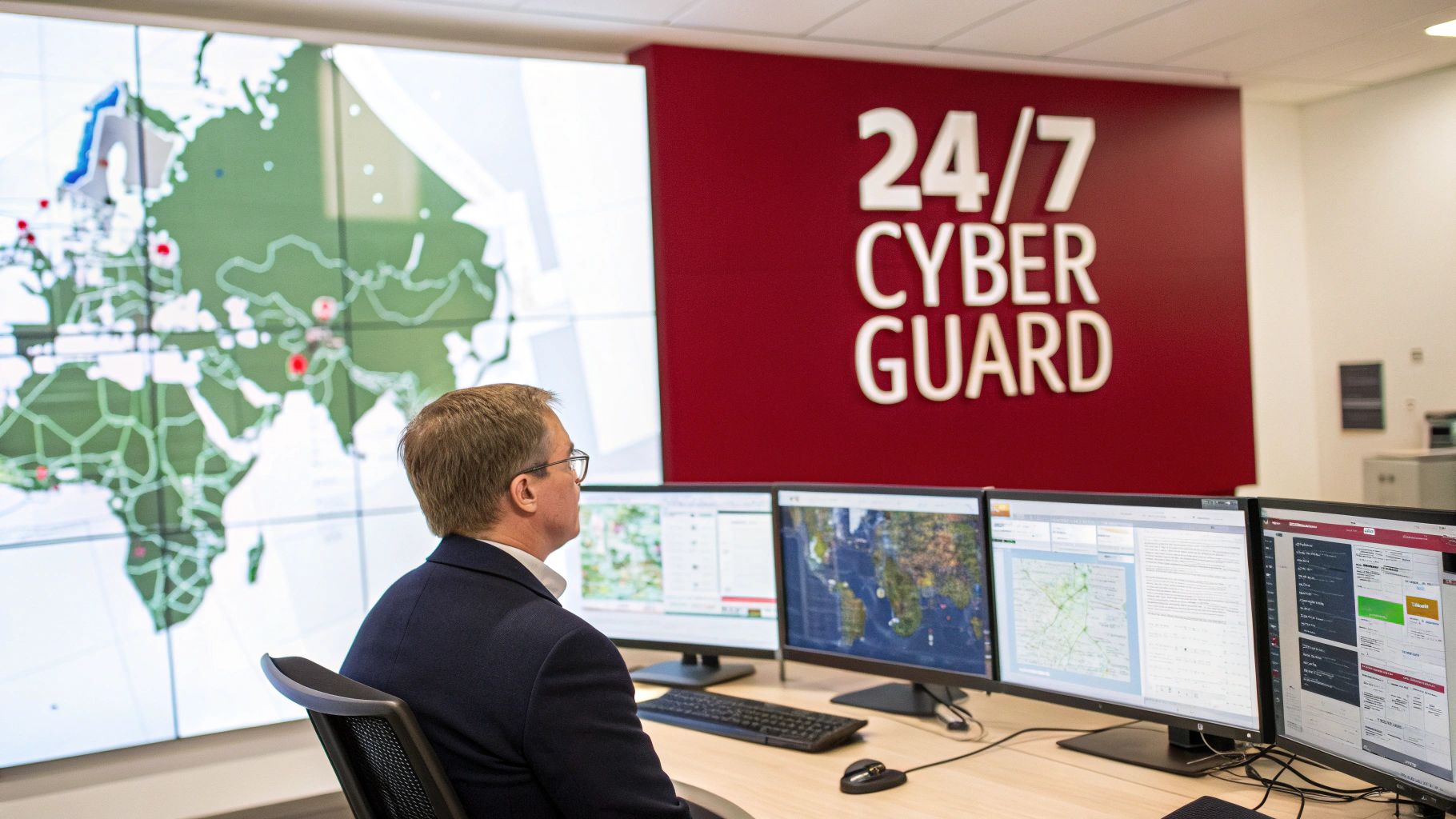
An MSSP functions as your dedicated cybersecurity department. They deploy advanced technology and a team of specialists whose sole purpose is to monitor for, detect, and neutralize digital threats. Their mission is to find, analyse, and shut down cyber threats before they can disrupt your operations or damage your hard-earned reputation.
Closing the Critical Skills Gap
Realistically, for most small and medium-sized businesses (SMBs), hiring a full roster of cybersecurity analysts is not feasible. There is a significant skills shortage in this field, making genuine experts both incredibly expensive and difficult to find. This is why many organisations turn to managed security solutions to fill this crucial expertise gap.
Partnering with an MSSP gives you immediate access to a deep pool of talent with specialised skills, including:
- Threat Intelligence: Staying current with the latest tactics, techniques, and procedures (TTPs) used by cybercriminals.
- Incident Response: Executing a battle-tested plan to contain a breach the moment it occurs.
- Compliance Management: Navigating the complex requirements of regulations like the Australian Privacy Act.
- Digital Forensics: Investigating post-incident to determine the root cause and full impact of an attack.
More Than Defence—A Business Advantage
Viewing managed security as merely another expense is a shortsighted perspective. A strong security posture is a powerful engine for business growth. When you can demonstrate that your systems are secure, you build trust with customers, confidently launch new digital initiatives, and meet the stringent security standards required by larger corporate partners. For a deeper dive into the lifecycle of data protection, this comprehensive guide to secure data destruction is a great resource.
Handing off the relentless, 24/7 job of security monitoring frees up your internal team to focus on what they do best—innovating and driving the business forward. This isn't just about defence; it's a strategic move that turns cybersecurity from a burden into a business enabler.
Unpacking the Core Security Services You Need
A quality security managed services provider delivers a complete, multi-layered defence system, not just a single piece of software. This is where we move from abstract concepts to concrete, real-world protection for your business.
Think of it less like buying a new lock for the front door and more like installing an intelligent, fully integrated security system for your entire digital operation.
This suite of services provides visibility, deep analysis, and—most importantly—an active response, ensuring threats aren’t just spotted but are actively stopped. Let’s break down the essential components that form the backbone of any strong managed security partnership.
Table: Key Security Managed Services and Their Business Impact
| Service Component | Core Function | Primary Business Benefit |
|---|---|---|
| 24/7 Monitoring & Detection | Constant surveillance of networks, servers, and endpoints. | Catches threats that occur after hours, eliminating blind spots in your defence. |
| SIEM | Collects, correlates, and analyses security data from all sources. | Turns an overwhelming flood of alerts into actionable intelligence, spotting complex attack patterns. |
| MDR | Actively investigates threats and neutralises them on your behalf. | Provides an expert response team to contain breaches, drastically reducing damage and downtime. |
| Vulnerability Management | Scans for and prioritises known security weaknesses in your systems. | Proactively closes security gaps before cybercriminals can find and exploit them. |
| Penetration Testing | Simulates a real-world cyberattack to test your defences. | Confirms whether your security measures actually work under pressure and identifies hidden risks. |
This table provides a quick overview, but understanding how these services work in tandem reveals their true power.
Constant Vigilance with 24/7 Monitoring and Threat Detection
First and foremost, you need eyes on your systems at all times. Cybercriminals do not operate on a 9-to-5 schedule. An attack can be launched from anywhere in the world while your team is offline, which is why 24/7 monitoring is absolutely non-negotiable.
This is the digital equivalent of having security cameras and motion sensors on every entry point to your business. It combines:
- Continuous Surveillance: A blend of automated tools and human analysts maintaining a constant watch over your networks, servers, and devices.
- Real-Time Alerts: Any suspicious activity—from anomalous login attempts to unusual data movement—instantly triggers an alert for immediate investigation.
- Proactive Threat Hunting: Experts actively search for subtle indicators of compromise that automated systems alone might miss.
Without this foundational layer of constant watchfulness, all other security measures are reactive.
SIEM: The Central Command Centre
Every device, application, and server in your business generates a constant stream of log data. Making sense of this information is like trying to hear a single whisper in a packed stadium. This is where Security Information and Event Management (SIEM) technology is essential.
A SIEM platform acts as your central security command centre, the brain of the operation. It ingests all that security data, correlates it, and analyses it for threats. Imagine a security guard watching dozens of camera feeds simultaneously, with the ability to see connections between tiny, seemingly unrelated events. That’s what a SIEM does—it connects the dots to uncover an unfolding attack.
Managed Detection and Response: The Active Defence Team
While monitoring and SIEM are about seeing threats, Managed Detection and Response (MDR) is about actively stopping them. MDR is your on-call, elite incident response team, ready to take action the moment a threat is confirmed.
This service is critical for containing damage and maintaining business continuity. The MDR market in Australia has grown significantly because it is effective. MDR services are incredibly adept at detecting 95% of advanced threats that evade traditional security tools. With the rise of remote work, MDR's endpoint focus has been shown to reduce threat dwell time by a massive 70%. You can see the full research on Australia's security market for a deeper dive.
An MDR team doesn't just email you an alert. They are your digital first responders—isolating compromised machines, blocking malicious traffic, and taking decisive action to shut down an attack before it can spread.
Finding Weaknesses Before Criminals Do
The best security posture is a proactive one. It involves finding and fixing vulnerabilities in your own defences before an attacker has a chance to discover them.
Two key services facilitate this:
- Vulnerability Management: This is the routine, disciplined process of scanning your systems, software, and network for known security flaws. Your MSSP provides detailed reports on these vulnerabilities, prioritises them by risk, and assists with patching.
- Penetration Testing: This takes vulnerability assessment a step further. Ethical hackers conduct a simulated cyberattack to stress-test your defences. By thinking and acting like a real attacker, they uncover gaps that a simple scan might miss.
For businesses interested in regular, structured testing, our guide on Pen Testing as a Service provides valuable insights.
By combining continuous scanning with periodic, deep-dive testing, you systematically reduce your attack surface. You're not just reacting to threats—you're making your business a much harder target.
Why Managed Security is a Smart Business Move
Every business owner must ask whether a new expense is a cost or an investment. When it comes to cybersecurity, the answer is essential for survival. Engaging a managed security services partner isn’t just adding another IT expense; it's a strategic decision that delivers tangible returns in cost savings, business continuity, and a competitive edge.
Many businesses are deterred by the idea of a monthly security subscription, yet they overlook the massive, unpredictable costs of a do-it-yourself approach. A partnership with a managed security provider transforms chaotic, reactive spending into a predictable, manageable investment.
Nail Down Your Costs and Stop the Financial Guesswork
Building an in-house security team from scratch is a significant financial drain. Consider the real costs:
- Recruitment: Finding and hiring skilled cybersecurity talent is difficult, time-consuming, and expensive.
- Salaries: A single person cannot provide 24/7 protection. A team is required, and senior analysts command high salaries.
- Constant Training: The threat landscape is always evolving. Your team needs continuous, costly training to keep up.
- Expensive Technology: Professional security tools like SIEM and MDR platforms have high upfront costs and substantial annual licensing fees.
A managed security service provider consolidates all these expenses into a single, straightforward monthly fee. This shifts your spending from a large capital expenditure (CapEx) to a predictable operational expense (OpEx), simplifying budgeting and freeing up capital for business growth.
Get a Team of Experts on Day One
Beyond the financial aspect, consider the skills. Most SMBs cannot find or afford the level of cybersecurity expertise required today. An MSSP provides an entire team of seasoned professionals—threat hunters, forensic analysts, and compliance gurus—from day one.
This isn't about hiring one "IT guy" who knows a bit about security. It's about plugging your business directly into a security operations centre staffed by specialists who live and breathe this work. They have extensive experience and know exactly what to do when an incident occurs.
This immediate access to deep expertise means your defences are managed by people who are in the trenches fighting cyber threats every day. This is a significant advantage that is difficult to replicate in-house.
Security That Grows with You
As your business expands, your security risks multiply. More staff, more customer data, and new online services create more opportunities for attackers. For an in-house team, scaling security is often a slow and painful process of hiring more people and purchasing more equipment.
Security managed services, however, are designed to scale with you. A good MSSP can adjust your coverage as your needs change, ensuring your protection keeps pace with your success without any growing pains. This gives you the freedom to pursue new opportunities, confident that your security can handle what comes next.
Tame the Compliance Beast
Keeping up with Australia’s regulatory landscape, such as the Privacy Act, can be a full-time job. Compliance is not a one-time task; it requires constant monitoring, detailed documentation, and robust processes. An MSSP can manage this complexity for you.
They have the right tools and expertise to generate the reports needed to demonstrate compliance to regulators and auditors. What was once a major distraction becomes a business strength.
It’s no surprise that Australia's IT Security Consulting industry is projected to reach $8.0 billion in revenue. This growth is driven by small and medium businesses—which constitute 97% of all Australian businesses—seeking affordable security solutions. With the national cost of cybercrime exceeding AUD 33 billion, and SMEs being hit the hardest, partnering with an MSSP is no longer a luxury. It's smart business. You can explore more on the growth of IT security consulting in Australia to see the trend for yourself.
How Managed Security Can Fast-Track Your ISO 27001 Certification
Achieving ISO 27001 certification can feel like a monumental task, especially while running a business. It requires meticulous documentation, continuous monitoring, and tangible proof that your security controls are effective. This is where a security managed services provider can completely change the game, transforming a stressful compliance sprint into a structured, manageable process.
An MSSP doesn’t just add on security; they integrate it into the fabric of your Information Security Management System (ISMS). The daily tasks of threat monitoring, vulnerability management, and incident response are not just "security work"—they are the living evidence required for a successful ISO 27001 audit. This synergy means you aren’t chasing compliance as a separate project; it becomes the natural outcome of being secure.
The relationship is clear: expert security services lead directly to stronger compliance, all while keeping costs under control.
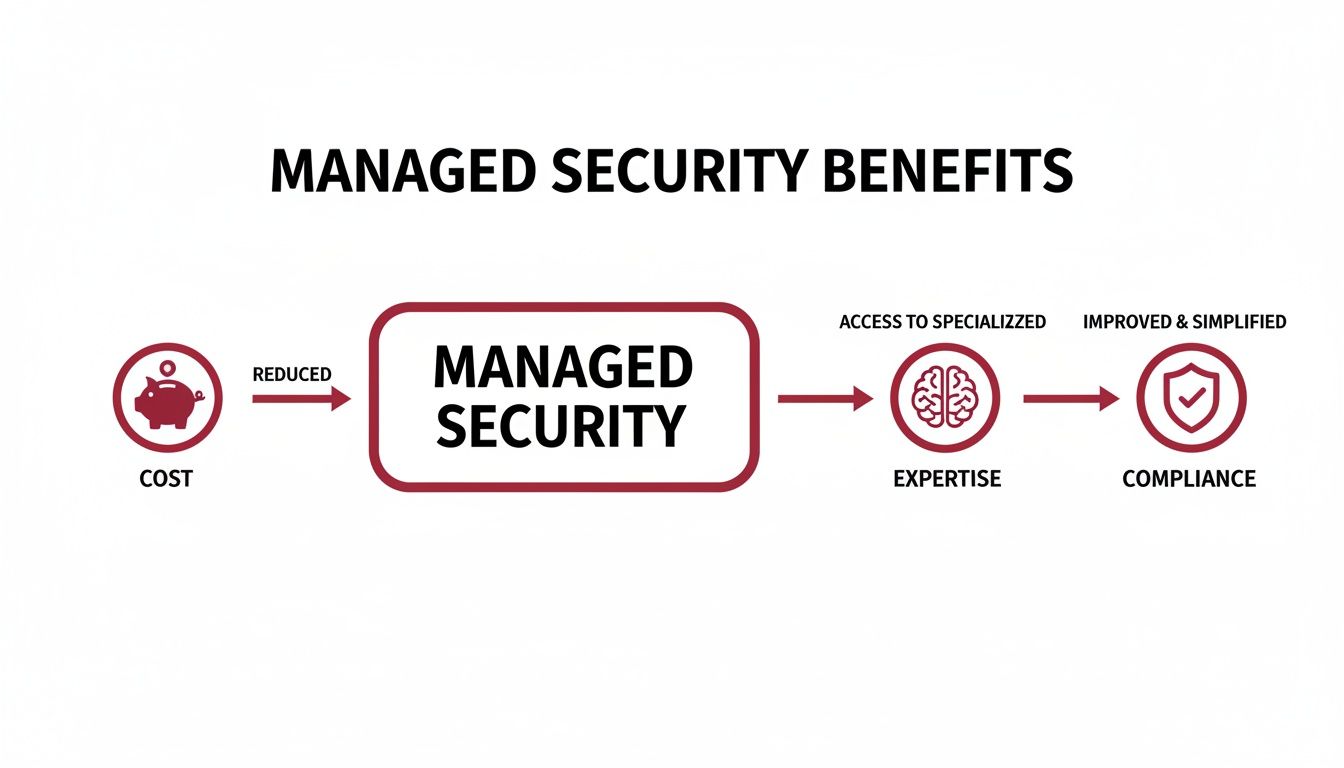
This demonstrates that investing in an MSSP is not just a defensive move but a proactive strategy for achieving major compliance milestones like ISO 27001.
Mapping MSSP Services Directly to ISO 27001 Controls
The real value becomes apparent when you see how an MSSP’s daily services map directly to the specific security controls in ISO 27001's Annex A. Annex A is the auditor's checklist, and a good MSSP helps you satisfy a significant number of these controls from the start.
Here’s a practical look at how this works:
- A.12 Operations Security: This section focuses on malware protection, detailed logging, and managing technical vulnerabilities. An MSSP's 24/7 monitoring, SIEM platform, and vulnerability management services not only perform these tasks but also generate the reports and logs that prove consistent implementation.
- A.16 Information Security Incident Management: The standard requires a formal and effective process for handling security incidents. An MSSP's incident response team is precisely that: a battle-tested process for detecting, containing, and learning from every security event.
- A.13 Communications Security: This involves securing your networks and protecting data in transit. An MSSP's continuous network surveillance and threat detection are the exact controls needed to meet these requirements.
With these capabilities running from day one, you operate in a state of continuous compliance, which is the ultimate goal of the standard.
Automating Your Evidence Collection
One of the biggest challenges of an ISO 27001 audit is collecting evidence. You must prove to an auditor that your controls are not just theoretical but are actively working day in and day out.
This is where your MSSP becomes invaluable. They are an evidence-generating machine.
An MSSP transforms the audit from a frantic search for old emails and reports into a calm, organised presentation of facts. Their routine dashboards and reports on incidents, vulnerabilities, and system health become your official record of due diligence.
This constant, automated flow of evidence can save hundreds of hours of manual work and removes the guesswork from audit preparation. When the auditor asks, "Show me how you handled the last critical vulnerability," you simply pull up the time-stamped report from your MSSP.
From Daunting Mountain to Achievable Summit
Without the right support, the path to ISO 27001 can be steep and overwhelming, filled with technical jargon and endless paperwork. A managed security provider acts as your guide, providing the tools, expertise, and clear path to make the journey successful.
They handle the heavy lifting—the relentless monitoring, late-night incident response, and detailed reporting—so your team can focus on the bigger picture. They help you build an ISMS that is not just a certificate on the wall, but a genuinely resilient security posture. With such a partner, ISO 27001 becomes the next strategic peak for your business to conquer.
How to Choose the Right Managed Security Partner
Selecting a managed security partner is one of the most critical decisions for your business. This is not just about outsourcing a task; you are entrusting a team with the protection of your most valuable assets—your data, your reputation, and your customers' trust. While it's tempting to compare prices, finding a provider that understands your business and can substantiate their claims is what truly matters.
A great security partnership is built on more than just advanced technology. It requires a genuine understanding of your industry, your daily challenges, and the specific regulatory requirements you face in Australia. The right partner acts as a natural extension of your team, offering strategic advice and a clear roadmap, not just a flood of automated alerts.
Look for Local Expertise and Industry Experience
While cyber threats are global, your business context is local. A provider with a presence in Australia understands the nuances of regulations like the Privacy Act and the Notifiable Data Breaches scheme. More importantly, they operate in your time zone. When a crisis occurs at 2 PM in Sydney, you need a team that is awake and ready to act, not one just starting their day on the other side of the world.
Equally crucial is their experience in your industry. A partner who has protected businesses like yours already knows your likely weak spots. They understand the type of data you handle and the specific threats targeting your sector. This specialised insight allows them to be proactive rather than just reactive.
Scrutinise Their Service Level Agreements
The Service Level Agreement (SLA) is where promises are put into writing. It's the contract that defines expectations and is your best tool for evaluating providers. An SLA filled with vague language is a major red flag. You need a detailed, transparent document from a provider who is not afraid to be held accountable.
Focus on the specifics:
- Guaranteed Response Times: How quickly will they respond to a critical alert? The answer should be in minutes, not hours.
- Time to Resolution: What are their targets for containing and resolving different types of security incidents?
- Reporting Frequency and Detail: What kind of reports will you receive and how often? You need clear, understandable metrics on performance and your security posture.
- Clear Escalation Paths: Who do you contact in a major incident? What is the process for involving the right people immediately?
Think of the SLA as your emergency playbook. It’s not just a legal formality; it’s the agreed-upon plan for how your partnership will perform under pressure. A rock-solid SLA provides peace of mind that in a crisis, there’s no confusion—just action.
Verify Their Own Security Credentials
This is a critical step: before you entrust a company with your security, you must verify theirs. Ask potential partners about their certifications. For instance, an MSSP that is ISO 27001 certified has had its own security processes audited and verified by an independent body. This demonstrates a deep commitment to security that goes beyond a sales pitch.
To help you compare providers effectively, use this practical checklist to guide your conversations and ensure you ask the right questions.
MSSP Selection Checklist
| Evaluation Criteria | Key Questions to Ask | Importance (High/Medium/Low) |
|---|---|---|
| Local Presence & Support | Where is your Security Operations Centre (SOC) located? Are your support staff based in Australia and available 24/7? | High |
| Industry Specialisation | Can you provide case studies or references from businesses in our industry? What are the common threats you see for a business like ours? | High |
| Service Level Agreement (SLA) | What are your guaranteed response and resolution times for critical incidents? What are the penalties if you miss these targets? | High |
| Technology & Tools | What security platforms (SIEM, EDR) do you use? Do we get direct access to dashboards and reports? | Medium |
| Certifications & Compliance | Are you ISO 27001 certified? Can you provide evidence of your own security audits and compliance? | High |
| Team Expertise | What certifications and training do your security analysts hold (e.g., GIAC, CISSP)? What is your staff retention rate? | Medium |
| Reporting & Communication | Can we see a sample report? How often will we have strategy meetings with our account manager or a security advisor? | Medium |
| Scalability & Flexibility | How can your services grow with our business? What is the process for adding new services or adjusting our coverage? | Low |
Choosing the right managed security partner is a strategic move that pays dividends for years. By focusing on local knowledge, real-world industry experience, transparent SLAs, and their own proven credentials, you can build a partnership that not only protects you today but also helps you grow securely tomorrow.
Calculating the ROI of Your Security Investment
It’s easy to view a proposal from a security managed services provider as just another monthly bill. This is a common but critical mistake. The real conversation is not about cost; it’s about the substantial return on investment (ROI) that proper security brings to your business. Let's shift the perspective from an expense to a strategic investment by examining the costs you avoid and the value you gain.
Most providers use straightforward pricing models based on countable metrics like the number of users or devices they protect. This transparency transforms what could be unpredictable spending into a manageable operational expense that you can budget for.
The True Cost of Inaction
The simplest way to understand ROI is to compare the predictable monthly fee to the catastrophic financial impact of a single data breach. A cyber attack is not just a technical issue; for many small businesses, it can be a business-ending event. You face regulatory fines, significant legal fees, the cost of customer notifications, and crippling revenue loss from downtime.
When you weigh the MSSP fee against that nightmare scenario, the value proposition becomes clear. For a more detailed analysis, our guide on the ROI of cyber security explains how investing in protection benefits your bottom line. Think of it as a financial shield against a multi-million dollar disaster.
Uncovering the Hidden Savings
Managed security services also deliver significant operational savings that boost your bottom line every day. These "hidden" returns are often overlooked but add up quickly.
Consider these financial benefits:
- Zero Capital Expenditure: You gain access to enterprise-grade security tools—like powerful SIEM and MDR platforms—without the six-figure upfront investment in software and hardware.
- Reduced Operational Overhead: Your internal IT team is freed from the relentless, 24/7 task of chasing security alerts, allowing them to focus on revenue-generating projects.
- Elimination of Recruitment and Training Costs: You avoid the immense cost and difficulty of finding, hiring, training, and retaining specialised security experts.
These clear financial advantages are driving the Australian managed security services market, which is projected to reach USD 3,142.8 million by 2033. Studies show that MSSPs can reduce a company’s security costs by up to 40% compared to building an in-house team—a staggering saving, especially given the thousands of vacant cybersecurity roles across Australia. You can discover more insights on the Australian managed security market and what is fueling its growth.
The real ROI of managed security isn't just about the breaches you prevent; it's about the business you can confidently build. Enhanced customer trust and a resilient brand reputation are invaluable assets that allow you to innovate and grow securely.
Still Have Questions? Let's Clear a Few Things Up
Diving into the world of security managed services can be overwhelming, so it's natural to have questions. Let's address some of the most common ones from Australian business owners to provide the clarity you need.
How Quickly Can We Get Up and Running?
The timeline depends on your business's complexity, but most small to medium-sized businesses can be onboarded within a few weeks to a couple of months. A good MSSP provides a proper onboarding plan with clear milestones.
The process usually starts with a discovery phase to understand your environment. After that, they deploy the necessary tools and monitoring agents, carefully tuning everything to ensure smooth operation without disrupting your day-to-day business.
Does an MSSP Replace Our IT Team?
Not at all. An MSSP is a powerful extension of your current team, not a replacement. Whether you have an in-house IT person or use an external provider, the MSSP acts as a specialist partner.
The real magic is that this partnership frees your internal IT crew from the relentless, 24/7 grind of security monitoring. This allows them to focus on strategic projects that actually grow the business, while the MSSP handles the hardcore threat hunting and response.
Is My Business Too Small to Need This?
Definitely not. This is a dangerous misconception. Cybercriminals frequently target small businesses because they assume their defences are weaker. The reality is that no business is too small to be a target, making professional-grade security essential for everyone.
Modern MSSPs understand this and offer flexible, affordable service models designed for SMBs. The predictable monthly cost is a fraction of the financial and reputational damage that a single successful cyber-attack can cause.
How Does This Help With Ongoing ISO 27001 Compliance?
Achieving ISO 27001 certification is a significant milestone, but maintaining it is the real work. An MSSP is your secret weapon for staying compliant without the stress.
They handle the continuous monitoring, regular vulnerability scans, and detailed incident reports that the standard requires. This effectively automates much of the evidence-gathering needed for annual surveillance audits, providing concrete proof that your security program is active and effective every day.
Ready to build a stronger defence and simplify your ISO 27001 journey? The expert team at Anitech can help you implement a robust security framework. Learn more about our ISO 27001 consulting services.
Recent Comments