

Quick Summary: ISO 27001 is the global standard for information security management, and for Australian businesses, it’s now a critical asset. Achieving JAS-ANZ accredited certification builds powerful trust, opens doors to major government and commercial contracts, and defends your business against crippling data breaches by creating a robust Information Security Management System (ISMS).
Getting certified with ISO 27001 is the global gold standard for managing information security, and for Australian businesses, it's quickly shifting from a 'nice-to-have' to a 'must-have'. This definitive guide provides a clear, no-nonsense roadmap to ISO 27001 certification in Australia, focusing on the entire certification lifecycle, from initial assessment and auditing to achieving JAS-ANZ accreditation. We'll show you how to protect your business, build resilience, and unlock serious growth opportunities.
Why ISO 27001 Is a Game Changer for Australian Businesses
Think of your business's most valuable information—client lists, financial records, intellectual property—as the crown jewels. An Information Security Management System (ISMS), which is what ISO 27001 helps you build, is your complete security system for the treasure. It’s not just a strong password policy; it's the whole shebang: the access controls, the staff training, the risk assessments, and the incident response plans. In Australia's current climate, having this kind of structured defence is no longer optional.
The numbers paint a stark picture. The Australian Cyber Security Centre recorded over 94,000 cybercrime reports in the last year alone. That's a staggering 23% jump from the year before. With cyber threats escalating, ISO 27001 has become an essential shield.
Beyond Compliance to Competitive Advantage
For Australian businesses, the push for better security is coming from all sides. It's not just about dodging cybercriminals; it's also about meeting the tough demands of clients. Government departments and big corporations are now routinely making ISO 27001 certification a non-negotiable term in their contracts.
Achieving that certification sends a powerful message. It tells the market, your partners, and your customers that you are serious about protecting their data. It’s a differentiator that can instantly build trust and put you ahead of the competition.
An ISMS provides the framework for an organisation to identify, analyse, and address its information security risks. It ensures that the security arrangements are fine-tuned to keep pace with changes to the security threats, vulnerabilities and business impacts.
To help you get a quick overview, here's a snapshot of what the ISO 27001 journey looks like for a typical Australian small or medium-sized business.
ISO 27001 Certification at a Glance for Australian SMBs
| Aspect | Description | Typical Timeline (with expert help) |
|---|---|---|
| Initial Assessment | A gap analysis to see where your current security practices stand against the ISO 27001 standard. | 1-2 Weeks |
| ISMS Development | Creating the core policies, procedures, and risk assessments that form your Information Security Management System. | 4-8 Weeks |
| Implementation | Rolling out the new controls and processes across the business, including staff training and technical setups. | 6-12 Weeks |
| Internal Audit | A "dress rehearsal" audit to find and fix any issues before the official certification audit. | 1-2 Weeks |
| Certification Audit | The formal, two-stage audit conducted by an external certification body to confirm your compliance. | 2-4 Weeks |
| Ongoing Maintenance | Continuously monitoring, reviewing, and improving your ISMS to maintain certification and adapt to new threats. | Annual |
This table simplifies the process, but the core takeaway is that with a clear plan and the right support, certification is an achievable and incredibly valuable goal.
Building a Foundation for Growth
At the end of the day, pursuing ISO 27001 is a direct investment in your company's future. It elevates information security from a reactive, IT-centric problem to a proactive, board-level strategy. The benefits of ISO certification ripple through your entire organisation, creating a culture that understands and manages risk effectively.
By adopting this globally respected standard, you're not just managing risk; you're strengthening your digital fortress. You're building a secure foundation that protects your most critical asset—your information—and enables you to grow with confidence.
Winning Contracts in the Australian Market
If you're looking to work with government or critical infrastructure in Australia, you'll find that the security bar is set incredibly high. It's no longer just a "nice-to-have"; robust security is a non-negotiable part of the deal.
The Australian Cyber Security Strategy has effectively made ISO 27001 a baseline requirement for many government tenders. Without it, you’re not just at a disadvantage—you might not even get a seat at the table.
Why JAS-ANZ Accreditation is Your Golden Ticket
In Australia, not all certifications are created equal. The key is JAS-ANZ accreditation. This is the official seal of approval, verifying that the body that certified you is legitimate, competent, and recognised by the Australian government.
Think of it this way: a JAS-ANZ accredited certificate is your passport. It opens doors to lucrative government and infrastructure contracts that are firmly closed to others. Without that passport, you're staying home.
A JAS-ANZ accredited certificate grants access to tenders and panels that are completely off-limits to non-accredited organisations.
We’ve seen this play out time and again. A Sydney-based software firm, for instance, landed a $5 million federal contract after presenting their ISO 27001 certificate to a Defence supplier panel. Their JAS-ANZ accreditation was the deciding factor that put them ahead of larger, more established vendors.
Government agencies see this certification as proof of your due diligence and risk management maturity. It tells them you take security seriously.
- An energy provider in Brisbane secured a multi-million dollar network upgrade contract because their ISO 27001 certification met the client's stringent cybersecurity prequalification.
- A Western Australian transport firm won a key infrastructure partnership by clearly showcasing its ISO 27001 ISMS controls in its security annex.
Even smaller players are getting ahead. A regional software startup in Adelaide successfully secured a defence grant, and a major factor was their ability to demonstrate a functioning ISO 27001 ISMS.
This isn’t just about winning contracts, either. Many federal programs, like those run by the Digital Transformation Agency, now mandate security certification just to be eligible for grants.
Better still, JAS-ANZ has agreements with international accreditation bodies, which means your Australian certificate is recognised globally. Suddenly, that passport isn't just for local opportunities; it’s your entry into international bids and partnerships.
Meeting APRA's Tough Expectations
For businesses in financial services, the Australian Prudential Regulation Authority (APRA) sets the rules. Their guidelines on security and governance are notoriously strict.
ISO 27001 provides a clear framework to meet these demands. We saw a Melbourne fintech provider win a coveted spot on a regulated payments platform by demonstrating how effective their ISMS was in meeting APRA’s standards.
Here’s how you can make your ISO 27001 certification work for you:
- Align your risk assessment directly with JAS-ANZ accreditation requirements.
- Map your security controls to APRA CPS 234 to show clear financial services compliance.
- Use your certificate as leverage to negotiate better contract terms.
- Prominently feature your ISO status in all tenders and marketing materials.
The global certification market is on a steep climb, projected to grow from $16.14 billion in 2024 to a staggering $66.25 billion by 2034. You can learn more about this growth at KMTech.
And if you’re in the education sector, don’t forget to check out our guide on DESE ISMS Certification to understand those specific security requirements.
Ultimately, earning ISO 27001 certification in Australia is more than a security tick-box. It’s a powerful strategic move to win high-value contracts and position your business as a market leader.
On average, certified organisations see contract approvals move 30% faster in government procurement processes.
This isn't just about speed; it's a real competitive edge that translates directly into revenue and a much stronger position in the market.
Marketing Your ISO Certification
Once you have your certificate, don’t be shy about it.
Display it proudly on your website, proposals, and tender documents. It’s a powerful visual signal that you’re a leader in security.
Weave your certification into your pitch decks and even your email signatures. Every touchpoint is a chance to build trust.
Engaging the Public Sector
When it comes to government work, a bit of strategy goes a long way.
- Engage early with procurement officers. This lets you align your ISO 27001 scope with their specific project needs before the tender is even released.
- Make your ISO 27001 status a highlight in your Expression of Interest (EOI) documents to stand out from the very beginning.
When you’re tendering, always reference past projects where your certification played a role. It provides a tangible track record of security excellence and shows you have the experience to back it up. In a close contest, that kind of proof can be the one thing that tips the scales in your favour.
Your Step-by-Step ISO 27001 Certification Journey
Getting started with ISO 27001 certification can feel like a huge mountain to climb, but it’s much more manageable when you see it for what it is: a structured project with a clear beginning, middle, and end. Think of it like building a digital fortress to protect your most valuable assets. You wouldn't just start laying bricks without a blueprint, and the same principle applies here. The whole process is a logical sequence of steps, each one building on the last to create a tough, effective Information Security Management System (ISMS).
For Australian businesses, just understanding this roadmap is the first big step. It helps turn a complex compliance headache into a genuine, powerful business advantage. The journey is broken down into distinct phases, from the initial planning and scoping all the way through to the final audit and the ongoing work that follows. By breaking it down, you can map out your resources, set realistic expectations, and move forward with confidence.
As this diagram shows, a solid strategy that aligns with JAS-ANZ requirements is a direct path to securing those big, valuable contracts.
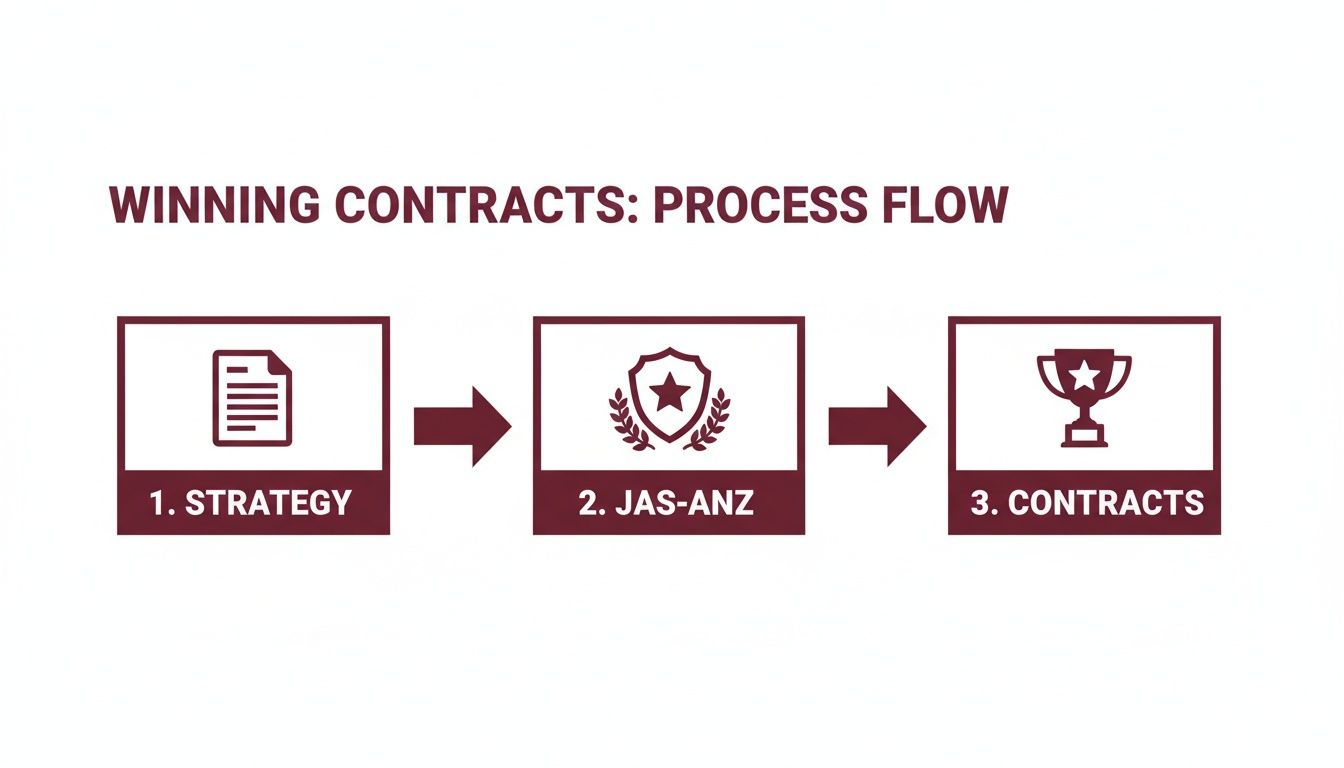
This really drives home the point that certification isn’t just a box-ticking exercise for the IT team; it's a strategic move that unlocks real commercial opportunities.
Let's walk through each phase of the journey. To make it even clearer, we've put together a table that outlines what happens at each stage, what you need to achieve, and how we at Anitech can guide you through it.
ISO 27001 Certification Phases and Key Activities
| Phase | Objective | Key Activities | Anitech's Role |
|---|---|---|---|
| 1. Scoping & Gap Analysis | Define the ISMS boundaries and identify current security shortfalls. | Determine which parts of the business are covered. Conduct a detailed review against ISO 27001 requirements. | We help you define a practical scope and conduct a thorough gap analysis to create a clear project roadmap. |
| 2. Risk Assessment & Documentation | Identify, analyse, and plan treatment for information security risks. | Conduct risk assessments. Develop the Statement of Applicability (SoA) and Risk Treatment Plan (RTP). Write core security policies. | Our experts facilitate risk workshops and provide templates and guidance to produce audit-ready documentation. |
| 3. Implementation | Put the required security controls and processes into practice. | Roll out new technologies and procedures. Conduct staff security awareness training. Implement access controls and backup solutions. | We offer project management support and expert advice to ensure controls are implemented correctly and efficiently. |
| 4. Internal Audit & Management Review | Verify the ISMS is working as intended and secure leadership buy-in. | Conduct a full internal audit to find and fix non-conformities. Hold a formal management review meeting to assess ISMS performance. | We can act as your independent internal auditors and facilitate the management review to ensure all requirements are met. |
| 5. Certification Audit | Achieve independent verification of your ISMS by an accredited body. | Engage a JAS-ANZ accredited certification body. Undergo the Stage 1 (documentation) and Stage 2 (implementation) audits. | We prepare your team for the audits, help you select the right certification body, and provide support during the audit process. |
| 6. Ongoing Maintenance | Maintain and continuously improve the ISMS to retain certification. | Conduct regular internal audits and management reviews. Manage and respond to security incidents. Adapt to new threats. | We offer ongoing support services, including internal audits and virtual CISO services, to keep your ISMS effective and compliant. |
As you can see, it's a comprehensive process. But with a clear plan and the right partner, it's entirely achievable for any Australian business.
Phase 1: Scoping and Gap Analysis
Before you can build your fortress, you need to draw the map and mark its boundaries. That’s scoping. You have to decide exactly what parts of your business the ISMS will protect. Will it cover the entire company, or just a specific team, product, or office that handles sensitive data? Getting the scope right is critical—go too broad, and the project becomes a beast to manage; go too narrow, and you might leave your crown jewels exposed.
Once the scope is locked in, you move on to a gap analysis. This is basically a health check of your current security practices against what ISO 27001 demands. It’s like a pre-flight checklist, showing you what you’re already doing well and, more importantly, where the gaps are. The results of this analysis become the foundation of your entire project plan, giving you a concrete to-do list.
Phase 2: Risk Assessment and Documentation
With your gaps identified, it’s time to get to the heart of the ISMS: risk assessment and management. This is where you identify potential threats to your information—think cyber-attacks, human error, or even a power outage—and figure out the likelihood and impact of each one. From there, you decide how to handle each risk: will you accept it, avoid it, transfer it (e.g., through insurance), or mitigate it with a new control?
This process results in two of the most important documents you'll create:
- Statement of Applicability (SoA): A master list of all the security controls in ISO 27001's Annex A, where you justify why each one is or isn't relevant to your business.
- Risk Treatment Plan (RTP): This is your battle plan. It details exactly how you’re going to implement the controls needed to tackle unacceptable risks, including who’s responsible and when it will be done.
This is also the phase where you’ll draft the foundational policies and procedures for your ISMS, like your over-arching Information Security Policy, your Access Control Policy, and your Incident Response Plan. This paperwork is the official blueprint for how your organisation will manage security from now on.
Phase 3: Implementation of Controls
Alright, planning is done. Now it's time to build the walls and post the guards. The implementation phase is where you bring your Risk Treatment Plan to life. This is often the most hands-on part of the journey, where you roll out your new policies and procedures across the business.
This can involve a whole range of activities, such as:
- Setting up technical controls like firewalls, endpoint protection, and encryption.
- Introducing new processes for managing who can access what information.
- Running security awareness training for all your staff (a crucial step!).
- Formalising your data backup and disaster recovery procedures.
Getting this right takes solid project management and great communication. Everyone needs to know what their role is in keeping the business secure.
Phase 4: Internal Audit and Management Review
Before you call in the official inspectors, you need to run your own drills. This is where the internal audit comes in—it’s essentially a dress rehearsal for the main event. An impartial auditor, either from your team or a third party, will review your ISMS against the ISO 27001 standard to make sure everything is running the way it should be.
The internal audit is one of the most valuable parts of the process. It’s your chance to find and fix any issues before they can put your certification at risk.
After the internal audit, you'll hold a management review. This is a formal meeting where your senior leadership team looks at how the ISMS is performing, reviews the audit findings, and makes strategic decisions to keep it on track. This step is non-negotiable; it proves that leadership is committed, which is a key requirement of the standard.
Phase 5: The Certification Audit
This is it—the final checkpoint. The certification audit is always conducted by an external, JAS-ANZ accredited certification body, and it happens in two stages:
- Stage 1 Audit: The auditor focuses on your documentation—your SoA, your policies, your risk assessment—to confirm that your ISMS has been designed correctly. They’re making sure you're actually ready for the main inspection.
- Stage 2 Audit: Now the auditor comes back for a much deeper dive. They’ll be checking if your ISMS is actually working in practice. This involves interviewing staff, looking at records, and testing controls to gather hard evidence that you’re compliant.
If you pass the Stage 2 audit with flying colours, the certification body will officially recommend you for ISO 27001 certification. This final step validates all your hard work, proves your commitment to security, and starts opening new doors for your business in the Australian market.
What to Expect: Timelines and Costs
Let's get straight to the two questions on every business leader's mind: "How long will this take?" and "What's the damage to my budget?" Getting a handle on the timeline and costs for ISO 27001 certification is essential for planning, and the answers really hinge on one big decision: do you tackle this yourself, or do you bring in the experts?
Going it alone might look like the cheaper option on paper, but it’s often a classic case of false economy. You could be looking at a drawn-out process of 12 to 18 months, maybe even longer. That time is often filled with frustrating trial-and-error, documentation headaches, and the very real risk of failing the final audit. That's a lot of internal time and energy down the drain, all while delaying your ability to win those big contracts.
Now, contrast that with bringing in a team that lives and breathes this stuff. Working with seasoned consultants can fast-track the entire project, getting you certified in a much more focused 3 to 9-month timeframe. It’s not just about speed; it's about efficiency. You save countless internal hours and get your business ready to compete for high-value work much, much faster.
The Financial Side of Things
The cost of certification isn't just a single invoice. Think of it as an investment with a few key components, all part of a bigger strategic play to protect and grow your business.
- Expert Guidance: This is your consulting fee. It pays for the expertise to navigate the entire journey, from figuring out where your gaps are to getting you ready for the final audit. It’s the surest way to get it done right the first time.
- The Audit Itself: An accredited certification body has to perform the formal Stage 1 and Stage 2 audits. Their fees cover their time, expertise, and the official JAS-ANZ accredited certificate you get at the end.
- Tools and Tech: Your initial gap analysis might highlight the need for some new tools to meet the standard's requirements—things like better endpoint security, encryption software, or more robust backup systems.
- Your Team's Time: Don't forget to factor in the time your own people will spend on this. While a good consultant minimises the load, your staff will still need to be involved in putting new processes into action.
For a really detailed look at how these costs break down, our guide on ISO 27001 certification costs is a great resource to help you budget properly.
Looking Beyond the Price Tag: The Real ROI
If you only see ISO 27001 as an expense, you’re missing the point. The real conversation is about the return on your investment (ROI). You have to weigh the upfront cost against the massive risks it helps you avoid and the incredible opportunities it opens up.
The cost of doing nothing is almost always higher than the cost of getting certified. A single data breach or one lost contract can easily cost more than the entire investment in building a solid information security management system.
Think about the consequences of not being certified. We’ve seen firsthand how a delayed or lapsed certification can hit the bottom line, hard. One regional bank reportedly lost a $2 million contract because its certification was out of date by only six weeks. You can read more about the steep price of non-compliance over at KMTech.
Imagine your software company has built a brilliant new product, but you can't even get in the door with a major government department because you don't have the security credentials they demand. All that lost revenue and missed opportunity can be devastating. ISO 27001 is the key that unlocks those doors, turning a potential disaster into a massive win and securing your place in Australia's competitive market.
How to Choose a JAS-ANZ Accredited Auditor
Picking the right certification body is probably one of the most important calls you'll make on your journey to ISO 27001 certification. Let's be frank: not all certificates are created equal. The real-world value of your certification comes down entirely to the credibility of the auditor who issues it.
Think of it this way: a degree from a prestigious university carries more weight than one from an unknown institution. It’s the same principle here. A certificate from a non-accredited body is, for all intents and purposes, just an expensive piece of paper.
This is exactly why the Joint Accreditation System of Australia and New Zealand (JAS-ANZ) is so crucial. As Australia's national accreditation body, JAS-ANZ is the gatekeeper. They rigorously vet certification bodies to make sure they're competent, impartial, and up to scratch with international standards. When you choose a JAS-ANZ accredited auditor, you’re guaranteeing your certificate will be taken seriously by government departments, major corporations, and international clients.
Consultants vs. Auditors: Two Sides of the Coin
Before you go any further, it’s vital to get your head around the two key players in this process: the consultant and the auditor. Their roles are completely separate, and they have to stay that way to maintain the integrity of the audit.
- Consultants (That’s us at Anitech): Think of us as your coach. Our job is to get you match-fit. We’re in your corner, helping you build your ISMS, figuring out where the gaps are, and running internal audits to make sure you're ready for the big day.
- Auditors (The Certification Body): These are the independent referees. They’re the ones who conduct the official Stage 1 and Stage 2 audits to see if your ISMS actually meets the ISO 27001 standard. They can't help you build the system—that would be a massive conflict of interest.
This separation is the bedrock of a credible certification. The auditor can't mark their own homework; their independence is precisely what gives your certificate its authority.
Your Checklist for Vetting a Certification Body
Choosing the right auditing partner isn't something you want to rush. A hasty decision here can lead to a lot of wasted time, money, and a certificate that doesn't actually open the doors you need it to. Use this checklist to make sure you're making a smart choice.
-
Verify Their JAS-ANZ Accreditation
This is the first and most important step. Don't just take their word for it. Head straight to the JAS-ANZ Register and check that they are listed and their accreditation for ISO/IEC 27001 is current. If they're not on that list, it’s a hard pass. -
Assess Their Industry Experience
You need an auditor who speaks your language. An auditor with a background in tech will understand the specific risks of a software company far better than someone who has only ever audited manufacturing plants. Ask them directly about their auditors' backgrounds and their experience with businesses like yours. -
Evaluate Their Audit Approach
A good audit is more than a box-ticking exercise. The best auditors take a "value-add" approach, offering insights that can genuinely improve your security. When you’re first talking to them, ask about their philosophy. Do they see the audit as a partnership, or is it just a pass/fail exam?
A quality audit should feel like a thorough health check that not only confirms your compliance but also identifies opportunities for strengthening your ISMS. It should be challenging but ultimately constructive.
-
Request and Check References
Any reputable certification body will be happy to provide references from other Australian businesses they’ve certified, ideally within your industry. This is your chance to get a real-world perspective on their professionalism, communication, and what the whole process is actually like with them. -
Beware of "Certificate Mills"
Be on high alert for any organisation promising a guaranteed certificate, fast and cheap. These are often predatory outfits that don’t have JAS-ANZ accreditation, and the certificates they issue are worthless. Real certification is a rigorous process. If an offer seems too good to be true, it always is.
By taking these steps, you can be confident that your investment in ISO 27001 certification in Australia will result in a credential that truly builds trust and unlocks new commercial opportunities.
Staying Sharp: Keeping Your Security Edge After Certification
Getting your ISO 27001 certificate is a huge milestone, but it’s really just the beginning. Think of it less as crossing the finish line and more as the starting gun for a new race—one of continuous security improvement. Your Information Security Management System (ISMS) isn't a static policy document destined for a dusty shelf; it's a living, breathing part of your business that needs to adapt to an ever-changing world of threats.
This ongoing commitment is built into the standard through a mandatory three-year cycle. It’s a rhythm of check-ins and deep dives, involving two annual surveillance audits and a full recertification audit in the third year, all designed to keep your security posture strong and effective.
The Annual Surveillance Audit
You can think of the annual surveillance audit as a yearly health check for your ISMS. An accredited auditor will pop in to make sure your system is still working as it should and that you’re genuinely committed to maintaining and improving it. They won't pull everything apart, but they will sample key areas to confirm you're still on track.
Essentially, they're looking for evidence that your organisation is:
- Consistently running internal audits and holding management reviews.
- Properly handling any non-conformities and putting corrective actions in place.
- Keeping all your documentation current and relevant.
- Genuinely committed to the principle of continual improvement.
Passing these audits is non-negotiable for keeping your certificate valid. More importantly, it’s how you prove to clients, partners, and regulators that your dedication to security is a constant, proactive part of how you do business.
The Three-Year Recertification Cycle
Every three years, it's time for a full recertification audit. This is a much deeper dive, more like your initial Stage 2 audit, where your entire ISMS goes under the microscope again. The goal is to verify that your whole security framework is still robust, relevant, and completely aligned with the ISO 27001 standard.
This is also the perfect time to make sure you're keeping up with changes to the standard itself. For example, a major shift is happening right now. By 31 October 2025, all certifications must transition to the updated ISO 27001:2022 version, which places a renewed focus on practical risk management to combat modern threats. As you can discover more about market trends, leading auditors are pushing for integrated cybersecurity and automation to help keep costs down—a huge plus for Australian businesses working on tight schedules.
A proactive approach turns your ISMS from a simple compliance exercise into a powerful strategic asset. Use the insights from your audits, threat intelligence, and management reviews to constantly sharpen your defences and build a truly resilient security culture.
This ongoing cycle of auditing and improving ensures your ISO 27001 certification in Australia is more than just a badge—it's a dynamic shield that actively protects your business day in, and day out.
Your ISO 27001 Questions, Answered
Let's clear up some of the most common questions we hear from Australian business leaders. Getting these fundamentals right is the key to moving forward with your ISO 27001 journey confidently.
Do We Need a Dedicated IT Security Team?
Not necessarily, and for most small to medium businesses, the answer is no. While you absolutely must have someone responsible for managing your Information Security Management System (ISMS), you don't need a whole department.
The standard is more concerned with clear accountability than it is with team size. Many businesses find it far more practical and cost-effective to lean on specialist consultants who live and breathe this stuff. The important thing is that roles are defined and you have access to the right expertise, whether that’s in-house or through a partner.
Is ISO 27001 Just for Tech Companies?
This is probably the biggest myth out there, and it stops too many businesses from strengthening their security. The truth is, ISO 27001 is for any organisation that handles information it can't afford to lose.
Think about it. The standard is valuable across a huge range of industries:
- Healthcare clinics protecting sensitive patient records.
- Financial advisors safeguarding client investment data.
- Law firms handling confidential case files.
- Manufacturers protecting priceless intellectual property and designs.
- Consulting firms managing proprietary client strategies.
If information is a critical asset for your business—and let’s be honest, it is for almost everyone—then ISO 27001 is a smart, strategic way to protect it.
What’s the Difference Between Certification and Compliance?
This is a crucial distinction, especially when you're trying to win new business. People often use these terms interchangeably, but they represent two very different things.
Compliance is an internal claim. It means you believe you’re following the principles and controls of the standard. You might have a fantastic ISMS in place, but it's your word against everyone else's.
Certification, on the other hand, is the formal proof. It’s an independent, third-party audit from a JAS-ANZ accredited body confirming that your ISMS meets every single requirement. It’s no longer just your claim; it's a verified fact.
When it comes to winning major government tenders or satisfying enterprise clients, certification is what they’re looking for. It provides the independent, verifiable proof of your security posture that stakeholders demand.
For a deeper dive into the nuts and bolts of the controls themselves, it's worth understanding the relationship between ISO 27001 and ISO 27002, as ISO 27002 provides detailed guidance for implementing the controls listed in ISO 27001.
This third-party stamp of approval is what gives your security efforts undeniable credibility. And if you’re eyeing other standards like SOC 2, there's good news. There’s a 40% overlap between ISO 27001 and SOC 2 controls, which means a well-planned project can get you both certifications far more efficiently. You can read the full research about these market efficiencies.
Getting your head around information security can feel like a monumental task, but you don’t have to tackle it alone. Anitech offers expert, practical guidance to make your journey to ISO 27001 certification straightforward. We’re here to help you build a truly resilient security foundation and turn compliance into your competitive advantage. https://iso-27001.com.au
Recent Comments