

Quick Summary: For Australian businesses in 2026, the game has changed. A master ISMS governance framework is emerging, pulling together ISO 27001, the Essential Eight, and AI risk principles into one cohesive strategy. This isn't just about ticking boxes; it's about tackling complex cyber threats head-on, staying ahead of regulations, and building a security posture that's truly ready for the future.
This new master framework marks a critical shift away from isolated compliance efforts towards a genuinely strategic, integrated approach. In a world of escalating cyber threats and tougher regulations, a unified model is the only way to build real resilience and protect what matters most: your data and your reputation.
Forging a Future-Ready ISMS Governance Framework for 2026
The days of shuffling information security off to a corner of the IT department are well and truly over. A perfect storm is brewing—think soaring data breach costs, eagle-eyed regulators, and increasing customer expectations—and it's forcing Australian boards to put cyber resilience right at the top of the corporate governance agenda.
This new reality demands a strategy that’s both cohesive and forward-looking. Sticking with isolated, disjointed security efforts just doesn't cut it anymore. Chasing compliance with one standard while letting another slide is like locking the front door but leaving all the windows wide open. It creates dangerous, and often costly, gaps.

Why a Unified Framework Is No Longer Optional
The push for this change is coming from all sides, and the financial sting is a powerful wake-up call. By 2026, Australia is naturally moving towards a "master framework" for information security governance, one that has ISO/IEC 27001, the Essential Eight, and risk-based board oversight at its heart.
Why now? Because recent data breaches are hitting Australian organisations for an average of AUD 3.9 million per incident. That kind of figure gets attention, pushing boards to view an Information Security Management System (ISMS) not as an IT problem, but as a core business function. You can dive deeper into these crucial cybersecurity trends and their impacts.
This whole evolution is about flipping the script on compliance, turning it from a grudge purchase into a genuine strategic asset. When you build it on a solid Governance, Risk, and Compliance (GRC) foundation, your ISMS becomes so much more.
A proactive, integrated ISMS doesn't just prevent breaches; it builds customer trust, unlocks new business opportunities, and creates a sustainable competitive edge in Australia’s digital economy.
Core Components of the 2026 Framework
The table below breaks down the foundational pillars of this unified governance model. Think of it as a practical roadmap, designed to show you how different security components work together to create a truly formidable defence.
Core Pillars of the 2026 Australian ISMS Governance Framework
This table summarises the foundational components of the integrated ISMS governance framework and their primary function within an Australian business context.
| Framework Pillar | Primary Standard | Key Focus Area | Business Outcome |
|---|---|---|---|
| Governance, Risk, and Compliance (GRC) Infrastructure | ISO 27001 | Policies, risk management, roles, and continuous improvement. | Establishes the foundational ISMS framework and aligns with the core "Management" aspects of the standard. |
| Technical Controls Baseline | ACSC Essential Eight | Hardening systems against common cyber-attacks (e.g., patching, access control). | Provides a practical, high-impact defence against the most likely threats. |
| Regulatory & Legal Alignment | Privacy Act, SOCI Act | Data handling, breach notification, and critical infrastructure protection. | Ensures compliance with national laws, avoiding fines and reputational damage. |
| Risk Management & Assurance | ISO 27005 / ISO 31000 | Continuous risk assessment, internal audits, and board-level reporting. | Creates a cycle of review and improvement, proving the ISMS is working. |
Each pillar is essential, and it’s the integration of these elements that allows your organisation to move beyond just reacting to incidents and start building a proactive culture of security. Understanding how they fit together is the first step towards not just surviving, but thriving in Australia's demanding business environment.
The Three Pillars of Modern Australian ISMS Governance
Building a genuinely strong security posture is about more than just putting up a single defensive wall. The best strategies rely on layers that work together, much like building a high-performance 4WD for tough Aussie conditions. You need a solid chassis, a powerful and reliable engine with modern safety features, and a clear owner's manual. This is exactly how you should think about the master framework for Australian ISMS governance in 2026.
This framework is built on three pillars that, while different, are designed to fit together perfectly. The first, ISO 27001, is your foundational 'chassis'—it provides the structure, process, and a clear roadmap for getting better over time. Your second pillar is the Australian Signals Directorate's (ASD) Essential Eight, which acts as the 'engine and safety systems'. These are the targeted, high-impact technical controls that stop the most common and damaging cyber-attacks dead in their tracks. Finally, you have the principles from the Protective Security Policy Framework (PSPF), which serve as the 'owner's manual', guiding your governance, people, and even physical security.
These pillars don't compete; they complement each other. Grasping how they lock together is what will shift your business from constantly reacting to threats to a state of proactive, strategic resilience.
Pillar 1: ISO 27001 as the Management Chassis
ISO 27001 is the world’s gold standard for an Information Security Management System (ISMS). Its job isn't to tell you which specific brand of firewall to buy. Instead, it gives you the overarching structure to manage all your information security in a systematic, repeatable way.
Think of it as the framework that sets up your Governance, Risk, and Compliance (GRC) engine room. It’s what helps you:
- Define Security Policies: Create the high-level rules of the road for information security across the entire business.
- Establish Roles and Responsibilities: Make it crystal clear who is accountable for what, from the board right down to the newest hire.
- Implement a Risk Management Process: Systematically find, assess, and treat your information security risks before they become major problems.
- Drive Continual Improvement: Use tools like internal audits and management reviews to make sure your ISMS is always evolving and getting stronger.
At its core, this standard provides the 'why' and the 'how' for your entire security program. It’s the management glue that holds everything together and aligns your security efforts with your business goals.
Pillar 2: The Essential Eight as the Technical Engine
If ISO 27001 is the strategic chassis, the ASD's Essential Eight is the high-performance technical engine. This isn't some exhaustive laundry list of every security control imaginable. Far from it. It's a tightly focused, prioritised set of eight mitigation strategies designed to make an attacker's job incredibly difficult.
The Essential Eight is all about practical, high-impact actions. We’re talking about things like application control, diligent patching of applications and operating systems, and locking down administrative privileges. By getting these controls right, you build a powerful baseline defence that neutralises a huge slice of the real-world threats we see every day, like ransomware and targeted data theft.
The real magic of the Essential Eight is its laser focus. By concentrating your efforts on these eight key areas, even a small business can achieve a massive leap in its cyber resilience, effectively shutting the door on the most common attack methods used in Australia.
Pillar 3: PSPF for Holistic Governance Guidance
The third pillar, the Protective Security Policy Framework (PSPF), brings a broader governance lens to the table. While it's mandatory for Australian Government agencies, its principles are simply best practice for any organisation that's serious about security. The PSPF looks beyond just the tech to cover critical ground like:
- Security Governance: Reinforcing the need for clear leadership, accountability, and fostering a positive security culture.
- Personnel Security: Managing the human side, from vetting new staff to securely handling employee departures.
- Information Security: Echoing many ISO 27001 principles but with a uniquely Australian government-level context.
- Physical Security: Recognising that security isn't just digital—it’s also about protecting your physical offices, server rooms, and assets.
Bringing PSPF principles into your ISMS ensures it’s truly holistic, addressing the human and physical elements of security that are so often the weakest link. This layered strategy—combining ISO 27001's management system, the Essential Eight's technical controls, and the PSPF's governance principles—is what creates a truly tough and defensible security posture built for the Australian landscape.
Of course, a rock-solid risk management process is vital for any of this to work. For a deeper dive into that specific area, you can consult A Practical Guide to Risk Management ISO 27005 for more detailed insights.
Integrating AI and Supplier Risk into Your Governance Model
A modern ISMS that doesn’t tackle artificial intelligence and third-party risks is like a fortress with an unguarded back gate. These aren’t just emerging trends anymore; they are critical blind spots that attackers are actively exploiting. To truly build the master framework for Australian ISMS governance in 2026, your security shield must extend beyond your own four walls to cover the risks coming from intelligent systems and external partners.
This requires a shift away from old-school risk assessments. The explosion of AI, often through unsanctioned ‘shadow AI’ tools your employees are using, introduces a whole new class of threats. At the same time, your supply chain is a direct extension of your attack surface—a single vulnerability in one vendor can bring your entire operation to its knees.
Tackling the Challenge of AI Governance
AI brings incredible opportunities, no doubt. But it also throws open the door to unique security headaches like data poisoning, model theft, and algorithmic bias. Your standard security controls won't catch these, which means you need a dedicated focus within your ISMS, taking cues from new standards like ISO/IEC 42001 for AI management systems. Your governance model simply has to evolve to handle these new, complex risks.
The research paints a clear picture of the urgency. By 2026, the collision of AI risk and regulatory complexity is forcing Australian businesses to see AI governance and their ISMS as two sides of the same coin. An ISACA study found that a massive 67% of respondents in Oceania expect AI-driven cyber threats to be their number one concern in 2026. Yet, a shockingly low 8% of Australian organisations feel 'very prepared' to manage these risks with solid governance.
To get ahead of this, your ISMS needs to include:
- An AI Use Policy: Lay down the law on what’s acceptable and what’s banned when it comes to using AI tools in the business.
- AI Risk Assessments: Update your risk register to include specific AI threats that actually matter to your operations.
- Data Governance for AI: Make sure the data used to train and run your AI models is handled securely and ethically, keeping it in line with the Privacy Act.
Getting a handle on the role of artificial intelligence in enhancing cybersecurity for businesses can help you see both the defensive opportunities and the risks more clearly.
Extending Your ISMS to the Supply Chain
Your organisation's security is only as strong as its weakest link, and more often than not, that link is a third-party supplier. Extending your ISMS governance to cover your supply chain is non-negotiable if you want to build a truly resilient security posture. This isn’t a quick check before signing a contract; it's a continuous process that lasts the entire life of the vendor relationship.
A critical first step is to conduct a thorough risk assessment to understand the dangers that come with each external partner. A good third party risk assessment guide can give you a practical blueprint for building your own evaluation process.
Your ISMS must treat vendor systems that handle your data with the same rigour as your own. This means due diligence is not a one-off task but a continuous cycle of assessment, monitoring, and verification.
Key actions for managing supplier risk include:
- Supplier Risk Assessments: Before you even think about onboarding, evaluate a vendor's security posture against your own standards.
- Contractual Security Clauses: Bake specific security requirements, incident notification timelines, and the right to audit them directly into your legal contracts.
- Ongoing Monitoring: Regularly check in on vendor compliance and performance. Don't just trust; verify that they're still meeting your security expectations.
As you expand your ISMS, you'll be juggling the unique demands of both AI and supplier governance. While they share the goal of reducing risk, the specific focus and controls differ significantly.
Integrating AI vs. Supplier Risk into Your ISMS
| Governance Aspect | AI Risk Management Focus | Supplier Risk Management Focus |
|---|---|---|
| Primary Goal | Ensure responsible, ethical, and secure development and use of AI systems. | Secure the extended enterprise by managing risks from third-party relationships. |
| Risk Focus | Algorithmic bias, model security, data poisoning, privacy in training data. | Data breaches, service disruptions, compliance failures, fourth-party risks. |
| Key Controls | AI Use Policies, model validation, data lifecycle management, explainability frameworks. | Due diligence, contractual security clauses, continuous monitoring, right-to-audit. |
| Regulatory Lens | Privacy Act, emerging AI-specific legislation (e.g., ISO/IEC 42001). | APRA CPS 234, CDR, PSPF, industry-specific standards. |
| Internal Stakeholders | Data Science teams, Legal, Ethics committees, IT, C-Suite. | Procurement, Legal, Vendor Management, IT, business unit owners. |
Understanding these distinctions is crucial for allocating the right resources and developing effective controls for each area.
By proactively taking control of AI and supplier risks, you turn your ISMS from a static policy document into a living, breathing framework that protects your business from the full spectrum of modern threats.
Defining Roles and Responsibilities for Effective Governance
A perfectly designed framework is just a piece of paper until people bring it to life. The entire success of the master framework for Australian ISMS governance in 2026 comes down to this simple fact: you have to give people clear ownership. It’s about weaving security duties into the very fabric of your organisation, making it part of everyone’s job.
This isn't about just hoping someone is looking after security. It’s a deliberate, structured approach where everyone, from the boardroom to the front desk, knows exactly what their part is in protecting the company’s information. Without that clarity, accountability disappears, policies gather dust, and the whole structure you’ve built will crumble.
The Board and Executive Leadership
Let's start at the very top. The Board of Directors and the C-suite are the ultimate custodians of your information security. They don't need to be technical wizards who can configure a firewall, but they are absolutely on the hook for setting the direction and proving the organisation is doing its due diligence.
What does that look like in practice? Their job is to:
- Set the Tone from the Top: Champion a culture where security is treated as a vital business asset, not just another IT problem. This is non-negotiable.
- Sign Off on the ISMS Policy: Formally approve the high-level Information Security Policy. This document is the constitution for your entire security program.
- Put Their Money Where Their Mouth Is: Allocate the budget, people, and tools needed to actually make the ISMS work.
- Ask the Tough Questions: Regularly review risk reports and performance metrics to hold management accountable for the ISMS's effectiveness.
When the leadership team is visibly committed, it gives everyone else the authority and resources they need to get the job done right.
The ISMS Steering Committee
So how do you connect that high-level strategy to what happens on the ground? You create an ISMS Steering Committee. Think of it as the central nervous system for your security program, a cross-functional team that ensures security decisions make sense for the whole business.
A strong Steering Committee pulls security out of the IT silo and makes it a shared responsibility. It ensures decisions are made with input from across the business, preventing unintended consequences and building buy-in from day one.
This committee oversees the whole lifecycle of the ISMS—from building it to running it and constantly improving it. You’ll want people like your CISO or IT Manager, heads of key departments like HR and Legal, and a senior executive in the room. They’ll typically meet every quarter, or more often if a major incident or change crops up.
Applying the RACI Model for Crystal-Clear Accountability
To make sure everyone knows their exact role and to stamp out any confusion, the RACI model is your best friend. It’s a simple but powerful tool for mapping out who is Responsible, Accountable, Consulted, and Informed for every key security task.
Here’s a simplified template you can adapt for your own business:
| ISMS Task | Responsible (Does the work) | Accountable (Owns the outcome) | Consulted (Provides input) | Informed (Kept up-to-date) |
|---|---|---|---|---|
| Conducting Risk Assessments | IT Manager / CISO | Steering Committee | Department Heads, Legal | Board of Directors |
| Approving Security Policies | Steering Committee | Board of Directors | Legal, HR | All Employees |
| Managing a Security Incident | IT Security Team | IT Manager / CISO | Legal, Comms, Dept. Head | Executive Leadership |
| Enforcing Policies | Department Heads | Department Heads | HR, IT Security Team | All Employees in Dept. |
By documenting roles this clearly, you kill ambiguity before it starts. This structure ensures that every critical piece of your ISMS has a dedicated owner, turning your governance framework from a theoretical document into a living, breathing reality. It’s an essential step for nailing ISO 27001 certification and building genuine, long-term resilience.
Your Practical Roadmap to Implementing the Master Framework
Putting governance theory into practice is where the rubber meets the road. This isn't just a generic checklist; it's a practical, phased roadmap designed to guide Australian businesses like yours from your current security posture to a robust, audit-ready future with the master framework for Australian ISMS governance in 2026.
The thought of moving from abstract principles to a fully-functioning Information Security Management System (ISMS) can feel overwhelming. But by breaking the process down into four manageable phases, you can build momentum, get everyone on board, and make sure your efforts are protecting what matters most from day one.
Phase 1: Initial Gap Analysis and Strategic Alignment
Before you even think about buying new technology, you need to know where you stand. A thorough gap analysis is your starting point—a diagnostic that compares what you're doing now against the requirements of ISO 27001 and the maturity levels of the Essential Eight. This process will shine a light on your strengths and, more critically, your vulnerabilities.
But this analysis can't happen in a vacuum. It has to be tied directly to your business goals. You need to ask the tough questions: What are our most critical information assets? Which business processes absolutely depend on them? By aligning your ISMS with these core priorities, you’re not just chasing compliance; you're actively protecting the engine of your business.
Phase 2: Comprehensive Risk Assessment and Control Mapping
With a clear picture of your gaps, the second phase dives headfirst into risk management. This is where you systematically identify, analyse, and evaluate the specific information security risks your organisation faces. Think of this process as the engine of your entire governance system—it dictates every single security control you'll put in place.
Your risk assessment needs to be grounded in the Australian threat landscape. That means focusing on the real-world threats we see every day, like ransomware, business email compromise, and insider risks, then mapping specific controls to shut them down.
This is where you'll lean heavily on your pillar frameworks:
- ISO 27001 Annex A: This gives you a comprehensive catalogue of controls, covering everything from access control to cryptography.
- The Essential Eight: This offers a prioritised, high-impact set of technical controls proven to defend against the most common cyber-attacks.
The end goal here is to produce a detailed Statement of Applicability (SoA). This is a core ISO 27001 document that lists every control you’ve chosen and, just as importantly, justifies why you've selected it.
Phase 3: Documentation and GRC Infrastructure Implementation
Phase 3 is where your framework truly takes shape through documentation. It’s about creating the policies, procedures, and guidelines that become the backbone of your ISMS. A common mistake here is creating monstrously complex documents that just gather dust on a shelf. Your documentation must be clear, concise, and practical for the people who actually need to use it every day.
Some of the key documents you'll be developing include:
- An overarching Information Security Policy.
- Procedures for incident management, access control, and data handling.
- Guidelines for the acceptable use of company assets.
Getting this right is crucial. For businesses looking for a structured approach, exploring a detailed ISO 27001 implementation plan can provide an invaluable blueprint for this stage. At the same time, you’ll be implementing the technical controls you identified in Phase 2, actively hardening your systems and networks.
To make sure everyone knows their role, a RACI model is a simple but incredibly powerful tool. It clarifies who is responsible for what, eliminating confusion and ensuring every critical security task has an owner.
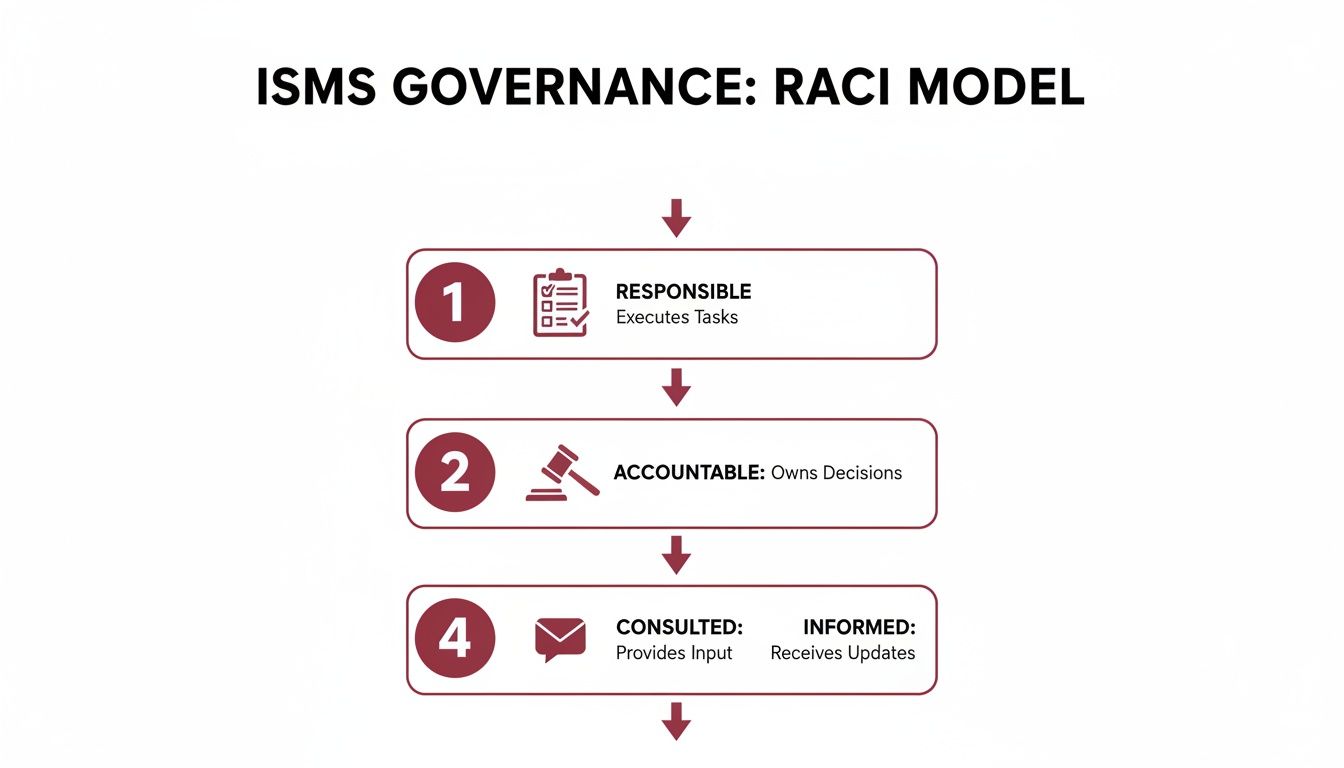
By clearly defining who is Responsible, Accountable, Consulted, and Informed, the model removes ambiguity and drives accountability across the business.
Phase 4: Internal Audits and Management Review
Finally, before you face an external certification audit, you need to kick the tyres on your own system. Phase 4 is all about verification and continuous improvement. An internal audit, conducted by someone impartial, will rigorously check if your ISMS is actually doing what your policies say it should and meeting the ISO 27001 standard.
The findings from this audit are then tabled at a formal management review meeting. This is far from a simple box-ticking exercise. It's a strategic checkpoint where leadership evaluates the ISMS’s performance, addresses any shortcomings, and allocates resources for improvement. This cycle of auditing and reviewing is what keeps your ISMS effective and aligned with the constantly changing business and threat environments.
Across Australia, public-sector cyber strategies are already embedding these ISMS principles, setting a clear precedent for what a national governance framework will likely demand by 2026. For instance, the Queensland Government reported a massive 68% growth in ISMS adoption across its organisations up to 2024, directly linking this success to its cyber security governance uplift program. This government-led adoption highlights just how vital this framework is becoming for all Australian businesses.
Measuring Success with Board-Level Reporting
Let’s be honest. An ISMS that can’t clearly show its worth is just seen as a cost centre, not the strategic asset it truly is. To get buy-in and prove your system is actually working, you have to translate all the complex, technical work into the language of business value. We’re talking risk reduction, operational resilience, and solid compliance assurance.
This is the final, crucial piece of the puzzle in making the master framework for Australian ISMS governance in 2026 a living, breathing part of your organisation.
Good board-level reporting cuts through the technical noise. It zeroes in on the metrics that answer the questions leadership actually cares about. Are we secure? Are we compliant? Is our security budget being spent wisely? Your entire goal is to paint a clear, concise, and data-driven picture of your security posture.
When you get this right, your ISMS transforms from a background IT function into a visible engine for business strategy. The moment the board sees how security protects revenue, opens up new markets, and builds customer trust, they don't just approve the budget—they become your biggest supporters.
Establishing Meaningful Security KPIs
The secret to powerful reporting is picking the right Key Performance Indicators (KPIs). You need to forget vanity metrics like the number of threats blocked. Instead, focus on indicators that directly reflect real-world risk and how effectively your team is operating. Your KPIs have to be specific, measurable, and directly tied to what the business is trying to achieve.
Think of it this way: good KPIs tell a story. They don't just spit out numbers; they give you genuine insight into your performance and shine a spotlight on areas that need attention.
For an Australian business navigating the landscape in 2026, a strong set of ISMS KPIs would look something like this:
- Vulnerability Management: What percentage of critical vulnerabilities are patched within our agreed Service Level Agreement (SLA)? Aiming for 95% within 14 days is a great start. This is a direct measure of how fast you’re closing known security gaps.
- Compliance Adherence: How many non-conformities (and how serious are they) are we finding in our internal audits? A downward trend here is concrete proof that your ISMS is maturing and getting stronger.
- User Awareness: What’s the click-rate on our simulated phishing emails? This gives you a tangible way to measure how well your security awareness training is reducing human risk.
- Incident Response: On average, how long does it take us to spot and contain a security incident? This KPI is a direct reflection of your organisation's resilience and its ability to stop the bleeding when things go wrong.
The ISMS Governance Dashboard
The absolute best way to communicate all of this is through a simple, visual ISMS governance dashboard. Think of it as a one-page summary designed specifically for busy, non-technical executives. Use clear charts and a simple traffic light system (red, amber, green) to make your entire security posture understandable in a single glance.
A well-designed dashboard doesn't just report numbers; it provides context. It should clearly show trends over time, benchmark performance against targets, and offer a brief executive summary of the key takeaways.
This kind of powerful reporting tool finally bridges the gap between your technical team and the boardroom. It delivers the assurance leadership craves and justifies the ongoing investment in your security program.
Building this level of transparent reporting is a cornerstone of any strong Governance, Risk, and Compliance (GRC) program. You can dive deeper into developing a comprehensive GRC and cyber security strategy to support these efforts.
By measuring what truly matters and communicating it clearly, you prove the immense value of your ISMS. You successfully shift the conversation from cost to value, cementing security as a core driver of business success and resilience.
Answering Your Burning Questions on Australian ISMS Governance
When you start digging into a unified security framework, a lot of practical questions pop up. It's only natural for business owners and IT managers to wonder about the real-world costs, legal hoops, and resources needed to build the master framework for Australian ISMS governance in 2026. Let’s tackle some of the most common questions we hear from Aussie businesses.
What’s the Real Cost of ISO 27001 Certification for a Small Business?
There’s no one-size-fits-all price tag. The cost for an ISO 27001 certification really depends on the size and complexity of your business, plus where you're starting from with your current security setup. For most small businesses, the investment breaks down into a few key buckets: fees for a consultant to guide you, the cost of the actual audit from the certification body, and any new tech you might need to get your controls up to scratch.
But thinking of this purely as a cost is missing the bigger picture. It's a strategic investment. What you spend is tiny compared to the value you get from slashing your breach risk, protecting your hard-earned reputation, and building serious trust with your customers. For many, certification becomes a key that unlocks doors to bigger contracts, especially with government and enterprise clients who won't work with anyone less secure.
Is the Essential Eight Something We Actually Have to Do?
Technically, the Australian Signals Directorate's (ASD) Essential Eight is only mandatory for federal government agencies. However, it's become the unofficial gold standard for cyber defence for everyone else in Australia. So, while you're not legally forced to adopt it, choosing to do so sends a powerful message that you take cybersecurity seriously.
Think of it as your first line of defence. Implementing the Essential Eight hardens your systems against the most common and damaging cyber attacks out there, like ransomware. If the worst does happen and you suffer a breach, being able to show you’ve implemented these controls proves you took reasonable steps to protect your data. That can make a world of difference during any regulatory investigations or liability discussions.
Can We Really Do This Ourselves, Without Bringing in Consultants?
Look, it’s possible to tackle this framework on your own, but it's a massive undertaking, especially if you don't have a team of governance and risk experts on hand. An experienced consultant has been through this process hundreds of times. They know the shortcuts, the common pitfalls, and how to avoid costly mistakes.
They make sure your Governance, Risk, and Compliance (GRC) foundation is solid from day one, which saves an incredible amount of internal time and headaches. Honestly, having an expert in your corner dramatically boosts your chances of sailing through the certification audit on your first go, getting you a much faster return on your security investment.
Navigating the world of ISO 27001 and building a robust ISMS can feel overwhelming, but you don’t have to go it alone. We've been guiding Australian small businesses through this exact process for years, helping them achieve compliance and rock-solid security. Let our experience make your journey a whole lot simpler. https://iso-27001.com.au
Recent Comments