

Quick Summary: ISO 27001 is the operational heart of Australian data privacy compliance. This guide explains how its global framework directly helps businesses meet the specific legal requirements of the Australian Privacy Act 1988, its Australian Privacy Principles (APPs), and the Notifiable Data Breaches (NDB) scheme, turning compliance into a strategic advantage.
Trying to connect the dots between a global standard like ISO 27001 and Australia’s local privacy laws can feel a bit like assembling a complex puzzle without the picture on the box. But here’s the straightforward truth: for any Australian business serious about data protection, ISO 27001 is the operational heart of your compliance efforts. It gives you a world-class framework to get your information security house in order.
When you put its controls into practice, you're not just aiming for an international certification; you're building the very foundation needed to meet the strict demands of Australian laws like the Privacy Act 1988. This guide provides in-depth, valuable information to answer your queries on how this regulatory hub works.
Your Guide to the Regulatory Hub: ISO 27001 and Australian Data Privacy Laws
In a world where a data breach can wreck your reputation overnight, just saying you take security seriously isn’t enough. You have to prove it. For businesses here in Australia, that means finding a smart way to blend global best practices with our own legal requirements. This is exactly where pairing ISO 27001 with Australian privacy law becomes your secret weapon.
Let’s use an analogy. Think of ISO 27001 as the master blueprint for building a fortress. It tells you exactly how to design the walls, where to put the guards, and what processes you need to keep it secure from any threat.
Australian privacy laws, like the Privacy Act 1988 and its Australian Privacy Principles (APPs), are the specific rules of engagement for what happens inside that fortress. They dictate how you must treat the personal information you're protecting. One gives you the "how-to" for security, while the other defines the "what" and "why" for privacy.
Bridging Global Standards with Local Rules
The goal isn't to create separate checklists for every single rule. That’s a recipe for confusion and wasted effort. The real win is building a single, cohesive system where your security practices naturally tick all the legal boxes. This is precisely what an Information Security Management System (ISMS)—the engine of ISO 27001—is designed to do.
An ISMS forces you to get methodical. It makes you:
- Pinpoint your actual risks: No more guessing. You have to systematically figure out what could go wrong with your information assets.
- Deploy the right controls: You then put practical security measures in place—from simple access controls to robust encryption—that directly address those risks.
- Constantly check your work: You monitor, audit, and review your security performance to make sure it's actually working and getting better over time.
- Build a security-first culture: It pushes security out of the IT department and makes it part of everyone's job description.
This structured approach is a perfect match for the APPs, especially APP 11, which legally requires you to take "reasonable steps" to protect personal information. An ISO 27001 certification isn't just a piece of paper; it’s tangible, verifiable proof that you are taking those reasonable steps. It shows that your security isn't just a policy gathering dust, but a living, breathing part of your business.
For anyone in a leadership role, navigating the evolving landscape of regulatory compliance is a constant challenge, and understanding this synergy is key. When you see it this way, compliance stops being a burden and starts becoming a powerful tool for building trust with customers and partners.
Connecting ISO 27001 with The Australian Privacy Act
Let's think of it this way: ISO 27001 is the technical blueprint for building a secure house, and the Australian Privacy Act is the set of rules for how you must look after the people and their personal belongings inside. One gives you the strong, risk-based framework to protect information; the other lays down the law on how you must handle personal details.
When you see how they work together, it all clicks.
Building an Information Security Management System (ISMS) based on ISO 27001 gives you the structured, logical foundation you need to meet your obligations under the Australian Privacy Principles (APPs). Instead of juggling two separate compliance headaches, you get a single, integrated strategy. It’s a much smarter and more efficient way to operate.
Fulfilling Your Legal Duty with a Global Standard
At the very heart of Australia’s data privacy law is Australian Privacy Principle (APP) 11. It states that Australian entities subject to the Act must take "such steps as are reasonable in the circumstances" to protect personal information from misuse, interference, loss, and unauthorised access, modification, or disclosure.
That phrase, "reasonable steps," can feel frustratingly vague. But this is precisely where ISO 27001 brings clarity.
An ISMS built on ISO 27001 doesn't just suggest good security practices; it demands a systematic process of identifying, assessing, and treating your specific information security risks. This is the kind of structured, documented approach that regulators like the Office of the Australian Information Commissioner (OAIC) want to see as proof of due diligence.
By implementing ISO 27001 controls, you are proactively defining what "reasonable steps" actually mean for your business. You move from a position of legal ambiguity to one of demonstrable, accountable control.
This diagram shows how ISO 27001 acts as a central hub, connecting a global standard with critical Australian laws like the Privacy Act and the Notifiable Data Breaches (NDB) Scheme.
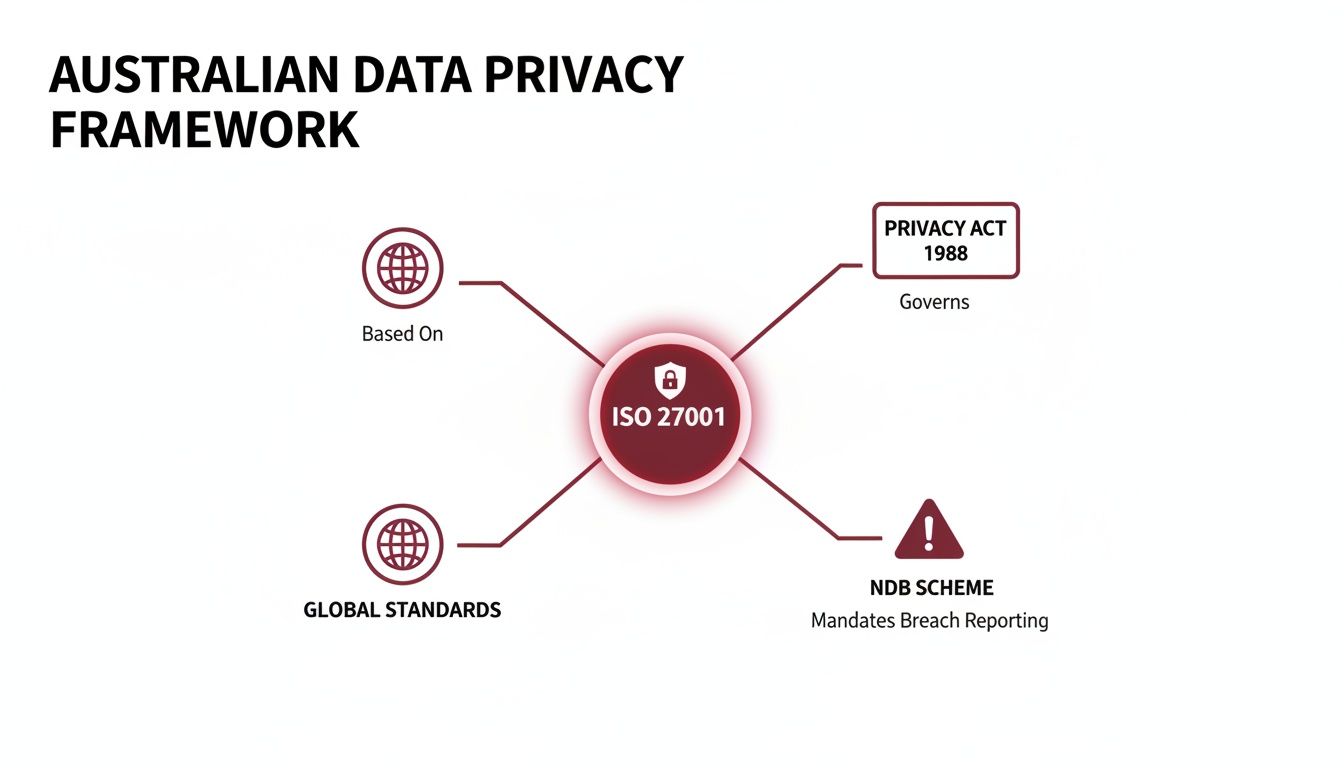
As you can see, by focusing on this one comprehensive security framework, your business can systematically tick off multiple legal requirements at once.
Mapping ISO 27001 Annex A Controls To Key Australian Privacy Principles
The real magic happens when you see how neatly the security controls in ISO 27001’s Annex A line up with the requirements of the APPs. The following table shows this direct link, illustrating how specific security measures help you satisfy your legal obligations under the Privacy Act 1988.
| Australian Privacy Principle (APP) | Core Requirement | Relevant ISO 27001 Annex A Control Example | How It Helps Achieve Compliance |
|---|---|---|---|
| APP 11: Security of Personal Information | Take "reasonable steps" to protect personal information from misuse, loss, and unauthorised access or disclosure. | A.5.15 Access Control: Enforce policies to manage access to information and applications based on business needs. | This directly prevents unauthorised access, a core tenet of APP 11. It ensures only the right people can see and handle sensitive data. |
| APP 8: Cross-border Disclosure | Ensure that overseas recipients of personal information handle the data with comparable privacy protections. | A.5.34 Protection of PII: Apply privacy and PII protection requirements according to applicable laws and regulations. | This control forces you to assess and apply appropriate protections when data leaves Australia, directly supporting your APP 8 obligations. |
| APP 6: Use or Disclosure | Only use or disclose personal information for the primary purpose it was collected for, unless an exception applies. | A.5.16 Identity Management: Manage the full lifecycle of identities to ensure access rights are appropriate and revoked when no longer needed. | Proper identity management prevents former employees or unauthorised users from accessing data, which in turn stops improper use or disclosure. |
| APP 1: Open and Transparent Management | Have a clear and up-to-date policy about the management of personal information. | A.5.1 Information Security Policy: Define and communicate a clear set of policies for information security, approved by management. | Your ISO 27001 policy documents form the backbone of your public-facing privacy policy, providing the transparent framework required by APP 1. |
| APP 11.2: Destruction/De-identification | Destroy or de-identify personal information when it is no longer needed. | A.8.10 Information Deletion: Implement processes to securely delete information when it is no longer required. | This operational control ensures you have a systematic process for data disposal, directly fulfilling the data lifecycle requirements of APP 11.2. |
This alignment isn’t a coincidence; it’s a reflection of a shared global goal to protect the integrity and confidentiality of personal information. By embedding ISO 27001 controls into your operations, you are building the exact security posture the Australian Privacy Act demands.
The market data confirms ISO 27001's role as the regulatory hub for Australian data privacy laws. Global projections value the certification market at USD 21.42 billion in 2026, with expectations for it to surge to an incredible USD 74.56 billion by 2035. This trend is particularly strong in the Asia-Pacific region, the fastest-growing area for new certifications.
Here in Australia, small and medium businesses are feeling the heat from the OAIC, which is actively enforcing the NDB scheme and saw over 1,500 breach notifications in 2023 alone. You can discover more insights about these market trends and what they mean for local businesses.
By adopting ISO 27001, your organisation doesn't just get a certificate to hang on the wall. You build a resilient, defensible security posture that stands up to the scrutiny of auditors and regulators, creating a rock-solid foundation of trust for your brand.
How ISO 27001 Prepares You for The NDB Scheme
Think of Australia’s Notifiable Data Breaches (NDB) scheme as a fire drill for your data security. When a breach hits, the alarm bells are ringing and the clock is ticking. You either have a plan, or you have chaos. This is where ISO 27001 comes in—it’s the crisis-ready framework that ensures you’re not just reacting, but responding with confidence.
An Information Security Management System (ISMS) built around ISO 27001 gives you a documented, tested, and repeatable process for handling security incidents. It provides the muscle memory your business needs to navigate the intense pressure of the NDB scheme without fumbling.
Meeting the NDB Scheme’s Core Demands
Under the NDB scheme, specific Australian entities have strict obligations if they suffer an "eligible data breach"—one that’s likely to cause serious harm to individuals. You must quickly assess the situation, notify those affected, and report it all to the Office of the Australian Information Commissioner (OAIC).
The real pressure point for most businesses is that initial assessment. You get a maximum of 30 calendar days to figure out if a suspected breach is bad enough to require notification. Without a solid plan in place, that 30-day window slams shut with alarming speed, often leading to panicked decisions and compliance failures.
This is exactly where ISO 27001’s incident management controls prove their worth.
ISO 27001 turns incident response from a reactive scramble into a proactive, well-oiled process. It gives your team the confidence and clarity to act decisively, meet legal deadlines, and minimise the fallout.
This readiness couldn't be more critical. The Australian Cyber Security Centre (ACSC) fielded over 94,000 cybercrime reports last year alone—a massive 23% jump. With threats like ransomware becoming commonplace, a structured response plan is no longer a nice-to-have; it's a fundamental part of doing business in Australia. If you want to dive deeper, you can find more detailed information on Australian cybercrime statistics.
How ISO 27001 Incident Controls Align with NDB
The Annex A controls in ISO 27001 are essentially a blueprint for building a rock-solid incident response capability. They line up perfectly with what the NDB scheme demands, helping you turn legal text into practical, everyday procedures.
- A.5.24 Information Security Incident Management Planning and Preparation: This is your foundation. It forces you to establish and document exactly who does what when a crisis hits, so there’s no confusion on the day.
- A.5.25 Assessment and Decision on Information Security Events: This control gives you a clear methodology for evaluating an event to see if it’s a genuine incident. It directly supports that tight 30-day NDB assessment window, giving you a structured way to make the right call.
- A.5.26 Response to Information Security Incidents: This is about stopping the bleeding. The control covers containment, eradication, and recovery, ensuring you can limit the damage, fix the root cause, and get back to business—all vital for avoiding the "serious harm" trigger in the NDB scheme.
- A.5.27 Learning from Information Security Incidents: ISO 27001 demands you learn from your mistakes. A post-incident review helps you figure out what went wrong so you can strengthen your defences, showing regulators you’re serious about continuous improvement.
With a well-structured ISMS, your team isn't left asking "what now?" during a breach. They're executing a plan they already know. This systematic approach is the backbone of any effective data breach response plan that stands up to Australian legal scrutiny. By embedding these ISO 27001 controls into your business, you’re not just prepping for an audit—you’re building the resilience you need to survive a real-world security crisis.
Your Action Plan for Implementation and Gap Analysis
Alright, so you understand the theory behind how ISO 27001 and Australian privacy laws overlap. Now comes the real work: turning that knowledge into a concrete plan. The key here is to avoid getting overwhelmed. This isn't about trying to boil the ocean; it's about taking a methodical, step-by-step approach. For any Australian business, that journey starts with a solid gap analysis.
Think of it like planning a road trip. Before you even start the car, you need to know where you are and where you're going. A gap analysis is your map—it shows you precisely where your current security practices stand against the combined demands of ISO 27001 and the Privacy Act. Skipping this step is a recipe for wasted time, money, and effort, leaving you to plug holes you didn't need to while missing the ones that could sink you.

Conducting Your Initial Gap Analysis
So, what does this actually involve? A gap analysis is a systematic deep-dive, comparing what you’re currently doing against every single clause and control in the ISO 27001 standard. It’s an honest look in the mirror that gives you a clear, prioritised to-do list for getting compliant.
You'll want to tackle it from three main angles:
- Documentation Review: What policies do you already have? Dig up everything related to access control, data handling, or how you respond to incidents. It's time to gather every security-related document you can find and see what holds up.
- Operational Assessment: This is where the rubber meets the road. What actually happens day-to-day? Get on the floor, talk to your people, and observe your processes. You need to understand the reality, not just the polished version written down in a policy somewhere.
- Legal Alignment: Now, let's put on our legal hats. How do your current security measures stack up against the Australian Privacy Principles (APPs)? This is where you specifically connect the dots between your security controls and your legal duties.
If this is your first time navigating this process, getting a handle on how to perform a gap analysis is genuinely the most important thing you can do to set yourself up for success.
A Phased Implementation for Australian Businesses
With your gap analysis complete, you’ll have a clear picture of what needs doing. Now you can build a sensible, phased implementation plan. For most businesses, especially smaller ones, trying to do everything at once is a fast track to burnout. A phased approach lets you focus on the highest-impact areas first, delivering the biggest compliance wins right away.
Here’s a practical way to break it down:
- Phase 1: Foundation Building: Start with the essentials. This is about establishing your core governance, like drafting your main Information Security Policy and defining the scope of your system. A critical document you'll create here is the Statement of Applicability (SoA)—it lists every ISO 27001 control and your justification for including or excluding it.
- Phase 2: High-Risk Mitigation: Jump on the most urgent gaps you found. This usually means tackling critical controls like robust access management (A.5.15), data encryption (A.8.24), and getting some solid security awareness training in place for your team.
- Phase 3: Operational Integration: Now you start weaving the remaining controls into the fabric of your daily business. This is where you'll formalise your risk assessment process and create a Risk Treatment Plan detailing exactly how you'll handle each risk you've identified.
- Phase 4: Review and Refine: The job is never truly done. This final phase involves running internal audits and management reviews to make sure everything is working as it should and to find ways to improve. It’s your dress rehearsal for the final certification audit.
By prioritising controls that directly address both ISO 27001 requirements and APP 11 obligations—like encryption and access controls—you achieve dual compliance efficiently, turning a daunting project into a series of achievable milestones.
Prioritising Controls for Maximum Privacy Impact
When it comes to satisfying Australian data privacy laws, not all security controls carry the same weight. You want to get the best bang for your buck by focusing on controls that give you clear, undeniable proof that you're taking "reasonable steps" to protect personal information. A huge part of this is building strong internal programs, and it's well worth exploring actionable training in compliance strategies to get your team truly up to speed.
Start by zeroing in on these key controls:
- Employee Training (A.6.3): Your people are your first and last line of defence. Regular, practical training on their privacy responsibilities is one of the single most effective security measures you can implement.
- Vendor Management (A.5.19 to A.5.23): You’re only as strong as your weakest link. If you share data with third parties, getting your supplier security policies in order is absolutely essential for complying with APP 8 (cross-border disclosure).
- Data Encryption and Masking (A.8.24): This is a big one. Implementing strong encryption is hard, technical evidence that you are actively protecting data from prying eyes. It’s tough to argue with.
By taking this structured, step-by-step approach, you can build a security framework that not only gets you that ISO 27001 certificate but also stands as a rock-solid foundation for meeting your Australian data privacy obligations.
Successfully Navigating The ISO 27001 Audit in Australia
Getting that ISO 27001 certificate is the end goal, but first, you have to get through the formal audit. Let's be honest, it can feel a bit daunting. In Australia, this isn't just a box-ticking exercise. It’s a deep dive into how well your security practices are actually woven into the fabric of your daily operations.
Auditors are looking for a living, breathing Information Security Management System (ISMS), not a pristine folder of policies gathering dust. To get through it, you need to prove your ISMS is an active part of your business culture. It’s your chance to show a clear, undeniable line between your security controls and your legal duties under Australian data privacy laws. You're not just showing them you know the rules—you're proving you live by them.
Understanding the Two-Stage Audit Process
The road to ISO 27001 certification here in Australia follows a standard two-stage external audit, always carried out by an accredited certification body. Think of it as a preliminary check-up followed by a full-body inspection.
-
Stage 1 Audit (Documentation Review): This is basically a readiness check. The auditor pores over your core ISMS documentation—things like your risk assessment methodology, Statement of Applicability (SoA), and key policies. They’re making sure you have a complete and compliant framework on paper, ready for the real-world test.
-
Stage 2 Audit (Implementation Review): Now it gets real. The auditors come on-site (or do a very detailed remote review) to see if your ISMS is working as you claimed. They’ll chat with your staff, watch your processes in action, and dig through records to find hard evidence that your security controls are in place and doing their job.
This is where all your hard work preparing really shines. The auditor needs to see that your team gets their security responsibilities and that your controls are applied consistently, everywhere in the business.
What Australian Auditors Look For
Local auditors are all about substance over style. They couldn't care less about beautifully formatted documents; what they want to see is practical, effective security management that genuinely reduces risk. Your ISMS needs to be a dynamic tool, not a static monument.
A huge piece of the puzzle is demonstrating a solid connection to local laws. Auditors will absolutely expect you to explain how your ISMS helps you meet your obligations under the Privacy Act 1988. You need to be ready to walk them through how a specific control, like your incident response plan, directly supports your compliance with the Notifiable Data Breaches (NDB) scheme.
An auditor’s main goal is to walk away confident that your ISMS is a reliable, ongoing program for managing information security. Nothing is more persuasive than showing them you’re proactive about both the standard and your local legal duties.
The intersection between security and privacy law is only getting sharper. The auditing scene in Australia is now laser-focused on the real-world integration of security with data privacy compliance. Top auditors are looking for tangible cybersecurity outcomes, not just paper trails, especially with the ISO 27001:2022 transition deadline of 31 October 2025 getting closer every day.
The stakes are high. One regional bank had its certification suspended after missing a surveillance audit by just six weeks, which led to losing a $2 million AUD contract. It’s a stark reminder of how critical it is to stay on top of the continuous audit cycle.
Preparing to Excel in Your Audit
Passing the audit is great. Excelling is even better. It builds massive confidence with your stakeholders and cements your reputation. To make sure you’re more than ready, focus on these practical steps:
- Conduct Thorough Internal Audits: Before the external auditors even book their flights, you need to audit yourself. A tough, honest internal audit is like a full dress rehearsal—it’ll uncover any weak spots and give you time to fix them.
- Hold a Management Review: Get your leadership team in a room to review how the ISMS is performing. This isn't just for show; it demonstrates genuine top-level buy-in and proves to the auditor that security is taken seriously from the very top down.
- Gather Your Evidence: Get all your records, logs, and documents organised so the auditor can find what they need without a fuss. We're talking about everything from meeting minutes and training records to incident reports and access control reviews.
When you walk into your audit organised, prepared, and with a deep understanding of how your security system upholds Australian privacy principles, you’re not just passing a test. You’re demonstrating a mature, effective, and professional security posture.
For a deeper look into the process, you can explore our detailed guide on the specifics of the ISO 27001 audit and what to expect.
Gaining a Strategic Advantage in The Australian Market
Let’s be honest. Many businesses see standards like ISO 27001 as just another compliance hoop to jump through. But that's a missed opportunity, especially here in Australia. Treating ISO 27001 as the central pillar for your data privacy efforts isn't just about ticking boxes; it's one of the smartest strategic moves you can make.
In a market where trust is everything, weaving together world-class information security with local privacy rules sets you apart. This isn’t just about dodging fines. It's about building rock-solid customer confidence, giving you a powerful selling point that actually matters to clients who are more nervous than ever about how their data is handled. This becomes a massive competitive edge, particularly when you're bidding for government work or partnering with big corporations that demand proven security credentials.
From Box-Ticking to Business Excellence
The real magic happens when you move beyond a reactive, compliance-first mindset and start building a proactive culture of security. A box-ticking exercise might keep the regulators happy for a little while, but embedding security into your company’s DNA creates an organisation that’s resilient, agile, and genuinely trustworthy.
Making that leap really comes down to a few key things:
- Championing Security from the Top: This can't be just an "IT problem." Your leadership team has to see information security as a core business function, just as critical as finance or sales.
- Empowering Your Team: When every single employee understands their role in protecting sensitive data, your entire workforce becomes your strongest security asset. It's about building awareness and ownership.
- Demonstrating Due Diligence: A certified ISMS is the ultimate proof. It’s a clear, objective signal to partners, clients, and regulators that you are absolutely serious about your data protection responsibilities.
In Australia’s competitive economy, deliberately aligning ISO 27001 with our local privacy laws is your secret weapon. It turns what feels like a legal burden into a genuine strategic advantage that builds trust and opens doors.
Ultimately, this whole approach is about future-proofing your business. When you build your operations on the solid foundation of ISO 27001, you're creating a framework that can easily adapt to new threats and changing regulations. You’re not just playing by today's rules; you're getting your organisation ready for whatever comes next.
Got Questions? We’ve Got Answers.
When you're trying to align a global standard with local laws, questions are bound to pop up. Let's tackle some of the most common ones we hear from Australian business owners trying to make sense of ISO 27001 and our local data privacy laws.
Is ISO 27001 Something We Have to Do in Australia?
Straight up, no. ISO 27001 certification isn't legally mandatory for most businesses down under. But don't let that fool you—it's fast becoming a commercial necessity.
Think of it as the gold standard for information security. If you want to work with government departments or land contracts with the big players, you'll often find certification is a non-negotiable part of the tender. More importantly, it provides solid, independent proof that you're taking the "reasonable steps" needed to protect personal information under the Australian Privacy Act 1988.
Is This Standard Just for Big Corporations?
Not at all. One of the best things about ISO 27001 is that it's built to scale. It works just as well for a five-person startup as it does for a multinational bank.
The whole point is that you define the scope of your Information Security Management System (ISMS) based on what makes sense for your business, your size, and your tolerance for risk. For a small business, this means you can laser-focus on protecting your most vital information, skipping the complexity a massive enterprise might need. It’s all about putting in place controls that are right-sized for your specific risks.
How Long Does This Whole Certification Process Take?
There's no single answer here, as it really depends on a few things:
- Your business size and complexity: A larger company with more moving parts will naturally have a longer road than a small, lean business.
- Where you're starting from: If you've already got some decent security habits, you're well ahead. If you're starting from square one, it'll take more time.
- Resources you can commit: The more people and management buy-in you have, the faster things will move.
As a rough guide, a small to medium-sized Australian business should probably budget for anywhere between 6 to 12 months. This timeframe usually covers everything from the initial gap analysis and implementing new controls, right through to the two-stage external audit.
By treating ISO 27001 as the central hub for all your Australian data privacy obligations, you shift it from a box-ticking exercise to a genuine strategic investment. This mindset doesn't just get you ready for certification; it builds a rock-solid security foundation that keeps you on the right side of the law and gives you a real leg up in the Australian market.
Ready to turn compliance headaches into a competitive advantage? At Anitech, we specialise in guiding Australian small businesses through the ISO 27001 certification process with a 100% success rate. Let our 20 years of experience make your journey to compliance a whole lot simpler.
Discover how Anitech can help you achieve ISO 27001 certification.
Recent Comments