

TL;DR: This guide is your complete roadmap for achieving ISO 27001 certification in Australia by 2026. We break down the entire lifecycle, from defining your ISMS scope and conducting a risk assessment to implementing Annex A controls and navigating the final audit, providing a definitive framework for Australian business resilience.
This guide provides the ultimate framework for getting your Australian business ISO 27001 certified in 2026. We will break down the entire process into clear, manageable stages—from scoping and risk assessment right through to control implementation and the final audit. Think of it as your roadmap to strengthening security, winning client trust, and staying ahead of growing compliance demands.
In Australia today, ISO 27001 certification isn't just a "nice-to-have" anymore; it has become a core business requirement. A string of high-profile data breaches has completely changed the game. Clients, partners, and government bodies now demand proof of robust information security, making it a non-negotiable part of doing business.
This guide will demystify the Information Security Management System (ISMS). We'll cut through the jargon and show you exactly how it works as a powerful, strategic tool for any Australian business ready to take data protection seriously.
Why ISO 27001 Is No Longer Optional for Australian Businesses
The conversation around cybersecurity in Australia has moved from the server room to the boardroom. It's no longer just a technical issue for the IT team to handle. With mounting regulatory pressure and fierce customer demand, information security is now a top-level business priority. Pursuing ISO 27001 is the most direct and effective way to respond to this new reality.
This standard gives you far more than a certificate to hang on the wall. It provides a structured, globally respected method for managing your information security. When you adopt this framework, you’re sending a clear signal to the market: you are serious about protecting sensitive data. That’s a massive differentiator when you’re competing for contracts, especially with government agencies or large corporations who won't take the risk on an uncertified partner.
The New Currency of Trust
We've all seen the headlines. The consequences of weak data protection are severe, and the public's patience has worn thin. Between 2020 and 2024, Australia saw one of the sharpest rises in ISO 27001 adoption in the entire Asia-Pacific region. This surge was a direct reaction to major corporate breaches that exposed the personal data of over 20 million Australians.
It’s no surprise, then, that local certification bodies have seen ISO 27001 certifications grow faster than any other major ISO standard. One provider reported a staggering 17.56% year-on-year increase. This isn't just a statistic; it's a fundamental shift in business expectations. Simply claiming you're secure doesn't cut it anymore. Stakeholders want to see the proof.
Moving Beyond a Tick-Box for a True Competitive Edge
While compliance is often the initial driver, the real value of certification goes much deeper. Implementing an ISMS forces your entire organisation to systematically find and fix security weaknesses. The result? A much stronger, more resilient business.
Here are the key strategic benefits businesses gain time and time again:
- Rock-Solid Client Confidence: Certification is a powerful trust signal. It assures clients and partners that their data is handled according to the world's best practices.
- Dramatically Reduced Breach Risk: By proactively managing your security risks, you significantly lower the odds of a costly data breach and the financial and reputational nightmare that follows.
- Smarter Internal Processes: The framework demands clear documentation and defined responsibilities. This naturally leads to more efficient, secure, and streamlined operations across the board.
- Unlocking New Market Opportunities: Many tenders, especially in the government and enterprise sectors, now list ISO 27001 as a mandatory requirement. Certification gets you in the door.
To get a clearer picture of the journey, let’s look at the end-to-end certification process. We’ve broken it down into a simple table to give you a quick roadmap.
Your ISO 27001 Journey at a Glance
| Phase | Key Activities | Primary Outcome |
|---|---|---|
| Phase 1: Plan & Scope | Define the scope of your ISMS, secure management buy-in, conduct a gap analysis, and create a formal project plan. | A clear understanding of what needs to be protected, the resources required, and a roadmap for implementation. |
| Phase 2: Implement & Document | Develop security policies, conduct a risk assessment, select and implement Annex A controls, and create all necessary documentation. | A fully functioning Information Security Management System that addresses identified risks and meets standard requirements. |
| Phase 3: Audit & Certify | Conduct internal audits, perform a management review, select a certification body, and undergo the two-stage external audit. | Official ISO 27001 certification, demonstrating compliance and a commitment to ongoing security improvement. |
This table shows how each phase builds on the last, moving you methodically towards your goal. It’s a structured path, not a chaotic scramble.
The visual below also helps illustrate this high-level journey, breaking it down into its three core phases.

This simple roadmap shows how strategic planning flows into hands-on implementation, which is then verified through a tough but fair auditing process.
Ultimately, this is about more than just passing an audit. It’s about embedding a culture of security deep into your organisation’s DNA. For a closer look at the core concepts, our guide on what is ISO 27001 covers the essentials. This commitment to continuous improvement is what turns the ISMS from a one-off project into a lasting business asset.
Defining Your ISMS Scope and Strategy
Right out of the gate, you’ll make the single most important decision of your entire ISO 27001 journey: defining the scope of your Information Security Management System (ISMS). This one choice has a bigger impact on your project's complexity, cost, and timeline than anything else.
Nail the scope, and you’ve laid a rock-solid foundation. Get it wrong, and you’re signing up for a project that will likely blow its budget and never quite deliver what you need.
Think of your scope as the protective boundary you draw around your most vital information. Everything inside this line has to meet the ISO 27001 standard. Everything outside of it doesn't. Your goal is to make this boundary as lean as possible while still protecting the sensitive data and systems that your business, clients, and partners depend on.
One of the most common pitfalls is businesses trying to certify the entire organisation at once. This "boil the ocean" approach is a recipe for burnout. A far smarter play is to start with your crown jewels—the specific products, services, or departments that handle your most sensitive information or are under the most pressure from customers to be certified.

Scoping Scenarios for Australian Businesses
Let’s get practical. Here’s how this looks on the ground for different types of Australian businesses.
- The Melbourne SaaS Provider: Imagine a software company with a cloud-based HR platform. Their clients are Aussie businesses trusting them with very sensitive employee records. A clever scope would be to certify only the production environment hosting the app, its database, and the dev team that looks after it. This carves out corporate functions like their own internal HR and finance, which can always be added later.
- The Perth Government Contractor: A consulting firm works with state government departments, and their contracts demand rock-solid security. Here, the scope must cover all people, systems, and processes touching project delivery. We're talking everything from the consultants' laptops to the specific cloud storage they use for client files.
- The Brisbane E-commerce Retailer: This online store handles thousands of credit card payments every day. The most critical zone is their payment processing gateway and the customer database. They could scope their ISMS to wrap around just these systems and the people managing them, which helps with PCI DSS compliance and builds huge customer trust at the same time.
As you can see, scoping is a business decision, not just an IT one. You have to weigh up your contracts, what your customers expect, and the unique risks your business faces.
Securing Management Buy-In
Once you've mapped out a proposed scope, your next big hurdle is getting genuine commitment from the top. This is where so many ISO 27001 projects falter. To get this across the line, you need to frame the project as a business enabler, not a cost centre.
Don't walk into the boardroom talking about Annex A controls. That's a surefire way to see eyes glaze over.
Instead, talk their language: commercial outcomes. Explain how certification unlocks bigger government and enterprise contracts that are currently out of reach. Put a number on the potential cost of a data breach and position the ISMS as a powerful insurance policy against both financial loss and reputational ruin.
A well-defined ISMS is more than a compliance tick-box; it's a strategic asset that builds trust in the market, slashes commercial risk, and fuels sustainable growth. When you tie security directly to business goals, a perceived cost transforms into a clear competitive edge.
Use recent Australian data breach stats to make the threat feel real. Talk about business resilience and client retention. Once the leadership team understands that the ultimate framework for ISO 27001 certification in Australia (2026) is about protecting revenue and enabling growth, that chat about budget and resources becomes a whole lot easier.
Assembling Your Project Team
Let's be clear: no one person can deliver ISO 27001 on their own. You need a dedicated, cross-functional team to push this forward. The team doesn't need to be huge, but it absolutely must have the right mix of skills and authority.
Your core team should have these key players:
- Project Sponsor: A senior leader (think CEO or CIO) who acts as the project's champion, clearing roadblocks and taking ultimate accountability.
- Project Manager: The person on the ground, responsible for planning, tracking the work, and keeping everyone aligned.
- Technical Lead: Your IT or security guru who knows the systems inside your scope and can spearhead the technical controls.
- Department Representatives: Key people from the teams inside the scope (like software development, HR, or legal). They provide crucial context and help drive adoption within their own departments.
This kind of structure ensures every decision is made with a 360-degree view of the business. It also creates a sense of shared ownership, which is absolutely vital for making the changes stick long-term.
Mastering Your Risk Assessment and Treatment Plan
If scoping is about drawing the map of your security territory, then risk assessment is about sending out the scouts to find the dangers. This isn't just a box-ticking exercise; it's genuinely the core of your Information Security Management System (ISMS). It's where the theory of ISO 27001 gets real and becomes a powerful tool to keep your business running, no matter what.
Many businesses get completely bogged down at this stage. They overcomplicate things until it feels like an insurmountable mountain of work. But it doesn't have to be.
The goal is pretty straightforward: figure out what could go wrong with your information, understand the odds of it happening, and then make some smart, deliberate decisions to stop it.
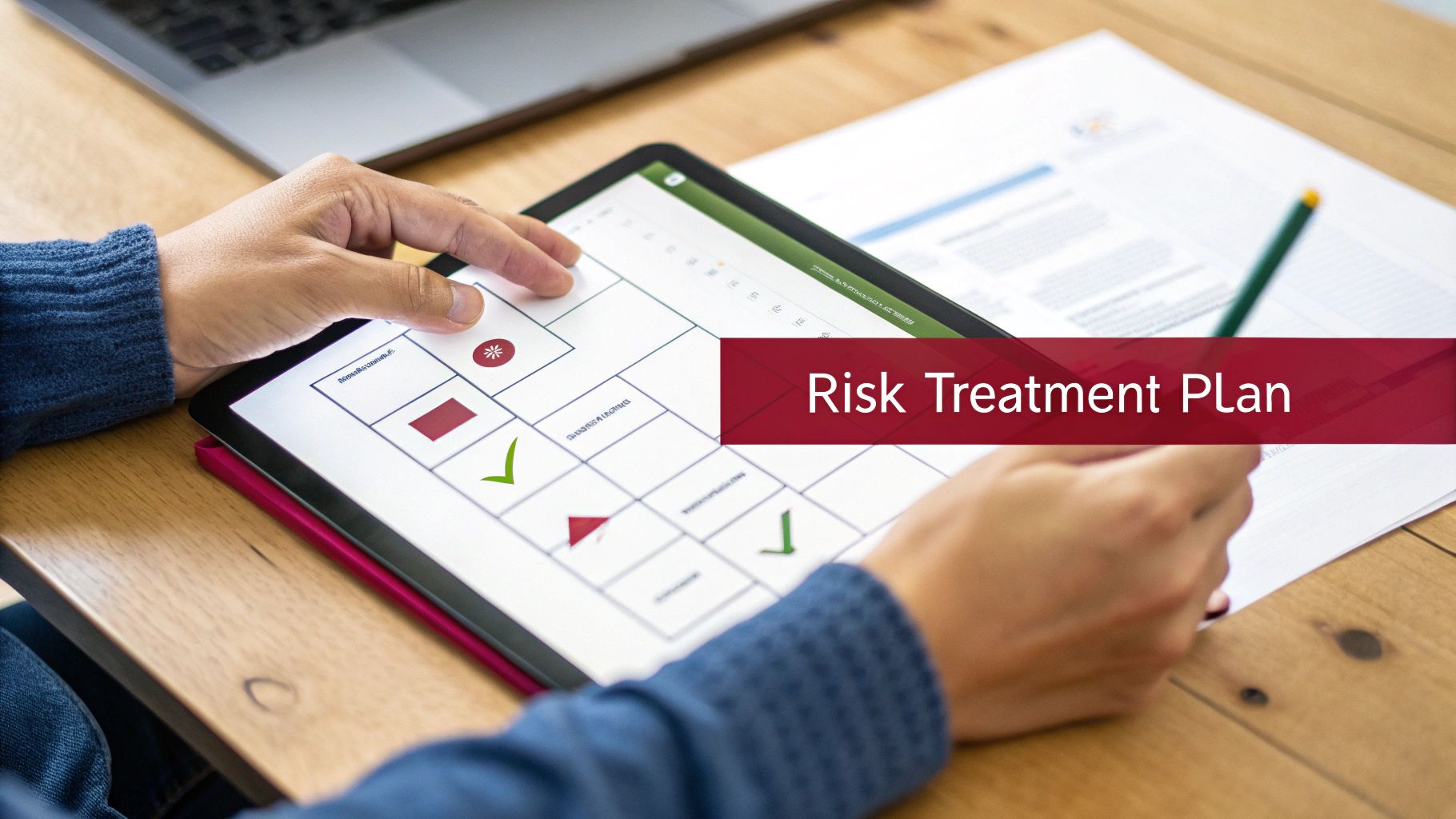
This entire process is grounded in proactive security risk management. You're not just reacting to incidents; you're methodically identifying, assessing, and treating threats before they can cause real damage. It’s all about making informed choices.
Identifying Your Critical Information Assets
First things first: you can't protect what you don't know you have. Your initial task is to create a detailed inventory of every information asset that falls within the scope you’ve just defined.
And don't just think about the obvious hardware like servers and laptops. Your assets are so much more than that. We're talking about:
- Data: The lifeblood. Customer databases, your unique IP, employee records, financial reports.
- Software: Your core business applications, operating systems, and any development tools you rely on.
- Physical Infrastructure: The office itself, server rooms, and even the network cabling in the walls.
- People: Never forget this one. Your employees and contractors, along with their knowledge, are some of your most valuable—and vulnerable—assets.
- Services: Those critical third-party services like AWS or Microsoft 365, your internet connection, and even the power grid.
For every single asset, assign an owner. This needs to be a real person who is responsible for its day-to-day protection. This simple step is a cornerstone of a well-run ISMS because it creates clear accountability.
Analysing Threats and Vulnerabilities
Okay, you've got your asset list. Now it's time to put on your pessimistic hat and play the "what if" game. For each of your critical assets, you need to brainstorm potential threats and vulnerabilities, keeping the Australian business landscape in mind.
It helps to be clear on the terms:
- A threat is something that could happen. Think a ransomware attack, a flash flood in your server room, or an employee accidentally CC'ing the wrong person on a sensitive email.
- A vulnerability is a weakness that a threat could exploit. This could be unpatched software, a lack of staff security training, or not having a backup generator.
Imagine a financial services firm based in Sydney. A very real threat is a sophisticated phishing campaign targeting their accounts team. A corresponding vulnerability? The team hasn't received any recent training on how to spot these clever, AI-powered phishing emails that are now so common.
Risk lives at the intersection of a threat and a vulnerability. You can't stop every threat from existing, but you can systematically patch up your vulnerabilities to make it much harder for those threats to do any real harm. That's the whole game.
Developing Your Risk Treatment Plan
Once you’ve identified and sized up your risks, you have to decide what to do about them. This is where your Risk Treatment Plan (RTP) comes in. Frankly, it’s one of the most critical documents you'll create for your ISMS.
For every significant risk, you have four main options. The right choice will always depend on your company’s specific risk appetite, budget, and resources.
Choosing Your Risk Treatment Strategy
Deciding how to handle each risk is a strategic decision. This table breaks down your four options to help you choose the most appropriate path for your business.
| Treatment Option | What It Means in Practice | Australian Business Example |
|---|---|---|
| Mitigate (Treat) | Implement security controls to reduce the likelihood or impact of the risk. This is what you'll do 90% of the time. | A Melbourne-based software company rolls out multi-factor authentication (MFA) across all systems to crush the risk of unauthorised account access. |
| Accept | Formally acknowledge the risk and decide to live with it, usually because the cost of fixing it is higher than the potential damage. | A small online retailer accepts the minor risk of a temporary website outage, deciding the cost of a fully redundant hosting setup isn't justifiable. |
| Transfer (Share) | Shift the financial impact of a risk to a third party. This almost always means insurance or outsourcing. | A Perth-based law firm takes out a comprehensive cyber insurance policy to transfer the enormous financial risk of a major client data breach. |
| Avoid | Stop doing the activity that creates the risk in the first place. This is the most extreme option and is often not practical. | A healthcare provider in Brisbane decides against using a third-party transcription service due to data privacy concerns, keeping the work in-house. |
Ultimately, your RTP is your roadmap for action. It will list every risk you've identified, its severity, the treatment you've chosen, the specific controls you'll use (many will come from Annex A), who is responsible for getting it done, and a deadline.
This plan becomes your to-do list for building a truly resilient business. It’s a living document that connects your high-level strategy directly to the practical, on-the-ground work of securing your company, making it a key part of the ultimate framework for ISO 27001 certification in Australia (2026).
Bringing Your Plan to Life: Implementing Controls and Documentation
You’ve done the hard yards on planning, and now it’s time to get your hands dirty. With your Risk Treatment Plan as your blueprint, you'll start turning strategy into real-world action. This is where you build the actual security measures and create the paper trail to prove they exist.
For many Aussie small businesses, this is the part that can feel a bit daunting. You're juggling resource limits and maybe some technical jargon that feels a bit out of your depth. But don't worry—a methodical, step-by-step approach is all you need.
Think of it as building the engine of your Information Security Management System (ISMS). You're not just ticking boxes; you're actively configuring systems, updating software, and putting formal processes in place where you might have had informal habits before. Every single action is about systematically knocking down those risks you identified until they’re at a level your business is comfortable with.
Creating Documents People Will Actually Use
Let's be honest, ISO 27001 demands a fair bit of documentation. The key is to avoid creating a library of binders that just gather dust. Your policies and procedures need to be living, breathing documents—clear, simple, and genuinely helpful for your team. If they're too long or full of corporate buzzwords, people won't use them, and an auditor will see right through it.
The absolute cornerstone of all this paperwork is your Statement of Applicability (SoA). It’s a non-negotiable, and it’s critical. This document lists all 93 controls from Annex A, and for each one, you have to state three simple things:
- Whether you’ve put the control in place.
- A quick justification for why you have (or haven't).
- A signpost pointing to the policy, procedure, or system that proves it's implemented.
Think of the SoA as the master index for your entire ISMS. It’s the bridge connecting your risk assessment to your day-to-day security measures, and it’s usually one of the very first things an auditor will ask to see.
From there, you'll need a handful of practical policies that your team can understand and follow. You’ll have a main Information Security Policy, but the real value is in the supporting documents, like:
- Access Control Policy: Who gets the keys to what? This policy spells it out.
- Acceptable Use Policy: Clear, simple rules for using company tech and data.
- Incident Response Plan: A step-by-step playbook for when things go wrong.
Your goal isn't to write a PhD thesis on security. An auditor would much rather see a simple, two-page policy that everyone in your company actually follows than a 50-page masterpiece that nobody has even opened.
Your People are Your Strongest Defence
You can have the best firewalls and the fanciest software in the world, but your security is only as strong as your people. Your team is your most valuable asset, but they can also be your biggest vulnerability if they aren't engaged. Building a genuine security-first culture isn't a "nice-to-have"; it's a fundamental part of the ultimate framework for iso 27001 certification in australia (2026).
This all starts well before someone even joins your team. A solid pre-employment screening process is a crucial control, forming the first line of defence by helping you hire trustworthy people from the get-go.
Once they're on board, security training can't be a one-and-done PowerPoint during their first week. It has to be an ongoing conversation that keeps security front and centre in everyone's mind.
How to Make Security Awareness Stick
To really embed this stuff, you have to get creative and move beyond the boring stuff.
- Run Phishing Drills: Send out simulated phishing emails on a regular basis. When someone clicks, use it as a gentle, immediate coaching moment. It’s one of the most powerful training tools out there.
- Talk About Real-World Breaches: Did you see that story about the Aussie company that got hit with ransomware? Talk about it in your team meetings. Break down how it happened in plain English and connect it back to the protections you have in place.
- Make it a Game: A bit of friendly competition goes a long way. Use quizzes or create a leaderboard for completing security training modules to boost engagement.
- Appoint Security Champions: Find those people in your teams who are naturally enthusiastic about this stuff. Empower them to be the local go-to person for security questions and best practices.
When you weave security awareness into the fabric of your daily work, your ISMS stops being a set of documents and becomes a living, breathing part of how you do business. This doesn't just keep the auditors happy—it builds a tougher, more resilient business from the inside out.
Navigating Audits and Achieving Certification
You've done the hard yards. Your Information Security Management System (ISMS) policies are written, and your controls are in place. Now comes the final leg of the journey: proving it all works in the real world. This is where you have to successfully navigate the audit process.
This final phase is all about meticulous preparation and showing genuine confidence in the framework you’ve built. It’s a bit like a dress rehearsal—you’ll run a full internal audit to find and fix any issues yourself before the external auditors even get a look in.
The Critical Role of the Internal Audit
Before an external auditor sets foot in your office, you have to audit yourself. The internal audit isn’t just a good idea; it's a mandatory part of the standard. More importantly, it’s your best chance to spot any non-conformities—those gaps where what you’re actually doing doesn't quite match the standard or even your own policies.
Treat your internal audit as seriously as the real thing. It involves a systematic review of all your documentation, interviewing staff, and checking that the security controls are actually working as you intended.
The findings from this process are gold. They give you a clear-cut corrective action plan to sort out any weaknesses long before the certification body sees them.
Conducting a Meaningful Management Review
Right after your internal audit, you need to hold a formal Management Review. This isn't just a quick chat in the boardroom; it’s a structured meeting where your leadership team gets together to formally assess how the ISMS is performing.
The standard actually dictates what needs to be on the agenda. Be sure to cover key points like:
- Results of Audits: A rundown of the findings from your internal audit.
- Security Performance: Hard data on security incidents, any near-misses, and how effective your controls are.
- Stakeholder Feedback: Any security-related input you’ve received from clients, partners, or regulators.
- Risk Assessment Status: A review of the current risk landscape and the performance of your risk treatment plan.
- Opportunities for Improvement: Thinking ahead about how to make the ISMS even stronger.
Documenting the minutes from this meeting is absolutely crucial. Auditors see this as clear evidence of management's commitment and oversight, proving the ISMS is being actively governed from the very top.
Choosing Your Australian Certification Body
Let’s be clear: not all auditors are created equal. In Australia, it’s vital you choose a certification body that is accredited by the Joint Accreditation System of Australia and New Zealand (JAS-ANZ). This is your guarantee that the auditors are competent, impartial, and work to internationally recognised standards.
But don’t stop at just checking their accreditation. You need to find the right fit for your business, so ask some direct questions:
- Do your auditors have experience in our industry (like SaaS, professional services, or e-commerce)?
- Can you give us references from other Australian small businesses you've certified?
- What's your process if you find a non-conformity during the audit?
- What are the full costs for the three-year certification cycle, including the annual surveillance audits?
Globally, ISO 27001 services are becoming a multi-billion dollar industry, with consulting growing fastest as small businesses seek expert help. It's a trend we're seeing right here in Australia's SME sector, too.
Choosing your certification body is like choosing a business partner. You want a firm that is not only thorough but also understands the commercial realities of a small business and can add value beyond simply issuing a certificate.
The Two-Stage External Audit
The final hurdle is the external certification audit, and it always happens in two distinct stages.
Stage 1 Audit (Documentation Review): Think of this as a desktop review. The auditor will pore over your ISMS documentation—your scope statement, risk assessment, Statement of Applicability, and all your policies—to make sure it ticks all the boxes required by the ISO 27001 standard. They are basically checking if you have a complete and compliant system on paper.
Stage 2 Audit (Implementation Review): A few weeks later, the auditors come back for the main event. This is a much more hands-on assessment where they verify that your ISMS is fully up and running. They’ll interview your team, observe your processes, and look for real-world evidence that you're actually following your own rules. This is where all your preparation and that tough internal audit really pay off, allowing your team to confidently show you're compliant and finally secure that certification.
Got Questions? We've Got Answers
Stepping into the world of ISO 27001 always brings up a few practical questions. It's completely normal. Let’s tackle some of the most common queries we hear from Australian business owners and IT managers to help clear the path forward.
How Long Does This Whole Certification Thing Take?
For a typical Aussie small or medium-sized business, you’re generally looking at a timeframe of 6 to 12 months from start to finish.
What pushes you to one end of that scale or the other? It really boils down to a few things: how much of your business you're putting under the microscope (your ISMS scope), the state of your current security, and how many hands you have on deck for the project. If you've already got some solid security habits, you'll get there faster. If you're building from scratch, plan for closer to the year mark.
What’s the Damage? Are There Ongoing Costs?
Getting that certificate is a fantastic achievement, but it's not the end of the story for your budget. The costs don't just stop once it’s hanging on the wall.
You’ll need to factor in a few recurring expenses to keep your certification active and your security sharp:
- Annual Surveillance Audits: Your certification body will pop in each year to make sure you're still on track. Think of it as a check-up, and it usually costs about a third of your initial audit fee.
- Security Tool Subscriptions: Those licences for antivirus, monitoring platforms, and vulnerability scanners will be a recurring operational cost.
- Keeping Your Team Sharp: Security isn't a "set and forget" thing. Ongoing security awareness training and phishing drills are vital.
- The Big Recertification: Every three years, you'll go through a full recertification audit. This ensures your ISMS isn't just gathering dust but is a living, breathing part of your business.
If We Get ISO 27001, Are We Automatically Compliant with the Privacy Act?
This is a really important one for any business in Australia. Getting ISO 27001 certified puts you in a fantastic position for data protection, but it doesn't automatically mean you're compliant with the Australian Privacy Act.
Think of it this way: your ISMS is the engine for protecting personal information, and it aligns beautifully with the spirit of the Australian Privacy Principles (APPs). Regulators love seeing that ISO 27001 certificate because it shows you're serious. However, you still have to do the work to make sure your day-to-day data handling practices tick every specific box required by the Privacy Act.
We're All-in on the Cloud. Can We Still Get Certified?
Yes, one hundred percent. Using cloud platforms like AWS, Azure, or Google Cloud is completely normal for ISO 27001 certified businesses today. The standard is all about managing information risk, no matter where that information lives.
The trick is to make sure your cloud environment is squarely inside the scope of your ISMS. Your risk assessment needs to tackle the specific threats that come with the cloud, and you have to treat your cloud providers like any other critical supplier. That means checking their security creds, getting your head around the shared responsibility model, and locking down your configurations to meet your security policies.
Making your way through the ISO 27001 maze can feel a bit daunting, but you don’t have to go it alone. The best approach involves leveraging expert guidance to navigate every single step, from that first scoping meeting right through to a successful audit. A proven framework can make the journey as smooth as possible.
Ready to build a business that’s more resilient and trustworthy? Find out how our ISO 27001 consulting services can get you there.
Recent Comments