

Quick Summary:
Effective training for security awareness is crucial for ISO 27001 compliance and building a strong defense. This guide covers designing engaging training programs, using blended learning methods like phishing simulations, and measuring impact through key metrics to cultivate a resilient, security-first organizational culture.
Effective security awareness training isn't just a box to tick for your ISO 27001 audit. It's the absolute bedrock of a strong security posture, turning your employees from your biggest potential risk into your most powerful line of defence—a 'human firewall'. This guide lays out a practical framework to build, run, and measure a program that does more than just satisfy auditors; it genuinely reduces your real-world cyber threats.
Forget seeing this as a compliance chore. The reality is, human error is still the number one reason businesses get breached. When you look at it that way, security awareness stops being a cost centre and becomes a strategic investment with a very real return.
Why Your People Are Your Best Defence
A team that knows what to look for is your single greatest asset against cunning attacks like phishing and social engineering. Your firewalls, antivirus, and other tech controls are crucial, of course, but they're powerless if an attacker simply tricks an employee into handing over the keys to the kingdom. This is exactly where training security awareness proves its worth.
The goal is to weave security into the fabric of your daily operations, empowering every single person—from the CEO to the newest intern—to become an active part of your defence. They become your eyes and ears on the ground, spotting and reporting suspicious activity before it can escalate. This collective vigilance is what we mean by a "human firewall," and it's a concept that ISO 27001 auditors are always thrilled to see in action.
From Training Session to Real-World Save
Let's look at a real-world example. A small Aussie e-commerce business I worked with recently dodged a ransomware attack that would have been catastrophic. An employee in their accounts team got an email that looked like a standard invoice from a regular supplier. It was convincing.
But she had just finished a training session with us a week earlier. Because of that, a few red flags popped out to her:
- The sender's email address was almost right, but not quite.
- The language was pushy, creating a false sense of urgency.
- When she hovered over the "invoice" link, the URL was completely wrong.
Instead of clicking, she reported it. That single action stopped a targeted phishing attempt that would have crippled their operations and cost them a fortune. This isn't just theory; it’s proof that good training directly prevents financial and reputational damage.
The Alarming Reality of Human Error
The data backs this up in a big way. According to the 2024 Annual Cyber Threat Report, human error was a factor in a staggering 74% of cyber incidents. Worse, for small and medium-sized businesses, phishing attacks were the initial way in for over 60% of breaches. These aren't just numbers; they're a clear signal that technology alone can't solve this problem. You can dive deeper into the human element in our article on strategies for employee awareness and training.
A successful ISO 27001 program isn't about having a dusty folder of policies on a shelf. It's about demonstrating a living, breathing security culture. Your human firewall is the most powerful evidence of this culture at work, turning a compliance line item into a tangible business advantage.
The table below breaks down exactly why this training is so crucial for both your security and your certification efforts.
Why Security Awareness Training Matters for ISO 27001
| Key Benefit | Impact on Your Business | Relevant ISO 27001 Annex A Control |
|---|---|---|
| Reduced Human Error | Dramatically lowers the risk of breaches from phishing, malware, and social engineering. | A.7.2.2 Information security awareness, education and training |
| Strengthened Security Culture | Embeds security as a shared responsibility, making everyone an active participant in defence. | A.5.1 Policies for information security |
| Improved Incident Response | Empowers staff to identify and report potential threats faster, minimising damage. | A.6.1.3 Contact with special interest groups |
| Demonstrable Compliance | Provides clear, auditable evidence that you are meeting key ISO 27001 requirements. | A.7.2.2 & A.8.1.3 Acceptable use of information |
| Enhanced Client Trust | Shows customers and partners that you take the protection of their data seriously. | A.5.10 Acceptable use of information |
Ultimately, building this human firewall is essential for ISO 27001 success. It means making sure everyone understands their role in protecting information, right down to following secure data destruction policies for old hardware and documents. This is how you build a security-first culture that not only satisfies auditors but genuinely protects your business from harm.
Designing a Training Program That Actually Works
Let’s be honest, most security training is a box-ticking exercise. Buying an off-the-shelf solution and forcing your team to watch it is a surefire way to get disengaged staff and a failed audit. A program that genuinely strengthens your defences starts long before anyone clicks ‘play’. It starts with a solid understanding of your business's unique risks and goals.
First things first, you need to figure out where your weak spots are. Are your people notorious for clicking on phishing links? Is password reuse a chronic problem? Or is it something as simple as sensitive documents being left out in the open? You can't fix a problem until you know exactly what it is.
Pinpointing Your Unique Vulnerabilities
This doesn’t need to be a massive undertaking. You can get a pretty clear picture by reviewing past security incidents, chatting with your IT support team about the most common helpdesk tickets, and even sending out a quick, anonymous survey to your staff. The aim here is to gather real-world data on your biggest human-related risks.
Once you know what you’re up against, you can set sharp, measurable learning objectives that link directly back to your ISO 27001 controls. It’s a simple but powerful formula.
- Vulnerability: A high click-rate on simulated phishing emails.
- Objective: Slash the company-wide phish-prone percentage by 50% within six months.
- ISO 27001 Control: This directly supports A.7.2.2 (Information security awareness, education and training).
Following this process ensures your training is a targeted intervention, not just a generic lecture. It’s about plugging your most critical security gaps. This is the foundation for turning your team from a potential risk into a solid line of defence.
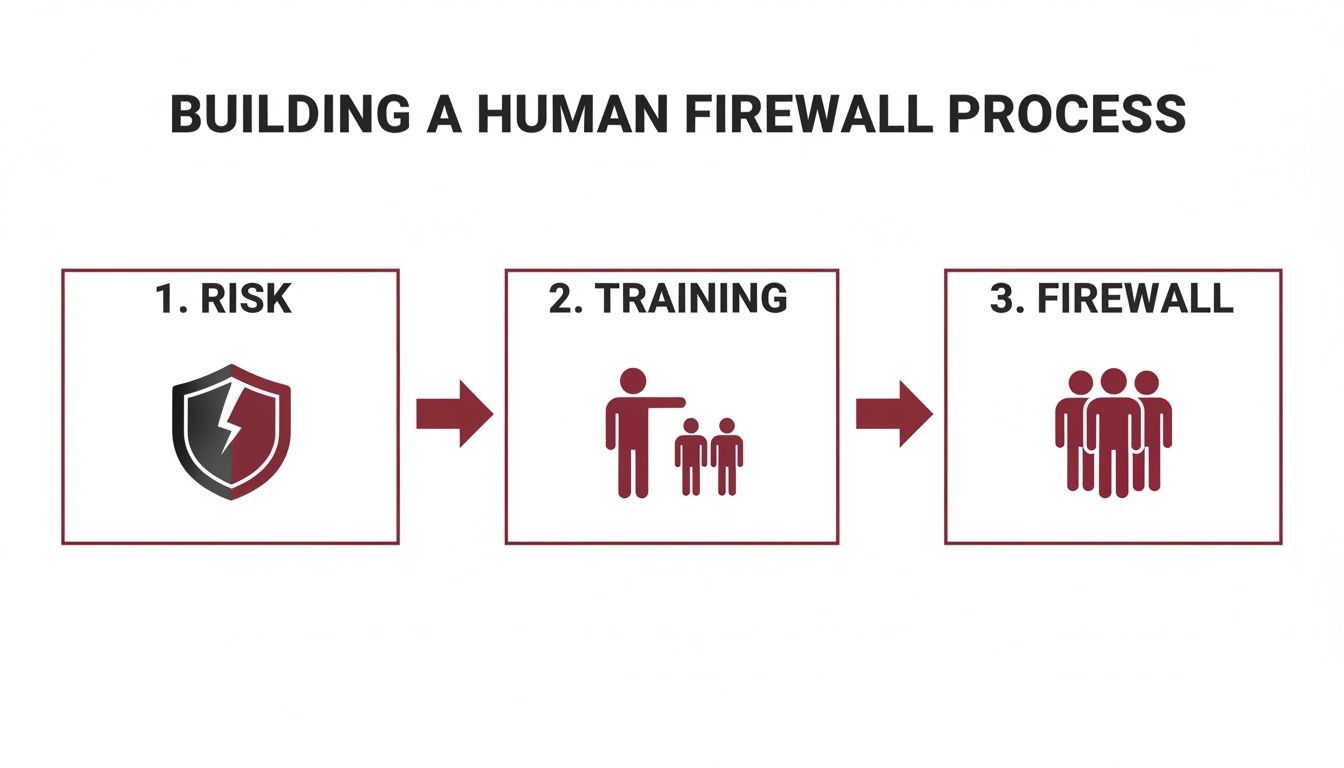
As you can see, identifying specific risks is the bedrock upon which effective training and a resilient human firewall are built.
Crafting Content That Connects
The secret to making security training stick is relevance. Ditch the dry, corporate speak and use relatable, real-world examples your team will actually remember. To build a program that really lands, it's essential to weave in effective science-backed learning strategies.
So, instead of a slide defining "phishing," tell a story about how a fake package delivery notification almost caught out a colleague. For a deeper dive into this, our guide on how to spot and avoid email scams is a great resource. This narrative approach transforms abstract threats into concrete, memorable lessons.
Your training should feel less like a lecture and more like a conversation. Focus on the scenarios your team sees every day—from those urgent requests from the "CEO" to suspicious text messages. That’s what makes the learning immediate and practical.
It’s all about striking the right balance. Everyone needs to know the basics, but some roles naturally carry more risk and need more specialised guidance.
Balancing Foundational and Role-Based Training
A one-size-fits-all approach just doesn't cut it. A truly effective program builds a solid security foundation for every single employee, then adds specific, targeted modules for your high-risk teams.
Foundational Topics (For Everyone):
- Phishing Recognition: Spotting malicious emails, sketchy links, and dodgy attachments.
- Password Hygiene: Using a password manager and creating strong, unique passwords.
- Physical Security: The basics of securing workspaces, devices, and documents.
- Incident Reporting: Knowing exactly who to call and when something feels off.
Targeted Topics (For High-Risk Roles):
- Finance Team: Laser-focused training on spotting Business Email Compromise (BEC) and invoice fraud.
- IT & Developers: Advanced sessions on social engineering tactics and secure coding practices.
- HR Department: Education on securely handling sensitive employee data and avoiding recruitment scams.
- Leadership: High-level briefings on the major cyber threats and their financial and reputational impact.
This blended approach gets results. I’ve seen it work time and again with Australian businesses. ABS data reflects this trend: in 2015, only 35% of small businesses ran security training. By 2024, that number had jumped to 72%, which coincided with a 41% drop in reported data breaches.
And for businesses that adopt ISO 27001, the impact is even more profound. Studies show they achieve 85% employee engagement in training and see a staggering 52% reduction in insider-related threats. These aren’t just numbers; they represent a fundamental shift in security culture.
Choosing Delivery Methods for Maximum Impact
You've got your content sorted. Now, how are you actually going to get it in front of your team? This is where a lot of programs stumble. The most brilliant material in the world will fall flat if it’s delivered in a way that doesn’t engage your people or fit into their day-to-day work.
Effective training security awareness isn't about finding a single, magical method. It’s about creating a powerful mix that reinforces the right behaviours over time.
Think of it like a fitness plan. You wouldn't just do one exercise and expect a complete transformation. You mix cardio, strength training, and flexibility to get the best results. The same logic applies here. A blended learning strategy is your best bet for building a truly resilient, security-first culture.

Combining Digital and In-Person Training
From my experience, the strongest programs always mix scalable, on-demand training with interactive, hands-on sessions. Let's break down the core components you should be thinking about for your own blended approach.
Computer-Based Training (CBT)
These are the self-paced online modules that often form the backbone of a training program. They are incredibly efficient for getting foundational knowledge out to your entire organisation, especially if you have remote or distributed teams.
I'm a big fan of using CBT for the essentials, but with a twist. Look for platforms that offer "micro-learning" – short, sharp modules. A five-minute video on password managers is far more likely to stick than a 60-minute lecture that everyone just clicks through.
Live Workshops
Never, ever underestimate the power of getting people in a room together (whether that's a physical room or a virtual one). Live workshops, run by someone who knows how to hold a room, allow for real-time questions, candid discussions, and a much deeper dive into tricky topics.
Workshops are your chance to move from theory to practice. Use them to pull apart real-world case studies of recent breaches or run an interactive exercise where teams work together to dissect a phishing email. This kind of active participation cements learning in a way that passively watching a video just can't match.
These sessions are also perfect for tackling role-specific threats. For example, you can run a targeted workshop just for your finance team on how to spot and handle sophisticated business email compromise (BEC) attacks.
Reinforcing Learning with Practical Application
Training shouldn't stop when the module is finished or the workshop ends. The most impactful programs I've seen are the ones that integrate continuous, hands-on reinforcement to test skills and keep security front-of-mind.
Simulated Phishing Campaigns
This is where the rubber really meets the road. Phishing simulations are, without a doubt, the most effective way to measure and improve your team's ability to spot real-world threats. By sending safe, simulated phishing emails, you give your employees a chance to practise their skills in a controlled environment where a mistake is a learning opportunity, not a disaster.
The data you get back is pure gold. It helps you pinpoint individuals or departments that might need some extra coaching and shows a clear return on investment as your company's "phish-prone percentage" drops. The results can be dramatic. For instance, data from Australia's public sector showed that after implementing mandatory annual training, phish-prone percentages plummeted from 28% to under 8%. This same program, which trained over 1.2 million employees, also saw a 62% decrease in malware infections from social engineering. These numbers really highlight the impact you can have. You can discover more insights about the cybersecurity talent gap and its implications.
To help you decide on the right mix, here's a quick comparison of the most common delivery methods.
Comparison of Training Delivery Methods
| Delivery Method | Pros | Cons | Best For |
|---|---|---|---|
| Computer-Based Training (CBT) | Scalable, cost-effective, consistent messaging, self-paced. | Can be passive and unengaging, lacks interaction. | Delivering foundational knowledge to the entire organisation. |
| Live Workshops (In-Person/Virtual) | Highly interactive, allows for Q&A, good for complex topics. | Can be costly, difficult to schedule for all staff. | Deep dives, role-specific training, and practical exercises. |
| Phishing Simulations | Measures real-world behaviour, provides actionable data. | Can cause anxiety if not managed well, requires follow-up. | Testing and reinforcing threat identification skills. |
| Micro-Learning (Videos/Tips) | Quick to consume, great for reinforcement, keeps security top-of-mind. | Not suitable for complex topics, can get lost in email noise. | Ongoing awareness and quick, timely security alerts. |
Ultimately, there's no single "best" method. The most successful programs I've built and seen have always used a combination of these approaches, playing to the strengths of each one.
A Sample Blended Learning Schedule
So, what does this look like in practice? Imagine a layered annual program that unfolds something like this:
- Annual Kick-Off: Everyone completes a foundational CBT module covering the core security principles for the year ahead.
- Quarterly Phishing Tests: You run simulated campaigns every three months, using the results to see where the weak spots are.
- Mid-Year Workshop: Host an interactive workshop (in-person or virtual) that focuses on a high-risk area you identified from the phishing tests, like invoice fraud.
- Ongoing Micro-Learning: Share short, monthly video tips or security alerts through email or your company's intranet to keep awareness high.
This kind of blended model ensures you’re not just box-ticking. You're actively building and reinforcing a security mindset throughout the year in a way that respects your employees' time while driving genuine, lasting change in their behaviour.
How to Know Your Training Is Actually Working
Are you just ticking a box, or are you actually making your business safer? Running a security awareness program without measuring its impact is like flying blind. For ISO 27001, proving effectiveness isn't just a good idea—it's non-negotiable. Auditors need to see tangible results, not just a spreadsheet showing who clicked "complete" on a training module.
This is where you move beyond simple pass/fail grades and start tracking the metrics that reveal a genuine shift in your team's behaviour.
Effective measurement is the only way to know if your investment is paying off. It gives you the hard data to justify the program's budget, demonstrate compliance, and, most importantly, make your organisation genuinely more resilient. It creates a powerful feedback loop, showing you exactly what’s landing and where you need to refine your approach.

Moving Beyond Completion Rates
Let's get one thing straight: aiming for 100% completion is missing the point entirely. While it's good to know people showed up, it tells you nothing about whether they learned anything or if they'll apply it when a real threat hits their inbox.
Your real goal is to build a simple, clear metrics dashboard that tells a compelling story of risk reduction. This doesn't need to be some complex, data-science project. A few well-chosen Key Performance Indicators (KPIs) tracked over time can paint a vivid picture of your program's value for leadership.
Key Metrics That Truly Matter
To get a proper read on your program's impact, you need to look at a mix of indicators—some that predict future success and others that show what's already happened.
Here are the ones I’ve seen deliver the most insight:
Phish-Prone Percentage (PPP): This is your headline number. It’s the percentage of your staff who click a link or open an attachment in one of your simulated phishing emails. A steady downward trend here is undeniable proof that people are getting smarter about spotting fakes. It's the most powerful metric you have.
Employee Incident Reporting Rate: This tracks how many suspicious emails and potential incidents your team reports to IT. An increase in reporting is a fantastic sign. It shows your team is shifting from being passive targets to active defenders in your security posture. You're building that human firewall.
Knowledge Assessment Scores: Think short quizzes before and after a training session. This directly measures knowledge lift. Seeing a significant jump in scores after a module provides clear evidence that the content is actually sinking in and people are absorbing the information.
Don't just count the number of reports; look at the quality. When employees start forwarding sophisticated, well-crafted phishing attempts that they might have fallen for a few months ago, you know a real cultural shift is underway.
Building a Simple Metrics Dashboard
How you present your data is just as important as the data itself. A simple dashboard can speak volumes to leadership and make the case for continued investment.
It's all about telling a story with numbers. For example, track your PPP quarterly. If you start with a 30% click rate in Q1 and, after some targeted training, it drops to 15% in Q2 and 8% in Q3, you’ve got a powerful visual of risk being stamped out.
Now, layer that with your reporting numbers. Show that security reports jumped by 200% after a workshop on social engineering. Those two data points together prove your training is delivering real, measurable value.
Using Feedback to Continuously Improve
Data tells one side of the story, but you can’t forget the human element. After a training session, send out a short, anonymous survey to get your team's honest thoughts.
Keep it simple and ask direct questions:
- What was the single most useful thing you learned?
- Was any part of the training confusing or unclear?
- What topics do you want to learn more about next?
This feedback is absolute gold. You might discover your team still feels shaky on identifying business email compromise (BEC) attacks. Great—now you know exactly where to focus your next micro-learning module or phishing simulation.
This ongoing cycle of measuring, listening, and adjusting is what turns a good security awareness program into a great one. It ensures what you're doing is always relevant, engaging, and actually works.
Keeping the Security Mindset Alive All Year
Security awareness isn't a "set and forget" exercise. It's not a box you tick once a year. The most secure small businesses I've worked with are the ones that treat security as a continuous conversation, not a one-off lecture. This is all about shifting from a training event to a genuine security culture, which is right at the heart of the continuous improvement cycle in ISO 27001.
An annual training module is a great foundation, but real behavioural change happens in the day-to-day. It’s about making security second nature, embedding it into the very fabric of how your team operates.
The goal here is to keep that initial momentum going. We want to move beyond the classroom and make everyone an active player in defending the business. That’s how you build true resilience.
From Training Day to Everyday Habits
To make good security habits stick, you have to keep the conversation alive. This doesn't mean bombarding people with more hour-long training sessions. It’s about weaving small, consistent reminders into their normal work routine.
This approach is effective because it's practical. A quick tip in the company newsletter or a message on your internal chat is far more digestible than another lengthy video. These little nudges keep security front and centre.
Think about a multi-channel approach to keep the message fresh:
- Bite-Sized Newsletters: Send out a short monthly email. You could feature a "threat of the month," share a simple security win, or give a shout-out to someone who correctly reported a phishing attempt.
- A Dedicated Comms Channel: Set up a space on your intranet, Teams, or Slack just for security. It becomes a place where people can ask questions, share odd-looking emails, and get quick updates.
- Good Old-Fashioned Posters: Never underestimate the power of physical reminders. Simple, clear posters in the kitchen or near the printer with messages like "Think Before You Click" or "Lock It Before You Leave" really do work.
These small, consistent touchpoints are what turn knowledge into instinct.
Find and Empower Your Security Champions
One of the most effective things you can do to maintain a security culture is to create a "Security Champions" program. This is all about finding those keen, security-savvy people in different departments and officially making them the security go-to for their team.
And I don't just mean people from the IT department. Your best champion might be a project manager who is meticulous about process, a marketing coordinator who’s naturally sceptical of weird links, or someone in finance who just gets it.
A Security Champion is the friendly face of security on their team. They’re the first port of call for quick questions, they help promote new security practices, and they can feed back to the IT team on what’s actually working on the ground.
This approach decentralises security, making it feel less like an order from on high and more like a shared responsibility. It gives people a real sense of ownership, which is a massive catalyst for cultural change.
You Can’t Do It Without Leadership Buy-In
Let's be blunt: if the leadership team isn't on board, your security culture is dead in the water. Visible, vocal support from the top is non-negotiable. It sends a clear message to everyone in the business: this is important.
This is about more than just signing off on the budget. Senior leaders need to be seen to:
- Walk the Walk: They must do the same training as everyone else, and do it on time. No exceptions.
- Talk the Talk: They should be bringing up the importance of security in all-hands meetings and company updates.
- Lead by Example: They have to follow the rules themselves. Whether it’s using the company password manager or forwarding a suspicious email to IT, their actions speak volumes.
When an employee sees their CEO openly talking about a phishing email they received and reported, it reinforces the program's value more than a dozen memos from IT ever could. It’s this top-down commitment that makes the culture stick. A staggering 40% of employees have never had any cybersecurity training, according to a study from Yubico. Strong leadership is the only way to close that gap.
Keep Your Program Fresh and Relevant
The threat landscape is anything but static, and your training can't be either. A program based on examples from two years ago will quickly feel dated and irrelevant, and your team will switch off. To keep people engaged, you have to keep your content aligned with the real-world threats they face today.
Stay on top of emerging attack methods, like AI-powered phishing or QR code scams (quishing). When a new type of threat hits the headlines, use it as a teachable moment. Fire off a quick security alert explaining what it is and what your team should look out for.
This proactive approach does two things. It keeps your training sharp and relevant, but it also shows your team that security isn't just a compliance task—it's an active, ongoing effort to protect them and the business. By constantly adapting, you ensure your security awareness efforts stay credible and effective, year after year.
Frequently Asked Questions
When you're trying to get security awareness training right, especially with a standard like ISO 27001 in mind, a lot of questions pop up. We get it. Here are some straight-shooting answers to the most common queries we hear from small businesses, designed to help you build a program that actually works and keeps the auditors happy.
Think of this as moving beyond just ticking a box for compliance. It’s about building a genuine line of defence for your business.
How Often Should We Conduct Security Awareness Training?
For ISO 27001, security awareness training can't be a one-and-done deal. It has to be a continuous effort. Best practice points to a layered approach that mixes deeper educational sessions with constant, gentle reminders.
At a bare minimum, every single employee needs comprehensive training when they first join your team, followed by a mandatory annual refresher. That's the baseline.
But let's be realistic—an annual session alone won't build a security-first culture. To make security a reflex, you need to weave it into the fabric of your daily operations. We strongly recommend rolling out monthly or quarterly activities to keep security top of mind.
These don't have to be massive undertakings. Think:
- Simulated phishing campaigns: A safe way to see who’s paying attention and who might need a bit more help.
- Quick security newsletters: Share updates on the latest scams, offer practical tips, and remind everyone of your internal policies.
- Short 'micro-learning' videos: Bite-sized lessons on specific topics, like how to create a killer password or spot a dodgy email attachment.
Consistency is everything. A steady drumbeat of small, regular reinforcements is far more powerful for changing long-term habits than one overwhelming annual info-dump. Plus, this ongoing effort is exactly what an ISO 27001 auditor wants to see—it shows a real commitment to continuous improvement.
What Is the Average Cost for a Small Business?
The honest answer? It varies wildly. The cost of security awareness training really depends on the tools you use, how deep you want to go, and your delivery methods. For a small Aussie business with 20 to 50 employees, you've got a few options.
A basic subscription to an online training platform often includes pre-made learning modules and phishing simulation tools. You’re typically looking at anywhere from $20 to $50 per user, per year. This is a fantastic and budget-friendly starting point for covering the essentials.
If you need content customised to your industry's specific risks or you prefer face-to-face workshops run by an expert, the price tag will climb. A single customised workshop could easily run into several thousand dollars.
Often, the sweet spot is a blended approach. You can use scalable online platforms for the basics and bring in an expert for targeted, high-impact sessions on your biggest risks. It's also worth looking into support options like government-funded cyber security courses that might be available to you.
It's not about finding the cheapest option. The real goal is to balance your budget with your unique risk profile. A smart investment here delivers a huge return by drastically lowering the odds of a costly, reputation-damaging security breach.
Does Training Alone Satisfy ISO 27001 Requirements?
In a word: no. While training is an absolutely vital piece of the puzzle, it won’t get you over the line by itself for ISO 27001 certification. The standard’s Annex A controls, particularly A.7.2.2, demand that your people are aware of the information security policy and know their role in upholding it. Good training is how you make that happen.
But an ISO 27001 auditor will need to see more than just attendance sheets. They'll be looking for proof that your training program is a fully integrated part of your wider Information Security Management System (ISMS).
To show you’re fully compliant, you’ll need solid evidence that you have:
- Documented Your Program: A formal training plan that clearly outlines your objectives, the topics covered, and the schedule.
- Tracked Participation: Clear records showing who completed what training and when they did it.
- Measured Effectiveness: This is the big one. You need hard data to prove your training is actually changing behaviour.
An auditor will want to see metrics—things like a drop in click-rates during phishing simulations or a clear rise in employees reporting suspicious emails. This shows them your training isn't just theory; it’s a living, breathing part of your security strategy that delivers tangible results.
Ready to build a security culture that not only achieves ISO 27001 certification but genuinely protects your business? The experts at Anitech have a 100% success rate in guiding Australian businesses through the entire process. Contact us today to simplify your certification journey.
Recent Comments