

Quick Summary:
An ISO certified company is an organization that has proven its processes and systems meet specific international standards set by the International Organization for Standardization (ISO). This certification, verified by an independent third-party auditor, acts as a globally recognized seal of approval for quality, security, and operational excellence.
Here’s what it really means when a business says they're “ISO certified.” In short, it’s a globally recognised seal of approval. An ISO certified company is one that has proven its systems and processes meet a specific international standard, verified not by themselves, but by an independent, third-party body. This certification demonstrates a commitment to excellence and adherence to globally accepted best practices.
Think of it as a universal language of quality. It tells customers, partners, and even competitors that you’re committed to doing things the right way, every single time. It’s not just about a certificate on the wall; it’s about having a rock-solid framework for how your business runs, ensuring consistency and reliability in your products or services.
What Is ISO, Exactly?
The standards themselves are developed by the International Organization for Standardization (ISO), a global body with members from over 160 countries. They're the architects who create the blueprints for excellence in almost every industry imaginable, from quality management systems to information security protocols.
But here’s a critical point: ISO develops the standards, but they don’t issue the certifications. That job falls to accredited certification bodies, which act as the independent auditors. They’re the ones who come in, review your operations, and verify that you’re living up to the standard’s requirements.
It’s an important distinction to grasp. If you'd like to dive deeper, we break down the roles in our guide on what ISO accreditation is.
Why International Standards Matter
ISO standards create a reliable playbook for businesses to follow, ensuring consistency and quality whether you're in Sydney or Stockholm. These international benchmarks provide a common framework that facilitates global trade and builds trust between organizations.
For instance, an ISO certified company in Australia has passed a rigorous audit from a JAS-ANZ accredited body. This proves they meet global benchmarks like ISO 9001 for quality management or ISO 27001 for information security. It immediately signals that the business is serious about its operations.
Just how important is this in Australia? There are currently 24,466 ISO 9001 certified organisations across the country, a testament to how vital this credential is for competing both locally and on the world stage.
More Than Just a Badge of Honour
Achieving ISO certification is a powerful statement. It tells the world your business is built on a foundation of:
- Consistency: You deliver a reliable and predictable level of service or quality.
- Customer Focus: You have systems in place designed to keep customers happy.
- Risk Management: You proactively identify and handle potential issues, which is the entire point of a standard like ISO 27001 for data security.
- Continuous Improvement: You’re committed to getting better, year after year.
An ISO certified company doesn’t just talk about high standards; it has proven them through an independent, meticulous verification process. It turns quality from a vague marketing promise into a tangible, measurable part of the business.
Navigating the path to certification, especially for tech-heavy or regulated sectors, often requires expert IT compliance services. These specialists ensure your technology and infrastructure are perfectly aligned with the standard's strict rules, which is a massive piece of the puzzle. This structured approach provides a clear roadmap for building trust and demonstrating operational excellence to everyone you do business with.
A Snapshot of Key ISO Certifications
While ISO has thousands of standards, a few are particularly relevant for modern businesses. Here’s a quick look at some of the most common ones and what they're all about.
| ISO Standard | Area of Focus | Primary Benefit for Businesses |
|---|---|---|
| ISO 9001 | Quality Management | Enhances customer satisfaction and operational efficiency by ensuring consistent delivery of products and services. |
| ISO 27001 | Information Security Management | Protects sensitive data, builds client trust, and helps meet regulatory requirements by securing information assets. |
| ISO 14001 | Environmental Management | Reduces environmental impact, ensures legal compliance, and improves brand reputation with a focus on sustainability. |
| ISO 45001 | Occupational Health & Safety | Creates a safer working environment, reduces workplace incidents, and lowers insurance premiums. |
Understanding which standard fits your goals is the first step. Each provides a unique framework to strengthen a specific part of your organisation, giving you a clear path to improvement and recognition.
What is an ISO Certified Company for Information Security (ISO 27001)?
In our world, information isn't just power—it's currency. For any business today, protecting that data isn't some side task for the IT department; it’s a core responsibility. This is exactly where ISO 27001 comes into play, standing as the gold standard for information security across the globe.
Think of ISO 27001 as the detailed architectural blueprint for your company's digital fortress. It provides a structured, methodical way to build, implement, and continuously improve an Information Security Management System (ISMS). An ISMS is really just the collection of policies, procedures, and controls your business uses to manage and protect its sensitive data.
Core Principles of ISO 27001
At its heart, ISO 27001 is built on three pillars, often called the "CIA triad." These principles are the bedrock of any secure system, and understanding them is the key to appreciating what the certification truly represents.
- Confidentiality: This is all about keeping secrets. It means ensuring information is only accessible to people who are authorised to see it. Think customer details, internal financials, or trade secrets—you don't want them falling into the wrong hands.
- Integrity: This principle is about trust and accuracy. It ensures your data is complete and can't be altered or messed with without it being noticed. It’s about preserving the reliability of your information.
- Availability: Simply put, this means your systems and data are there when you need them. It's about building resilience so that authorised users can always access the information and tools they need to do their jobs, even if something goes wrong.
A huge part of a robust ISMS involves having rock-solid procedures for handling data from start to finish. This even includes how you get rid of old information, which is why a comprehensive secure data destruction guide is a critical resource.
The CIA Triad in Action
Let's ground these ideas in the real world. Here’s what the CIA triad looks like on a typical day for any business.
- Confidentiality Example: Imagine a healthcare clinic that encrypts all patient records. Even if a cybercriminal managed to breach their server, the stolen data would be unreadable gibberish, keeping patient privacy intact. That’s confidentiality.
- Integrity Example: An online retailer protects its pricing database with very tight access controls. This stops an unauthorised person from changing a $500 item to $5, which would cause huge financial losses and erode customer trust in a heartbeat. That’s integrity.
- Availability Example: A financial services firm has duplicate servers running in different locations. If a power outage takes down their main system, they can instantly switch to the backup. Customers can keep accessing their accounts without interruption. That’s availability.
Dropping the ball on just one of these can spell disaster. That's why a holistic approach is so essential.
The New ISO 27001:2022 Update and Urgency
Cybersecurity never stands still, and the standards have to keep up. The latest version, ISO/IEC 27001:2022, was released in October 2022 to tackle modern security challenges head-on.
This update brought in some important changes, reorganising security controls to better reflect today's risks, like those tied to cloud computing, data privacy, and threat intelligence. These aren't just minor tweaks; they represent the new global benchmark for information security.
In the cybersecurity realm, an ISO certified company—specifically one following ISO 27001—demonstrates a robust ISMS, crucial for protecting sensitive data in Australia's high-stakes digital economy. The updated ISO 27001:2022 standard mandates transition by October 31, 2025, affecting all holders of the previous 2013 version who must now conduct gap analyses, revise policies, and pass audits or risk losing their certification status.
This deadline creates a genuine sense of urgency. If your business is certified to the old 2013 version, waiting until the last minute is a risky game that could jeopardise the trust you’ve worked so hard to build. For any business just starting the journey, adopting the 2022 version from day one is the only path that makes sense. It ensures your digital fortress is built to handle the threats of today, not yesterday.
The Real-World Benefits of Being an ISO Certified Company
Let's be clear: getting ISO certified is much more than a box-ticking exercise or a fancy certificate for the wall. It’s a serious business move that delivers real, tangible results. Think of it less as a cost and more as a direct investment in your company’s future growth, credibility, and overall strength.
For many businesses, the first and most powerful payoff is gaining access to brand-new markets. Suddenly, you’re not just another supplier on a long list; you’re a pre-vetted, trustworthy partner. This credential acts like a master key, unlocking doors to major contracts and opportunities that were completely shut before.
This is especially true if you’re trying to land work with government departments or big-name corporations. For them, ISO certification is often a non-negotiable requirement. It completely levels the playing field, letting smaller, dedicated businesses compete head-to-head with industry giants based on proven quality and reliability.
Gain a Powerful Competitive Edge
In any crowded market, you have to find a way to stand out. ISO certification gives you a clear, internationally respected signal that you’re a cut above the rest. It answers a potential client's biggest unspoken question—"Why should I trust you?"—before they even have a chance to ask it.
This built-in trust gives you a much stronger position in the market. When a customer is weighing up two similar providers, the one with a verified commitment to quality, security, or safety will almost always get the nod. Your certification becomes a silent salesperson, working around the clock to build your reputation for excellence.
Being an ISO certified company profoundly impacts a business's market access and growth, transforming it into a preferred partner for tenders and supply chains. For small and medium businesses, this certification can open doors to grants and large contracts. The Asia Pacific market, including Australia, is projected to see a 13.2% CAGR in this sector through 2033, underscoring the escalating importance of these standards.
Enhance Operational Efficiency and Reduce Costs
While opening up new markets is a massive drawcard, the internal improvements that come from becoming an ISO certified company are just as powerful. The certification process forces you to put every single one of your processes under a microscope, hunt down inefficiencies, and lock in standardised procedures for everything you do.
This disciplined approach brings some significant wins:
- Reduced Waste: Standardising how things get done cuts down on errors, re-work, and wasted materials, which feeds directly back into your bottom line.
- Improved Consistency: With everyone following the same playbook, the quality of your product or service becomes dependably excellent every single time.
- Clearer Roles and Responsibilities: A well-defined management system makes it crystal clear who is responsible for what, which slashes confusion and boosts productivity.
This internal housekeeping doesn't just make your business run more smoothly; it makes it more profitable. By optimising your operations, you free up resources and cash that can be funnelled back into innovation and growth, sparking a powerful cycle of continuous improvement.
Build Unshakeable Customer Trust
Trust is the foundation of any great business relationship. In a world of constant data breaches and hit-or-miss service, customers are desperately looking for partners they can count on. ISO certification is a public declaration of that reliability.
Take ISO 27001, for instance. Achieving that certification shows you have an iron-clad commitment to protecting sensitive client information. It proves you have a robust system for managing information security risks—a huge selling point for any client who is about to hand over their valuable data. This proactive approach to security and quality builds deep, lasting customer loyalty. If you want to dive deeper into how this works, you can read more about the specific benefits of ISO certification in our detailed guide.
Ultimately, certification changes the entire conversation. You stop selling just a product or a service and start building a partnership founded on proven quality and trust. It sends a clear message to your clients: we value your business enough to hold ourselves accountable to the highest standards on the planet.
Your Step-by-Step Path to Certification
Getting your company ISO certified can feel like a massive undertaking, but it’s really just a well-defined project. The key is to break it down into a logical sequence of steps. When you see it as a series of manageable phases, the whole process becomes far less intimidating and you end up with a robust system that adds value long after you hang the certificate on the wall.
Let’s walk through the roadmap and demystify the path to becoming fully certified.
Stage 1: Choose the Right Standard
First things first, you need to decide which ISO standard actually matters to your business. This isn't a one-size-fits-all situation.
Are you looking to prove your commitment to quality and keep your customers happy? Then ISO 9001 is where you should be looking. If your main concern is locking down sensitive data and proving you can be trusted with client information, then ISO 27001 is the standard for you.
Getting this right from the start is absolutely crucial. It sets the direction for everything that follows, ensuring you pour your energy into a system that solves real-world business problems and ticks the right boxes for your clients and partners.
Stage 2: Conduct a Gap Analysis
Once you’ve picked your standard, you need a clear picture of where you stand right now. This is where a gap analysis comes in. Think of it as a diagnostic health check for your business. It meticulously compares what you’re currently doing—your processes, policies, and controls—against the specific requirements of the ISO standard.
This step is incredibly revealing. It gives you a detailed, no-nonsense list of every single area where you're falling short. You'll see exactly what’s missing, from gaps in your documentation to weaknesses in your procedures. The findings from this analysis become the blueprint for your implementation plan, helping you focus your resources where they’re needed most.
As the infographic below shows, the work you put into these stages directly translates into real business wins.
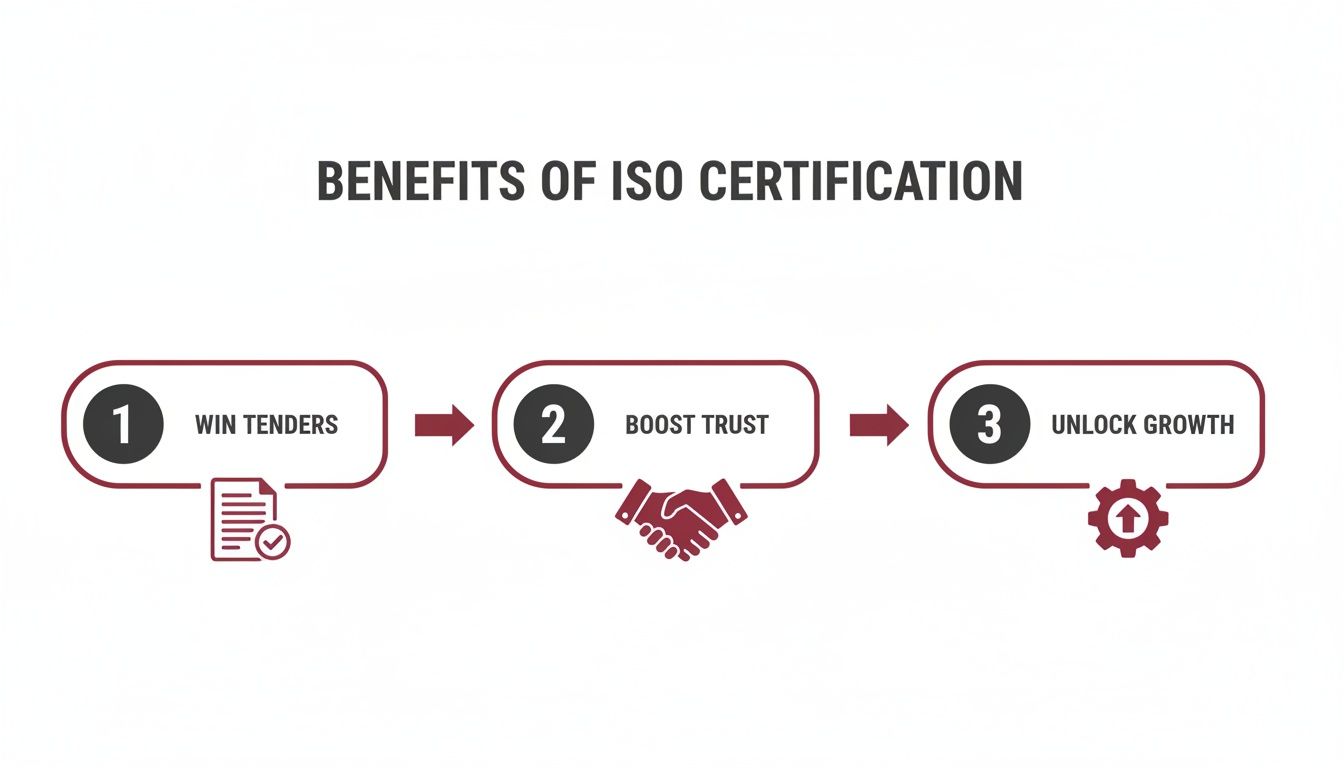
It’s clear: turning compliance into a competitive edge is a smart move.
Stage 3: Build and Implement Your Management System
With your gap analysis in hand, it’s time to roll up your sleeves. This is the hands-on phase where you bridge those gaps by creating the documentation and rolling out the new processes your business needs.
It generally boils down to three key activities:
- Developing Policies and Procedures: This means writing the official documents that define how things work, like an Information Security Policy for ISO 27001.
- Implementing Controls: You'll put the necessary security measures or quality checks into practice across the business.
- Training Your Team: It’s vital everyone understands their role in the new system. A system that only exists on paper is useless; your people need to live and breathe it.
Stage 4: Perform an Internal Audit and Management Review
Before you bring in the official auditors, you need to audit yourself. An internal audit is essentially a dress rehearsal. Someone impartial—either from within your team or an external consultant—will review your new system to see if it truly meets the ISO standard.
Think of the internal audit as your chance to find and fix any issues before they become a real problem. It's a critical self-check that proves you're serious about getting it right.
After the audit, your leadership team needs to conduct a management review. This is a formal sit-down to go over the system's performance, the audit results, and any areas for improvement. It ensures everyone at the top is on board. For a deeper dive, our guide on how to get ISO certified breaks down these steps even further.
Stage 5: Undergo the Certification Audits
This is it—the final hurdle. The certification audit is always handled by an accredited, third-party organisation and is split into two parts:
- Stage 1 Audit: The auditor focuses on your documentation. They’re checking that you’ve designed a management system that, on paper, meets all the requirements of the standard.
- Stage 2 Audit: This is a much deeper dive. The auditor will be on-site (or virtual), watching your processes in action, talking to your staff, and making sure you’re actually doing what your policies say you do.
Once you successfully pass the Stage 2 audit, the certification body will issue your official ISO certificate. Congratulations! You've reached the destination, but it's also the beginning of your ongoing commitment to maintaining that standard of excellence.
How an ISO Consultant Can Guide Your Journey
Let's be honest, you could tackle ISO certification on your own. It's possible. But for most businesses, it's a long, winding road filled with confusing jargon, potential dead ends, and a whole lot of frustration. Think of an expert ISO consultant as your guide through that tricky terrain. They don't just give you a map; they walk the path with you, turning a daunting task into a genuine strategic advantage.
It's a bit like building a house. You could grab a hammer and some plans, but hiring an experienced builder means the job gets done faster, safer, and the final result is a home that’s built to last. An ISO consultant brings that same specialised skill to building your management system. They’ve seen it all before and know exactly how to sidestep the common pitfalls that trip up most DIY attempts.
Their real value is in translating the dense, technical language of the standards into practical, actionable steps that actually make sense for your business. It’s this kind of expertise that makes all the difference when you're trying to figure out what is an ISO certified company and how you can become one without bringing your daily operations to a grinding halt.
Expert Guidance Through Complex Processes
One of the biggest hurdles is simply knowing where to begin. A good consultant cuts through the noise with a proven methodology, laying out a clear project plan that takes you from the initial gap analysis right through to your final audit.
This structured approach takes the guesswork out of the equation and keeps everything moving forward. They’ll have ready answers for critical questions, like who from your team needs to be involved and how to communicate changes across the organisation without causing chaos.
A consultant’s job typically involves:
- Making the Standard Make Sense: They’ll break down each clause, explaining what it means and, more importantly, how it applies to your specific business operations.
- Cutting Through the Red Tape: They help you create policies and procedures that are not only compliant but also practical. The goal is to avoid needless bureaucracy that just slows everyone down.
- Getting You Audit-Ready: They act as a friendly auditor, running pre-assessments to spot any weaknesses. This gives you a chance to fix things before the official auditors walk through the door, massively boosting your chances of passing the first time.
Saving Time and Internal Resources
For most businesses, particularly smaller ones, your team is already stretched thin. The last thing you need is to pull key people away from their core jobs to run a complex certification project. It’s a sure-fire way to slow the whole business down.
A consultant steps in as your dedicated project manager, driving the process and doing the heavy lifting. They’ll manage the timeline, coordinate tasks, and keep everyone on track. This frees up your team to focus on what they do best—running the business.
When you bring in a consultant, you’re essentially buying back hundreds of hours of your team's time. Their experience means the project gets done in a fraction of the time it would take an internal team learning as they go, delivering a much faster return on your investment.
This efficiency is everything. Instead of your people spending months trying to get their heads around risk assessments or control implementation, the consultant provides the right templates, tools, and hands-on guidance to get it done properly from the start.
Maximising the Value of Your Certification
Perhaps the biggest win of working with a consultant is that they help you build more than just a compliant system—they help you build a valuable one. An expert’s focus is always on weaving the ISO framework into your existing processes so that it genuinely improves how you operate.
They make sure your new management system isn't just a folder of documents that sits on a shelf collecting dust. It becomes a living, breathing part of your organisation that helps you spot opportunities for improvement, reduce operational risks, and keep your customers happy.
Ultimately, a great consultant ensures that when someone asks you "what is an ISO certified company?" you can confidently say it’s a business that isn’t just compliant, but one that’s more efficient, more secure, and perfectly positioned for future success. Their guidance transforms certification from a tick-box exercise into a powerful tool for growing your business.
Frequently Asked Questions About ISO Certification
Alright, let's get down to brass tacks. You understand the "what" and the "why" of ISO, but what about the practicalities? When business owners start seriously considering certification, the same questions always pop up: How long will it take? What’s it going to cost me? What happens after we get the certificate?
This is where the rubber meets the road. So, let's tackle these common questions head-on, giving you the real-world answers you need to plan your next move.
How Long Does It Take to Get ISO Certified?
There’s no one-size-fits-all answer here, as the timeline really depends on your company's size, complexity, and where you're starting from. For a typical small to medium-sized business with some decent processes already in place, you’re generally looking at a journey of 6 to 12 months.
This timeframe covers the full spectrum of activities – from the initial gap analysis to see where you stand, through to building out your management system, running internal audits, and ultimately, passing the official certification audits. The biggest variable? How quickly your team can implement the necessary changes. Partnering with an experienced consultant can definitely put a rocket under the process, as they bring a proven roadmap and help you sidestep common pitfalls that cause delays.
What's the Real Cost of ISO Certification for a Small Business?
It’s crucial to think of ISO certification as a strategic investment, not just another line item on the expense sheet. For a small business, the total investment typically falls somewhere between $15,000 and $40,000. This range depends heavily on the standard you're aiming for (ISO 27001 is more involved, for example) and the scope of your operations.
So, where does that money go? It's usually split across three main areas:
- Consulting Fees: This covers the expert guidance needed to get your documentation right, implement controls, and make sure you're fully prepared for the audit.
- Certification Body Fees: These are the fees you pay to the accredited third-party organisation that conducts your formal Stage 1 and Stage 2 audits.
- Internal Resources: Don't forget to factor in the time your own team will dedicate to the project.
While it's a significant outlay, the return often comes faster than you'd think. It might be from landing a single big contract that required certification, streamlining your operations and saving money, or avoiding one catastrophic data breach that could easily put a small business under.
The real cost isn't in achieving certification; it's in missing out on the opportunities it unlocks. You're investing in credibility, security, and market access that will pay dividends for years.
Is ISO Certification a One-Time Thing?
This is a very common misconception. Getting your ISO certificate isn't like crossing a finish line; it’s more like earning a driver's license. You’ve proven you meet the standard, but now you have to keep driving safely to maintain it. Your certification is part of a three-year cycle that requires an ongoing commitment.
Here’s what that looks like after your initial audit:
- Annual Surveillance Audits: In year one and year two, your certification body will check in to make sure you're still following the standard and continually improving your systems.
- A Re-certification Audit: At the end of year three, you’ll undergo a more comprehensive audit, much like the initial one, to renew your certificate for the next three years.
This cycle is what gives the certification its weight. It ensures that an ISO certified company doesn't just tick a box once, but truly lives and breathes its commitment to quality and security every single day.
How Can I Check if a Company Is Genuinely ISO Certified?
In a world full of big claims, this is a vital piece of due diligence. When you're choosing a partner or supplier, you can't just take their word for it. You need to verify.
The most straightforward way is to ask for a copy of their ISO certificate. A legitimate certificate will always show:
- The company's full legal name.
- The exact standard they are certified for (e.g., ISO/IEC 27001:2022).
- The scope of certification, which tells you which parts of their business are covered.
- The name of the accredited body that issued the certificate.
- The certificate’s issue and expiry dates.
For peace of mind, you can take it one step further. Contact the issuing certification body directly to confirm the certificate is valid. Many of them have online registers you can search, giving you independent, trustworthy proof of a company's status.
Ready to build a stronger, more secure, and more competitive business? The path to ISO certification is a direct investment in your company's credibility and future growth. With expert guidance, you can simplify the entire journey and unlock the full potential of becoming an ISO certified company.
Contact us today to start your journey with a trusted expert.
Recent Comments