

Let’s be honest, "business continuity planning" sounds like a mouthful of corporate jargon. But what it really boils down to is having a solid game plan for when things go sideways. It’s the strategy that keeps your essential operations running, protecting your revenue, reputation, and customer trust when a crisis hits.
Think of it as preparing for the unexpected before it happens.
What is Business Continuity Planning, Really?
Imagine your business is a high-performance race car. A sudden storm hits the track, making it slick and treacherous. A business continuity plan (BCP) isn't just the spare tyre in the pit lane. It's the advanced telemetry, the wet-weather tyres, and the experienced driver who knows exactly how to handle a spin-out.
In simple terms, a BCP is your comprehensive strategy to keep moving forward, safely and effectively, even when the conditions are a total mess.
This goes way beyond a simple IT recovery document or a checklist tucked away in a drawer. It's about building genuine resilience into the very fabric of your organisation. Whether you're hit with a cyber attack, a critical supplier goes bust, or a natural disaster strikes, a good BCP gives you a clear, actionable roadmap to navigate the chaos.
The Real Goal of a BCP
At its core, business continuity planning is about creating stability in a world that’s anything but. It forces you to answer the tough questions now, so you aren't scrambling for answers under immense pressure later.
- What parts of our business absolutely must keep running? Think customer support, processing payments, or your core production line.
- What do these critical functions rely on? We're talking about specific people, technology, physical locations, and key suppliers.
- How do we shield these resources when a disruption occurs? This is where you plan for redundancies, backup systems, and flexible work arrangements.
- How will we keep everyone in the loop? A solid communication plan ensures staff, customers, and partners know what's happening and feel confident in your response.
By tackling these questions head-on, a BCP can turn a potential catastrophe into a manageable incident. It’s about shifting from reactive panic to a coordinated, strategic response that protects the long-term health of your business.
Why Every Australian Business Needs a Plan
Here in Australia, the need for robust business continuity planning has never been more urgent. We face a unique mix of challenges, from frequent natural disasters to a constant barrage of cyber threats. It’s a tough environment to operate in.
The statistics are sobering. Around 50% of Australian businesses face some kind of disruption each year, yet an alarming number are caught completely off guard. In fact, only about 30% have a well-defined business continuity plan ready to go. This gap is particularly worrying given how vulnerable we are to floods and bushfires. If you're curious, you can find more insights on Australian business readiness in various industry reports.
This isn't just a "big business" issue. BCP is a fundamental survival tool for any organisation that wants to stick around for the long haul.
A business continuity plan is the ultimate expression of organisational foresight. It’s a signal to everyone that you’re committed not just to surviving a crisis, but to emerging from it stronger, more trusted, and ready for whatever comes next.
Without a plan, a single disruption can cause devastating financial losses, permanently tarnish your brand, and shatter the trust you’ve worked so hard to build with your customers.
With a plan, you create a foundation of resilience that becomes a genuine competitive advantage. You’re telling clients and partners that you are a stable, reliable organisation that can handle the heat. That kind of confidence is priceless, turning your preparedness into a powerful reason for customers to choose you over the competition. A BCP isn't just an expense; it's an investment in your future.
The Core Components of an Effective Business Continuity Plan
A powerful business continuity plan isn't a single, dusty document sitting on a shelf; it's a living system built on several interconnected pillars. Each piece has a specific job, and they all work together to create an organisation that can take a punch and keep moving forward. Getting your head around these building blocks is the first real step to crafting a plan that actually works when the pressure is on.
This diagram shows how a well-structured BCP isn't just about defence—it's about building resilience, protecting what you've built, and even gaining a competitive edge.
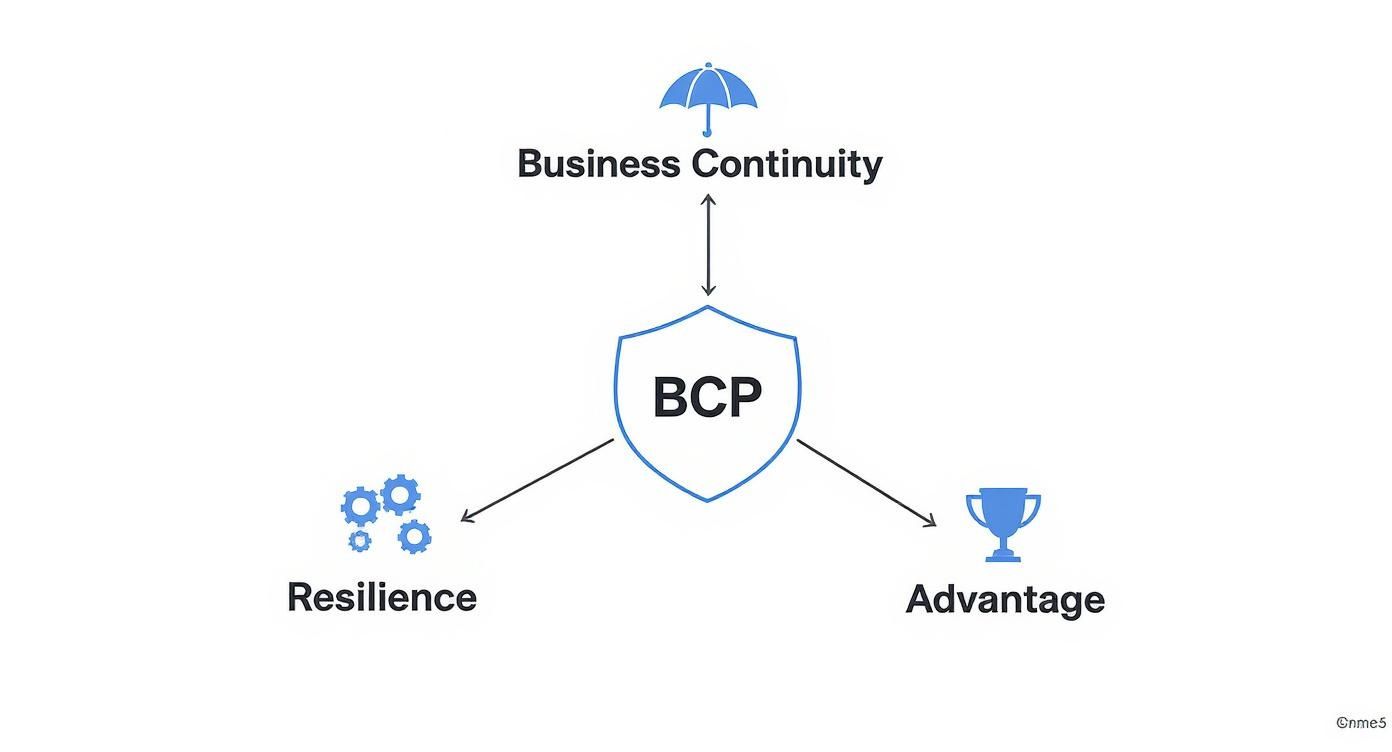
The main takeaway here is that BCP is far more than an insurance policy. It's a strategic tool that strengthens your entire business and its position in the market.
Business Impact Analysis: The Diagnostic Phase
Before you can fix a problem, you have to understand it. The Business Impact Analysis (BIA) is exactly that—the foundational diagnostic phase of your entire BCP. This is where you get brutally honest about your most critical business functions and what would happen if they suddenly stopped.
Think of it like a full medical check-up for your business. A doctor doesn’t just guess at a prescription; they check your vital signs and symptoms first. The BIA gives you the hard data needed to make smart decisions about where to focus your time, money, and energy.
During a BIA, you'll pin down two crucial metrics that will guide everything else:
- Recovery Time Objective (RTO): This is your deadline. It's the maximum acceptable time a critical process can be down before the business starts to suffer real, significant damage. For example, your online payment system might have an RTO of just one hour.
- Recovery Point Objective (RPO): This defines how much data you can afford to lose. An RPO of 15 minutes means you need to have backups that are, at most, 15 minutes old.
Without a solid BIA, your BCP is just a shot in the dark. This process ensures you’re protecting what truly matters, not just what seems important on the surface.
Recovery Strategies: The Architectural Blueprints
Once the BIA has told you what to protect and how quickly, the next step is to figure out how. This is where you develop your Recovery Strategies. If the BIA was the diagnosis, this is where you become the architect, drafting different blueprints to get your business back on its feet.
There's no magic bullet here. The right strategy will depend on the specific business function, your budget, and how much risk you're willing to accept. The goal is to have a clear, pre-approved game plan for every critical part of your operation.
Common recovery strategies often include:
- Workplace Recovery: Having a plan B for where people will work. This could be a dedicated hot site, a flexible co-working space, or another one of your own offices.
- Remote Work Capabilities: Ensuring your team has the secure access and tools they need to do their jobs effectively from home. This became a non-negotiable for many businesses recently.
- Supplier Diversification: Making sure you're not putting all your eggs in one basket. By having backup suppliers, you avoid being crippled if your primary vendor has a problem.
- IT Redundancy: Building fail-safes into your technology, like backup servers or cloud-based systems that can be switched on in a moment's notice.
These strategies are your practical, real-world solutions. They bridge the gap between "uh oh" and "we're back in business."
Incident Response Plan: The First Responder's Guide
When a crisis hits, the first few minutes are pure chaos. An Incident Response Plan (IRP) is your field guide for those critical initial moments. It provides clear, immediate instructions to contain the damage and stabilise the situation before it spirals out of control.
This plan is all about action. It answers the urgent question, "What do we do right now?"
An Incident Response Plan isn't about the long-term fix; it's about immediate control. The focus is on assessment, containment, and communication to stop a bad situation from becoming a catastrophe.
For instance, if you suspect a data breach, the IRP would trigger immediate actions: isolate the affected machines from the network, start tracking down the source, and alert the designated response team. It’s the emergency protocol that stops the bleeding, so you have a chance to start the healing.
Disaster Recovery Plan: The Technical Roadmap
People often use "Business Continuity" and "Disaster Recovery" interchangeably, but they're not the same. A Disaster Recovery (DR) Plan is a laser-focused part of your overall BCP. It is the technical roadmap for restoring your IT infrastructure—the digital nervous system of your company.
While the BCP worries about keeping the business running, the DR plan is all about getting the tech back online to make that possible. This is a deeply technical document, built and owned by your IT experts.
A solid DR plan gets into the weeds, detailing things like:
- Step-by-step instructions for restoring data from backups.
- Protocols for activating a secondary data centre or cloud environment.
- Essential contact lists for key IT staff and technology vendors.
Think of it like this: your BCP makes sure your sales team can still take calls (maybe on their mobiles at first). Your DR plan is what gets the CRM and quoting systems back online so they can actually do their jobs properly.
Communication Plan: The Voice of Stability
Last, but by no means least, is the Communication Plan. During a crisis, silence and uncertainty are your worst enemies. A well-crafted communication plan ensures that everyone—employees, customers, suppliers, and stakeholders—gets timely, accurate, and consistent information.
This plan decides in advance who says what, to whom, and how they say it. It’s your shield against misinformation and panic, and it shows everyone that you are in control, even when things are tough.
Key elements of a strong communication plan include:
- Pre-approved message templates for different scenarios (e.g., website down, office closed).
- Designated spokespeople to be the single source of truth for internal and external updates.
- A mix of communication channels (like email, SMS, social media, and your intranet) to make sure the message actually gets through.
By managing the flow of information, you protect your reputation, keep your team's morale up, and reassure your customers that you're on the case. It’s the glue that holds everything—and everyone—together.
Aligning Your BCP with ISO Standards and Information Security
Having a business continuity plan is a great start, but how do you prove it’s not just a document sitting on a shelf? This is where aligning your BCP with internationally recognised standards comes in. It elevates your plan from an internal guideline to a powerful statement that tells the world you're serious about operational excellence and security.
This isn't about ticking compliance boxes. It's about adopting a proven framework that builds rock-solid trust with your clients, partners, and stakeholders. It’s about creating a formidable competitive advantage. By weaving these global standards into your strategy, you're sending a clear signal: your organisation isn’t just prepared for disruptions; it’s built to withstand them.
ISO 22301: The Gold Standard for Business Continuity
When you talk about serious business continuity management, ISO 22301 is the undisputed international benchmark. Think of it as the master blueprint for building, implementing, and constantly improving a Business Continuity Management System (BCMS). It gives you a structured, methodical approach that ensures no stone is left unturned.
Adopting ISO 22301 takes all the guesswork out of your BCP. It provides a clear roadmap covering everything from high-level leadership commitment right down to performance reviews and day-to-day improvements. It's a complete framework designed for genuine, ingrained resilience.
The standard essentially pushes you to:
- Establish Clear Objectives: Define precisely what you want your BCMS to achieve, making sure it lines up with your bigger business goals.
- Systematically Identify and Assess Risks: Go way beyond the obvious threats to uncover a whole spectrum of potential disruptions and what they could cost you.
- Implement and Operate Controls: Put the right processes and procedures in place to manage and reduce those risks effectively.
- Monitor and Review Performance: Regularly check that your BCMS is actually working as intended and giving you the results you need.
- Drive Continual Improvement: Use what you learn from tests, reviews, and even real incidents to consistently sharpen and strengthen your resilience.
Adopting ISO 22301 transforms business continuity from a reactive, crisis-driven activity into a proactive, strategic discipline. It embeds resilience into your company culture, making it part of how you operate every single day.
The Unbreakable Link to Information Security and ISO 27001
Let’s be honest, in today’s world, one of the biggest threats to keeping your business running is a cyber attack. A data breach, a ransomware incident, or a major system failure can bring your operations to a dead stop. This makes information security an absolutely inseparable part of any credible BCP.
This is where ISO 27001, the global standard for Information Security Management Systems (ISMS), enters the picture.
While ISO 22301 is all about keeping the business running, ISO 27001 is focused on protecting your information assets—the data that fuels those operations. The two standards are really two sides of the same coin, working in harmony to create a comprehensive shield against modern threats.
A cyber incident is a business disruption. A severe one can be a catastrophe, hitting everything from your customer data and financial records to your hard-earned reputation. Integrating your BCP with an ISMS ensures you're ready for this specific, high-stakes scenario. When you’re building out your BCP, it’s smart to consider global standards like ISO 27001, which can be made even more effective with modern risk detection.
Why Integrating These Standards Creates a Competitive Advantage
Combining the strengths of ISO 22301 and ISO 27001 creates a powerful synergy. You're not just planning for a power outage; you're also planning for a sophisticated phishing attack. This dual focus shows a level of maturity and preparedness that truly sets you apart from the competition. For businesses ready to take that step, understanding the nuts and bolts of an ISO 27001 implementation provides a clear path to locking down your information assets.
This integrated approach delivers real, tangible benefits:
| Benefit | How It Helps Your Business |
|---|---|
| Enhanced Trust | Proves to clients that you take the security of their data and the continuity of your services seriously. |
| Reduced Risk | Systematically finds and deals with both operational and cyber threats, lowering the chance and impact of disruptions. |
| Streamlined Operations | Creates efficient, unified processes for managing risks, which means no duplicated effort or conflicting procedures. |
| Regulatory Compliance | Helps you meet the ever-growing list of legal and regulatory demands around data protection and operational resilience. |
The regulatory landscape here in Australia has put a major emphasis on business continuity, especially for financial institutions. The Australian Prudential Regulation Authority (APRA), for example, has updated its CPS 232 standard. It now requires financial organisations not only to have a business continuity plan but also to prove they are constantly testing it with board-level oversight. This push from regulators shows just how critical continuity planning has become for maintaining resilience and protecting customers.
At the end of the day, aligning your BCP with ISO standards is a strategic business decision. It's an investment in your reputation, your stability, and your future. It proves to the world that you are a resilient, secure, and trustworthy partner, ready to navigate uncertainty and deliver on your promises, no matter what comes your way.
A Practical Guide to Implementing Your Business Continuity Plan
Theory is one thing; action is another. A business continuity plan can't just be a document collecting dust on a shelf. It has to be built, tested, and woven into the very fabric of your organisation. This section is your roadmap for turning that theoretical BCP into a powerful, real-world asset that genuinely protects your business.
The whole process can feel a bit overwhelming at first, but don't worry. When you break it down into logical, achievable steps, it becomes a much more manageable and empowering journey. It’s all about taking deliberate actions to build resilience from the ground up.
First Things First: Secure Executive Buy-In and Assemble Your Team
Before you even think about writing a single line of your plan, you need genuine commitment from the top. Let's be clear: business continuity isn't just an IT project. It's a strategic business initiative that demands resources, a budget, and the authority to get things done. Without that executive sponsorship, even the most brilliant plans will stall.
When you have that conversation, frame it around risk mitigation and competitive advantage, not just cost. Explain how a BCP protects revenue streams, keeps customers happy and loyal, and ticks all the necessary regulatory boxes. Once leadership is on board, your next move is to assemble a cross-functional BCP team.
This team needs to be a proper cross-section of your business, making sure every critical function has a voice at the table.
- Executive Sponsor: A senior leader who will champion the BCP and fight for the resources you need.
- BCP Manager/Coordinator: The project lead who will drive the whole process forward and keep everyone on track.
- Department Representatives: Key people from IT, Operations, Finance, HR, and Communications who know their areas inside and out.
- Legal and Compliance: The experts who will ensure your plan meets all your legal and regulatory obligations.
Putting together a diverse team like this is the secret to creating a plan that is comprehensive, practical, and actually reflects how your organisation works.
Next, Conduct the Business Impact Analysis
The Business Impact Analysis (BIA) is the absolute foundation of your entire plan. As we've mentioned, this is where you pinpoint your most critical business functions and all the resources they lean on. A common trap is to treat this as a simple checklist, but you should think of it more as a series of strategic workshops.
To get the most out of your BIA, bring your team together and ask some hard questions:
- Which processes directly make us money or serve our customers?
- What's the absolute maximum time we can afford for each of these to be down? (This defines your Recovery Time Objective, or RTO).
- How much data can we stand to lose without causing major damage? (This sets your Recovery Point Objective, or RPO).
- What specific applications, systems, people, and third-party vendors are essential to keep these processes running?
The answers you get from this exercise give you the hard data you need to prioritise your recovery efforts. It ensures you’re focusing your time, money, and energy where they will make the biggest difference.
Develop Actionable Recovery Strategies
Okay, so your BIA is done. You now know what you need to protect and how quickly you need it back. The next phase is all about figuring out how you’re going to do it. This means developing specific, actionable recovery strategies for each of your critical functions and resources.
A huge mistake people make here is aiming for overly complex or eye-wateringly expensive solutions. The real goal is cost-effective resilience.
The most effective recovery strategies are often the simplest. A plan that is too complicated will be ignored in a real crisis. Focus on clear, direct actions that your team can execute under pressure.
For example, your strategies might include things like:
- Technology: Setting up cloud-based backups for critical data, making sure key staff have secure remote access, or even just having a backup internet connection.
- People: Cross-training employees on crucial tasks so you’re not reliant on a single person. It also means having a clear remote work policy and the right equipment ready to go.
- Facilities: Designating an alternative worksite or formalising a work-from-home plan in case your main office is out of action.
- Suppliers: Identifying backup suppliers for essential goods or services to protect yourself from supply chain chaos.
The key is to match the strategy to the RTO. A function with a four-hour RTO needs a much faster, more robust solution than one that can be down for 48 hours. If you're looking for a good way to structure these ideas, using a pre-built framework can be a lifesaver; you can learn more from this detailed business continuity strategy template to get started.
Document the Plan Clearly and Concisely
Now it’s time to get everything down on paper in a clear, accessible format. This is where so many organisations stumble. They create a massive, hundred-page beast of a document that’s impossible to use during an actual emergency. Your BCP needs to be a user-friendly guide, not an academic thesis.
Use simple language, checklists, flowcharts, and clear contact lists. The plan should be easy to understand for anyone who picks it up, even if they had nothing to do with writing it. Break it down into role-specific sections so people can quickly find what’s relevant to them without having to wade through pages of noise. For a deeper dive into structuring your documentation, this comprehensive guide on business continuity planning steps offers some excellent, practical advice.
Most importantly, make sure the plan is stored in multiple, accessible locations. A digital copy in the cloud and physical copies stored off-site are non-negotiable. A BCP that’s only stored on a server that goes down during a crisis is completely and utterly useless.
Finally, Communicate and Train Your Team
A plan that nobody knows about isn’t a plan at all—it's just a document. Once your BCP is written, you have to launch a communication and training campaign to make sure everyone understands their role. This isn't a one-off email blast; it’s an ongoing effort to build awareness and capability across the business.
Run regular training sessions for different teams, focusing on the specific actions they would need to take during a disruption. Key people, like department heads and your incident response team, will need more intensive training. The goal here is to build "organisational muscle memory." When a real event hits, you want the response to be swift, coordinated, and confident—not chaotic and panicked. This final step is what transforms your plan from a static document into a living, breathing capability that provides real protection.
Testing and Maintaining Your BCP for Ongoing Resilience
A business continuity plan isn't a "set and forget" document you can file away and feel safe. It’s a living, breathing strategy that has to grow and adapt right alongside your business. Without regular testing and diligent upkeep, even the most brilliantly crafted plan will become outdated, failing you when you need it most. This is where the real work of building resilience begins.
Think of testing your BCP like a fire drill. You don't wait for a real fire to find out if the alarms work or if everyone knows the escape routes. You practise in a controlled environment to build confidence and, more importantly, to find the weak spots before they lead to a real disaster.
This process is all about building what we call "organisational muscle memory." When a real crisis hits, you want your team's response to be swift, coordinated, and decisive—not chaotic and panicked.

Different Ways to Test Your Plan
Not all tests are created equal, and the right approach depends on your organisation's size, the complexity of your plan, and what you’re trying to simulate. The best strategy is usually a mix of simple and more intensive exercises to keep your plan sharp.
Here are a few of the most common methods I've seen work well:
- Plan Walkthroughs: This is your starting point. The BCP team gets together and verbally walks through the plan, step by step. It's a simple way to spot obvious gaps, check for clarity, and make sure everyone is on the same page about their roles.
- Tabletop Exercises: This is a bit more interactive. You present the team with a simulated scenario—something like, "Our main server just got hit with ransomware. What's our first move?"—and talk through the response. It’s fantastic for building strategic thinking and coordination without disrupting daily operations.
- Functional Drills: Now we’re getting hands-on. This involves testing a specific piece of your plan in the real world. For instance, you might actually try to restore a non-critical server from a backup to see if the process works as expected.
- Full-Scale Simulations: This is the most comprehensive test, where you simulate a major disruption from start to finish. It could involve everything from evacuating an office to activating a secondary work site and getting everyone online.
The real goal of testing isn't to pass or fail. It's to learn. Every gap you uncover during a drill is a potential disaster you've just prevented.
Establishing a Practical Testing Schedule
Consistency is everything. A one-off test is better than nothing, but a regular schedule is what keeps your plan effective. A good rule of thumb is to create a tiered testing calendar that builds in frequency and complexity over time.
A practical schedule could look something like this:
- Quarterly Tabletop Exercises: Every three months, get the core team together for a short, scenario-based discussion. You can focus on a different threat each time—a power outage, a key supplier going bust, or a cyber attack.
- Biannual Functional Drills: Twice a year, pick a critical technical or operational function and put it to the test. This could be a drill to check your emergency communication system or a test of your remote access capabilities for all staff.
- Annual Full Simulation: Once a year, plan for a more significant simulation. This is your chance to see how all the different parts of your plan—from IT to HR to communications—work together under pressure.
This steady rhythm keeps business continuity front-of-mind and ensures your response capabilities are always improving.
Analysing Results and Driving Improvement
The most important part of any test happens after it’s over. Simply running the exercise is not enough; you have to dig into the results to drive real improvement. This is how your plan stays sharp.
After every test, your team should hold a "hot wash" or debrief session to talk through what happened.
- What went well? Let's make sure we keep doing that.
- What didn't go as planned, and why?
- Did we discover any gaps in the plan or resource shortfalls?
- Was everyone clear on their roles and responsibilities?
Turn this discussion into a formal action report. Document the findings and assign clear, time-bound tasks to fix the issues. This might mean updating contact lists, rewriting a procedure, or investing in new tech. This feedback loop is what transforms a static document into a dynamic, resilient strategy.
Keeping Your BCP Current Through Regular Maintenance
Beyond scheduled tests, your BCP needs ongoing care. Your business is constantly changing, so your plan has to change with it. Certain events should be automatic triggers for a plan review to ensure it still reflects your operational reality.
Key triggers for a BCP review include:
- Technology Changes: Bringing in a new core software system, like a new CRM or ERP, can dramatically shift your recovery priorities.
- Personnel Changes: When key people with specific BCP roles leave the organisation, their responsibilities must be reassigned and the new person trained immediately.
- Operational Shifts: Moving to a new office, opening another branch, or significantly changing a production line all require an update to your plan.
- Supplier Changes: If you switch to a new critical supplier, your plan must be updated to reflect that new dependency.
Failing to update your plan after these changes is one of the most common pitfalls in what is business continuity planning. It’s how good plans become obsolete.
Many businesses are now turning to advanced tools to help with this. A 2025 report from the Australian Cyber Security Centre (ACSC) noted that over 70% of medium-sized companies and 26% of small businesses are using AI tools to strengthen their continuity planning. These tools can help model threats or draft plan outlines, making the whole process more efficient.
Ultimately, testing and maintenance are the engines that power your BCP. They transform your plan from a theoretical document into a proven, reliable capability that protects your business, reassures your customers, and gives you the confidence to face whatever comes next. For those looking to align these practices with information security, our guide on building a robust incident response plan offers valuable steps for handling security breaches effectively.
Frequently Asked Questions About Business Continuity Planning
Even after you've grasped the concepts, putting a business continuity plan into practice is where the real questions pop up. It’s where theory meets the messy reality of running a business, and navigating those nuances is key. I've put this section together to tackle some of the most common questions I hear, giving you clear, direct answers to get you past any roadblocks.
Think of this as your practical field guide. The aim is to reinforce what we've covered and give you solid advice for the challenges you’re bound to face. Let's make sure you have the confidence to turn your BCP from a document on a shelf into a living, breathing asset that genuinely protects your business.
What Is the Difference Between Business Continuity and Disaster Recovery?
This is easily the most common point of confusion, but getting the distinction right is vital. Imagine your business is a hospital hit by a city-wide power outage.
Business Continuity (BC) is the hospital’s master plan to keep treating patients, no matter what. It's about switching to backup generators, moving critical patients to unaffected wings, pulling out paper charts, and keeping families informed. The focus is on continuing the core mission—patient care—even when things go sideways.
Disaster Recovery (DR), on the other hand, is the specific, highly technical plan to get the main power grid back online. It’s the team of engineers fixing the fault and the IT specialists restoring the digital patient records from backups once the servers are running again.
In a nutshell, Business Continuity is the big picture: keeping the entire business operational. Disaster Recovery is a crucial piece of that puzzle, focused squarely on getting your IT infrastructure and data back online. You absolutely need both, but DR always serves the larger goal of BC.
How Often Should We Test Our Business Continuity Plan?
A plan that hasn't been tested is nothing more than a good intention. There isn't a single magic number for how often to test; the best approach is a layered one that keeps your team ready without causing "disruption fatigue."
A smart testing schedule usually looks something like this:
- Simple Walkthroughs or Tabletop Exercises: Aim to do these at least twice a year. They're low-impact, discussion-based sessions that keep the plan fresh in everyone's mind and quickly uncover any obvious gaps in logic.
- More Involved Functional Drills: These should happen at least annually. This is where you get more hands-on, like actually trying to restore a dataset from a backup or testing your emergency communication system to see if it works as expected.
And here’s a critical rule of thumb: you must re-test the plan anytime there’s a significant change in your organisation. That could be a new core software system, a move to a new office, or a major reshuffle of key personnel with BCP duties. Your plan has to reflect the business you are today, not the one you were six months ago.
Is a Business Continuity Plan Only for Large Corporations?
This is a dangerous and costly myth. Honestly, a BCP is arguably more critical for a small or medium-sized business (SMB) than it is for a corporate giant. Big companies often have deep pockets and can absorb the financial shock of a disruption. An SMB? Not so much. You're likely operating with thinner margins and fewer backup resources.
For a small business, a single event—a local flood that ruins your office, a key supplier going bust, or a ransomware attack that locks up your files—can be an extinction-level event. A 2023 report drove this point home, revealing that a staggering 60% of small businesses that suffer a major data breach go out of business within six months.
A well-scaled BCP is the lifeline that protects the business you’ve poured your life into. It’s what ensures you can weather these storms and live to fight another day. It also demonstrates a level of professionalism and resilience that can give you a real edge over less-prepared competitors. It’s not about size; it's about survival.
Where Is the Best Place to Start If We Have Nothing?
Staring at a blank page is daunting, I get it. But there's a clear, logical first step on any business continuity journey: the Business Impact Analysis (BIA).
Before you can write a single recovery procedure, you have to know, with absolute clarity, what you're trying to protect. The BIA provides this essential groundwork. It forces you to get methodical and ask the tough questions.
Going through a BIA will help you:
- Pinpoint Your Most Critical Business Functions: What are the non-negotiable activities that keep the lights on and money coming in?
- Define Your Recovery Time Objectives (RTOs): For each critical function, how fast does it really need to be back up and running before serious damage is done?
- Map Out Dependencies: What specific people, technology, suppliers, or facilities do these critical functions rely on?
Starting here will guide every other decision you make. It ensures your limited time, money, and energy are focused on protecting what truly matters, so you aren't wasting effort on the less critical parts of your operation. The BIA is, without a doubt, the smartest way to start.
Building a resilient organisation is a strategic move, and it all begins with a solid plan. At Anitech, we specialise in helping Australian businesses strengthen their security and operational frameworks through ISO 27001 certification, a cornerstone of modern business continuity. Our experts can guide you through the entire process, ensuring your business is not just compliant, but genuinely prepared for whatever comes next.
Ready to build unbreakable trust and a real competitive advantage? Contact Anitech today to learn how we can help secure your business's future.
Recent Comments