

Quick Summary: An Integrated Management System (IMS) brings multiple business standards (like quality, environment, and security) together into one cohesive framework. It cuts out redundant processes, simplifies audits, and boosts overall efficiency, making it easier for businesses to manage compliance effectively.
When business leaders hear the acronym 'IMS', it can spark a bit of confusion. In most cases, it refers to an Integrated Management System (IMS), which combines separate operational standards—like quality management (ISO 9001), environmental responsibility (ISO 14001), and information security (ISO 27001)—into a single, unified framework. This management system framework is all about stopping the siloed, often conflicting, way of managing different business functions.
What an Integrated Management System Actually Means for Your Business
Think of your business like a modern airliner. In the old days, you’d have had separate, clunky control panels for navigation, engine performance, and cabin pressure. Each system worked in its own little world, demanding its own checks and sometimes even giving you conflicting data.
An Integrated Management System (IMS) is like upgrading to a single, sleek glass cockpit.
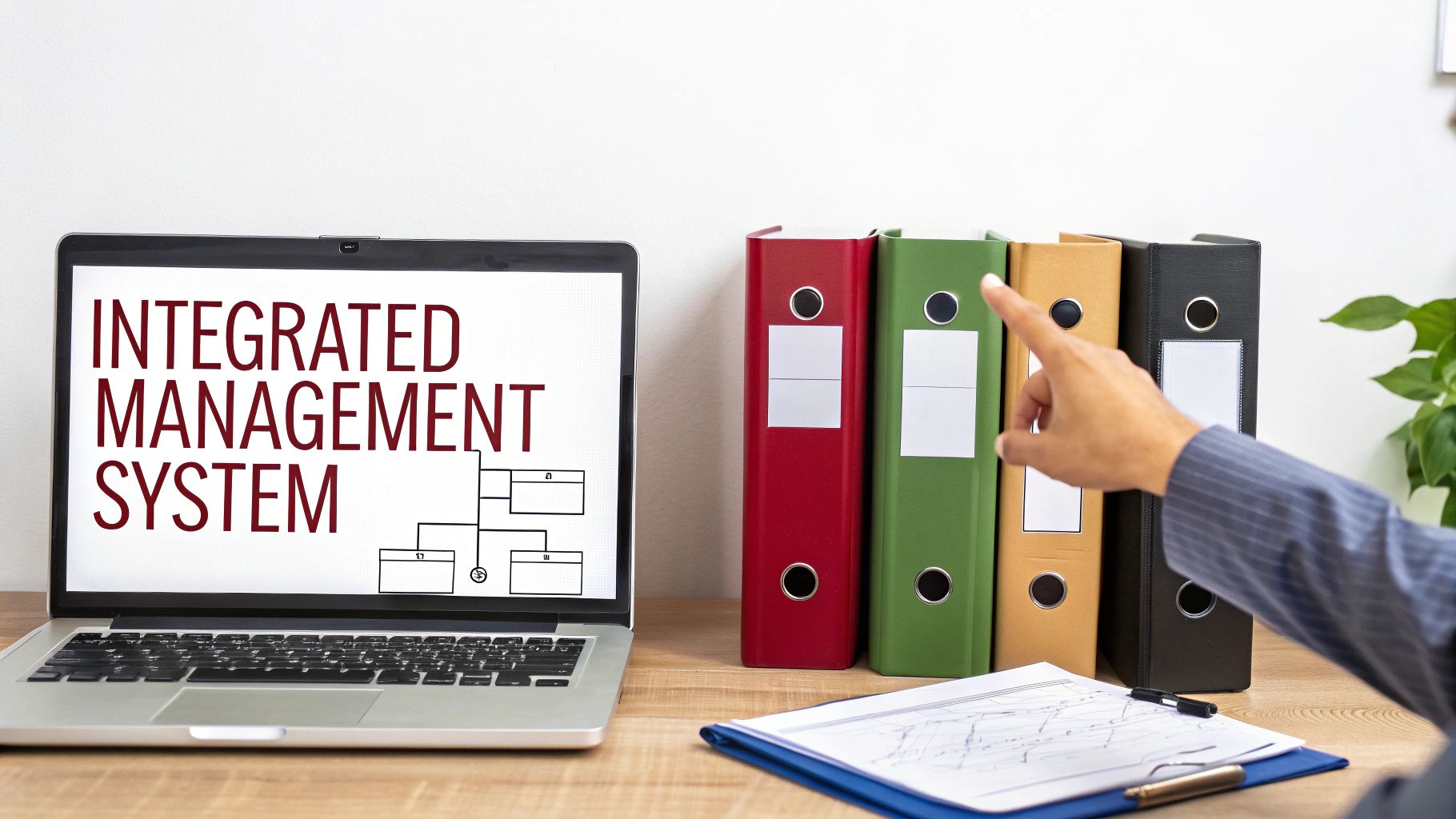
This central command centre ensures every part of the aircraft—your business—works in harmony. Instead of juggling separate audits, documents, and procedures for quality, safety, and security, an IMS creates one source of truth. It’s an approach that not only makes compliance worlds easier but also drives real, tangible improvements in how you operate.
Unpacking the Two Meanings of IMS
So, where does the confusion come from? The term ‘IMS’ gets used in two main ways, and telling them apart is the first step to clarity.
- Integrated Management System: This is the big-picture definition. It’s about merging multiple management standards into one streamlined framework to create a single, cohesive operational structure.
- Information Management System (IMS): This is a much narrower term, often used interchangeably with an Information Security Management System (ISMS). Its focus is purely on protecting an organisation’s information assets.
The easiest way to think about it is that an ISMS can be one part of a larger Integrated Management System. For many Australian businesses, the journey begins with getting their information security in order with an ISMS like ISO 27001, then expanding to bring other standards into the fold over time.
To help clear this up once and for all, here's a quick comparison.
IMS At a Glance: Integrated vs Information Systems
This table breaks down the two primary meanings of IMS, helping you pinpoint which system is relevant to your needs, especially when information security is a top priority.
| Aspect | Integrated Management System (IMS) | Information Management System (ISMS/IMS) |
|---|---|---|
| Primary Goal | To unify multiple business management standards (e.g., quality, environment, health & safety). | To protect the confidentiality, integrity, and availability of information. |
| Scope | Organisation-wide, covering various operational areas. | Focused specifically on information assets, data, and cybersecurity. |
| Key Standards | Combines ISO 9001, ISO 14001, ISO 45001, ISO 27001, etc. | Primarily ISO/IEC 27001. |
| Main Benefit | Reduces redundancy, simplifies audits, and creates holistic business efficiency. | Manages information risks, prevents data breaches, and builds trust with clients. |
| Typical Stakeholders | C-suite executives, Operations Managers, Compliance Officers. | CIO, CISO, IT Managers, and anyone responsible for data security. |
Essentially, one is about running the entire business more smoothly, while the other is laser-focused on keeping its information safe.
An IMS helps an organisation to focus on its objectives as a whole. It’s an effective system that ensures you consider all risks and opportunities associated with internal and external issues, including the needs and expectations of your stakeholders.
Why Integration Is So Much More Than Efficiency
Bringing your management systems together is about more than just saving a bit of time on paperwork. It helps create a culture where processes are consistent across the board, communication is clearer, and everyone is pulling in the same direction toward shared business goals.
This unified approach makes your entire operation more resilient and your decision-making sharper. For a parallel concept, look at IT Service Management (ITSM), which acts as a comprehensive rulebook for managing technology within a business. The underlying principle is identical: build a reliable, repeatable structure to get better results. For Australian businesses facing ever-growing compliance demands, truly understanding what an IMS is and how to use it has become a powerful strategic advantage.
The Strategic Business Case for an IMS
Let's move past the textbook definitions. For any Australian business serious about long-term growth, bringing your management systems together under one roof isn't just a "nice-to-have"—it's a game-changing strategic move. This is about more than just ticking a few compliance boxes. It's about fundamentally re-engineering how your organisation works to boost performance, build resilience, and earn rock-solid credibility in a crowded market.
An Integrated Management System (IMS) takes those abstract standards and turns them into real-world business advantages you can see and measure. It gives you a clear, structured way to handle risks, jump on opportunities, and deliver quality work every single time. Think of it as a proactive investment in your future, not a reactive cost.
Driving Down Costs Through Integration
One of the first things you'll notice is the impact on your bottom line. When you run your quality, safety, and security systems in separate silos, you're essentially paying for the same work multiple times over. Think redundant paperwork, separate training sessions, and multiple disruptive audits. It’s a huge drain on resources.
An IMS puts a stop to that.
Instead of juggling several expensive audits throughout the year, you conduct one streamlined audit covering all the standards you need to meet. This alone can slash the fees you pay to certification bodies and cut down on operational downtime. In fact, integrated audits are often up to 20% more efficient than doing them all separately.
And that’s before we even talk about the day-to-day admin. Imagine having one policy manual, one risk register, and one set of procedures instead of three. Your team spends less time buried in paperwork and more time doing what they do best.
Boosting Operational Efficiency and Productivity
Consistency is the secret sauce of an efficient business. By creating a single set of processes that everyone follows, an IMS ensures tasks are done the right way, every time, right across the company. This creates a kind of operational harmony with some massive benefits:
- Fewer Mistakes: When everyone is on the same page, the chances of errors, rework, and frustrating inconsistencies plummet.
- Smarter Collaboration: It breaks down the invisible walls between departments. When everyone is working within the same framework, communication and teamwork just naturally improve.
- Quicker Onboarding: New starters get up to speed much faster because they only have to learn one unified system, not three conflicting ones.
This unified approach smooths out the internal friction that slows businesses down, allowing your teams to focus on delivering fantastic results for your clients.
"Implementing an IMS is about creating a culture of continuous improvement. By unifying systems, you create a clearer path to identifying inefficiencies and making smarter, data-driven decisions that benefit the entire business."
Enhancing Your Brand Reputation and Credibility
In the Australian market, having a certified IMS is a powerful signal to the world. It tells potential clients, partners, and even regulators that your business is committed to the highest standards. It proves you're not just talking the talk; you're walking the walk.
A huge driver for adopting an IMS is how effectively it streamlines your overall compliance risk management. When you have an audited, robust system in place, you’re building a foundation of trust that is hard to beat.
This credibility opens doors that might otherwise have been closed, especially when it comes to:
- Government Tenders: Many government contracts now make certifications like ISO 9001 (Quality) or ISO 27001 (Information Security) a prerequisite. An IMS makes it far simpler to get and keep these certifications.
- Enterprise Clients: Big corporations do their homework. They need to know their supply chain partners are reliable. A certified IMS gives them the confidence that you have mature, well-managed processes in place.
At the end of the day, an IMS is far more than a certificate to hang on the wall. It’s a strategic asset that strengthens your position in the market, making you a more attractive and trustworthy partner. It's an investment in building a business that's not just successful today, but is resilient, efficient, and reputable for years to come.
IMS vs ISMS: What's the Difference and Why It Matters for Information Security
When you’re trying to get a handle on business compliance, you'll hear a lot of acronyms thrown around. Two of the most common—and easily confused—are IMS and ISMS. They sound almost identical, but mixing them up can lead to wasted time, blown budgets, and a system that doesn't actually solve your core security problems.
Let's cut through the jargon. Think of an ISMS (Information Security Management System) as a specialised tool for a very specific job. An IMS (Integrated Management System), on the other hand, is the entire toolbox. Your ISMS can sit neatly inside your IMS, but you can’t use the whole toolbox to do one specific task. Getting this right from the start is the key to building a security framework that works.
An Analogy to Make It Stick: The Airport
Imagine you're in charge of running a major airport.
An Integrated Management System (IMS) is your complete operational blueprint for the entire airport. It’s the master plan that ties everything together—from the quality of service at the check-in counters (ISO 9001 for Quality), to the environmental standards for the ground crew (ISO 14001 for Environment), and the safety protocols for the baggage handlers (ISO 45001 for Health & Safety). It ensures the entire operation is a well-oiled machine.
Now, an Information Security Management System (ISMS), often built on the ISO 27001 standard, is the highly specialised security team protecting the airport’s digital brain. Their one and only focus is defending the flight control systems, passenger databases, and communication networks from cyberattacks. It's a critical part of the airport's overall operation, but it has a very specific mission.
You wouldn’t ask the digital security team to manage runway maintenance schedules, just like you wouldn’t use the airport’s master operational plan to configure a network firewall. Both are vital, but they govern different things.
Why This Matters for Australian Businesses Right Now
This isn't just theory; it has serious, real-world implications, especially here in Australia. We're seeing a relentless surge in cyberattacks. The Australian Signals Directorate recorded over 94,000 cybercrime reports in the last financial year—that’s a shocking 23% jump from the year before.
For businesses, the threat is personal. A staggering 91% of data breaches reported were the direct result of malicious attacks like phishing emails and ransomware, with small businesses often bearing the brunt.
This is precisely why ISO 27001 has become the benchmark for information security. It gives you a proven, internationally recognised playbook for managing these risks head-on.
For many Australian companies, especially those supplying to government or operating in regulated sectors, having ISO 27001 certification isn't just a good idea—it's a requirement to even be in the running for contracts.
The big question for you is: do you need a standalone ISMS now, or should you be planning to build it into a bigger, integrated system down the track?
How to Scope Your Project: Standalone ISMS or an Integrated Approach?
The right path really depends on your immediate needs and where you see your business going.
Here’s a simple way to think about it:
- Go for a Standalone ISMS if: Your number one priority is tackling information security risks. Maybe a big client is demanding ISO 27001 certification, or you need to prove to the market that you take data protection seriously. This focused approach gets you compliant fast and plugs your most critical security gaps first.
- Plan for an Integrated IMS if: You already have other management systems in place (like for quality or safety) or your long-term goal is to create a single, streamlined system for running the whole business. An integrated system is more efficient in the long run, cutting down on duplicate paperwork and audit fatigue.
For most businesses, the journey begins with a laser focus on information security. They start by building a rock-solid ISMS. Once that foundation is in place, they can seamlessly connect it to their other systems, creating a truly resilient and efficient organisation. This way, the work you put in today becomes a cornerstone for your broader business strategy tomorrow.
For a deeper dive into what makes up an effective security framework, check out our guide on Information Security Management Systems.
Your Actionable Roadmap to IMS Implementation
So, you're sold on the idea of an Integrated Management System. Great. But turning that concept into a living, breathing part of your business can feel daunting. The key is to see it not as one giant leap, but as a series of deliberate, manageable steps.
Let's break down the journey into a clear, phased roadmap. This plan is designed to build an effective IMS from the ground up, with a special focus on weaving in the critical ISO 27001 standard for information security. Each phase builds on the one before, making sure you create a system that’s solid and sustainable.
The diagram below shows how an Information Security Management System (ISMS) nests perfectly within the bigger picture of a comprehensive IMS.
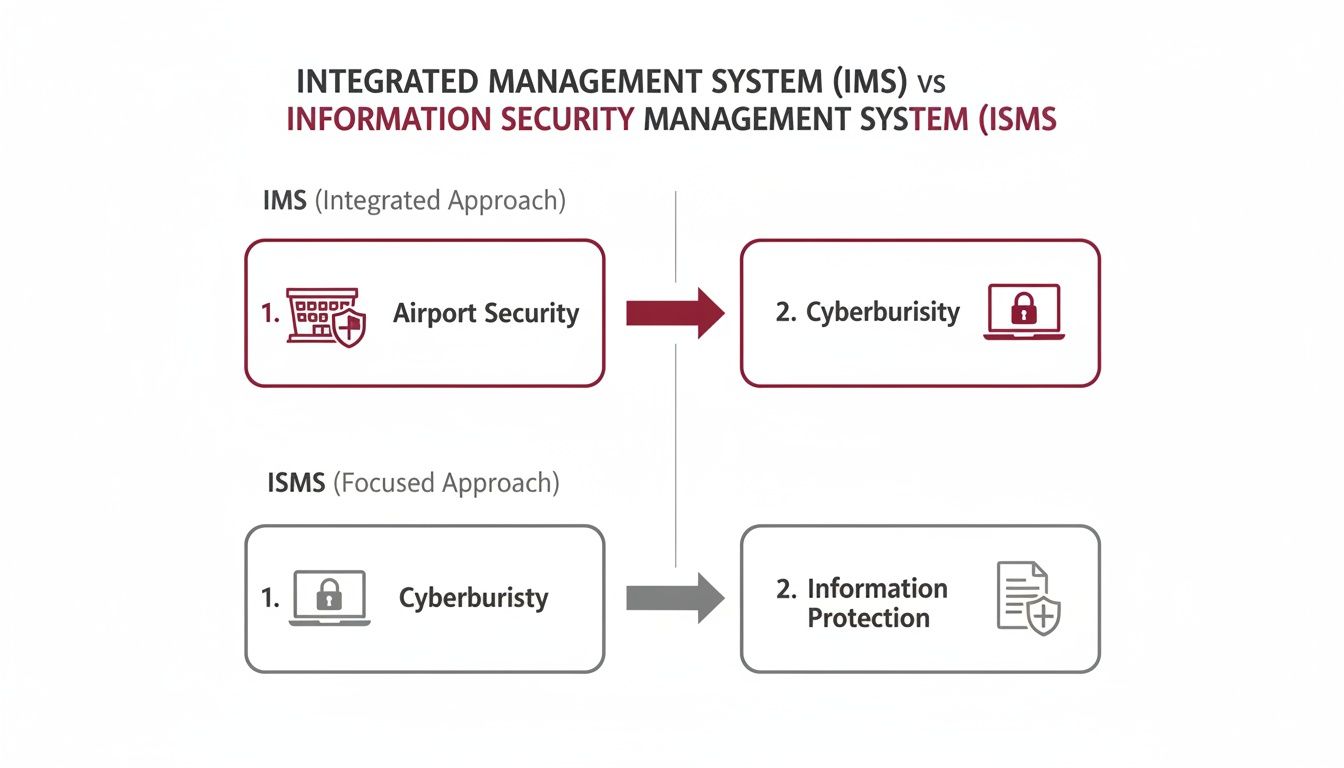
Think of the ISMS as the specialised security engine, while the IMS is the chassis and framework holding everything together—from quality and safety to environmental management.
Phase 1: Secure Leadership Buy-In and Define Your Scope
Before you even think about writing a single policy, you need your leadership team firmly in your corner. An IMS implementation isn't a side project; it demands real resources—people's time, focus, and a budget. Without genuine backing from the top, it’s dead in the water. Get them on board by presenting a rock-solid business case that speaks their language: reduced audit costs, stronger risk management, and a serious competitive edge.
Once you've got the green light, it’s time to draw your boundaries. Ask these critical questions:
- Which standards are we actually integrating? (e.g., ISO 27001 for security plus ISO 9001 for quality?)
- Which parts of the business are in? (e.g., just head office, or all operational sites?)
- What, specifically, are we trying to achieve with this?
Nailing down the scope stops the project from spiralling out of control and gives your team a clear target to aim for.
Phase 2: Conduct a Thorough Gap Analysis
You can't plot a course without knowing where you are right now. A gap analysis is essentially a deep-dive audit of your current ways of working, measured against the specific requirements of the standards you’ve chosen, like ISO 27001.
This process shines a light on what you’re already doing well and, crucially, where the holes are. You might find your access control policies are strong, but you’ve never formalised your risk assessment process. This is the step that turns a vague goal into a concrete, prioritised action plan.
A gap analysis isn't about pointing fingers or finding fault. It's about finding opportunities. It gives you a precise to-do list, so you’re only putting effort where it's truly needed to get compliant.
Phase 3: Develop Unified Documentation and Policies
This is where the magic of "integration" really happens. Instead of juggling separate, clunky manuals for each standard, you’re going to build a single, streamlined set of documents. The aim is to create one policy or procedure that ticks the boxes for multiple standards simultaneously.
Your essential documents will include:
- An Integrated Policy Statement: A powerful, high-level declaration from leadership stating the company's commitment to quality, security, and everything else in the IMS.
- A Consolidated Risk Register: One central place to track, analyse, and manage all risks—be they security threats, quality issues, or safety hazards.
- Unified Procedures: Combining common processes like document control, internal audits, and corrective actions to slash duplication and confusion.
Phase 4: Roll Out Training and Awareness Programmes
Let's be blunt: an IMS is worthless if it just sits on a server. Your people need to understand it, use it, and believe in it. Kick off a company-wide training program to get everyone up to speed on the new integrated system, what their role is, and why it all matters.
And this isn't a one-and-done deal. You need ongoing awareness campaigns—think newsletters, team meetings, and quick refreshers—to really embed these principles into your company culture.
Phase 5: Perform an Integrated Internal Audit
Before you invite an external auditor in for the final exam, you need to run your own dress rehearsal. An integrated internal audit is your chance to put the new system through its paces, testing it against your own policies and the demands of the standards. It's a low-pressure way to find any weak spots or non-conformities.
This audit gives you priceless feedback and a clear list of things to fix before the real thing. To get a better handle on this critical stage, check out our in-depth guide to the ISO 27001 implementation process.
Phase 6: Engage a Registrar for Final Certification
Okay, you’ve done the hard work. Your internal audit is complete, and you've ironed out the kinks. Now it's time to bring in the professionals. You'll engage an accredited, third-party registrar who will conduct the formal assessment of your IMS.
If your system ticks all their boxes and meets the requirements of the standard, you'll be awarded your certification. This isn't just a piece of paper; it’s the official validation of your commitment to excellence and the culmination of all your team's hard work.
Mastering Your IMS Documentation
Let’s be honest, documentation is often the most dreaded part of setting up any management system. It can feel like you’re scaling a mountain of paperwork, filled with dense, confusing jargon. But when it comes to an Integrated Management System (IMS), your documentation isn't just paperwork—it’s the engine that drives consistency and proves your commitment to auditors.
The secret is to stop thinking of it as a rulebook destined for a dusty shelf. Instead, see it as a living playbook your team actually uses to make smarter decisions every single day. When you get this right, documentation doesn't create work; it simplifies processes and brings genuine clarity to your operations.
Let's break down the core documents you'll need and turn that complexity into clarity.
The Integrated Management Manual
First on the list is the Integrated Management Manual. Think of this as the high-level guide to your entire system. It absolutely does not need to be a thousand-page novel; in fact, a lean, concise manual is far more powerful.
Its job is to clearly outline the scope of your IMS, point to your key policies and procedures, and explain how the different standards—like ISO 27001 for security and ISO 9001 for quality—actually work together inside your business. It's the constitution for your IMS, setting the overarching principles without getting bogged down in day-to-day details.
A Powerful, Unified Policy Statement
Next up, the Integrated Policy Statement. This is a short, punchy declaration straight from your leadership team. It’s your public commitment to hitting your quality, security, and other management goals.
What’s great about this is that a single, unified document replaces multiple, often conflicting, policies. It sends a crystal-clear message to your employees, customers, and partners that your commitment to excellence is solid across the entire organisation.
Your policy statement is more than just words on a page; it's the cultural cornerstone of your IMS. It sets the tone from the top and demonstrates that leadership is fully invested in the system's success.
The Consolidated Risk Register
This might just be the most valuable tool in your IMS toolkit: a consolidated Risk Register. Instead of juggling separate spreadsheets for security threats, quality control issues, and safety hazards, you pull everything into one central hub.
This unified approach gives you a complete, 360-degree view of all the risks your business is facing. It helps you prioritise resources more intelligently and, crucially, spot connections between different risks you might have otherwise missed. For example, a security vulnerability (an ISO 27001 issue) could directly cripple your service quality (an ISO 9001 issue).
A consolidated register transforms risk management from a siloed chore into a strategic business function.
Integrated Audit Checklists
Finally, to make sure your system is actually working, you need integrated audit checklists. The last thing you want is to audit the same process three different times against three different standards. It’s inefficient and frustrating for everyone.
An integrated checklist lets your auditors assess a single process—like how you control documents—against all the relevant standards in one go. This makes your internal audits dramatically more efficient and far less disruptive. The goal is to verify compliance smartly, not to create audit fatigue.
By focusing on these key components, you can build a documentation framework that is both compliant and genuinely useful. For a deeper dive, you can learn more about the minimum documented information required for ISO 27001 certification and see how those principles can be expanded to a full IMS.
Common IMS Implementation Mistakes to Avoid
Rolling out an Integrated Management System (IMS) is a fantastic move for any business, but the path to getting certified is often riddled with the same old traps. Honestly, knowing what these common mistakes are ahead of time is the best way to make sure your investment in time and money actually pays off.
Where most organisations trip up isn't on the tricky technical stuff. It's usually the foundational things they get wrong right from the start. If you can sidestep these pitfalls, you'll save yourself a world of pain, avoiding frustrating delays, blown budgets, and ending up with a system that doesn't deliver what it promised. Let’s walk through the most common blunders and, more importantly, how you can steer clear of them.
Treating It as Just a Paperwork Exercise
This is the big one. If you see your IMS as just a mountain of documents you have to create, file away, and then forget, you've already failed. An IMS isn't about creating paperwork; it's about fundamentally changing the way your business works for the better. It’s about weaving quality, security, and efficiency into the very fabric of your company.
When an IMS is treated like a box-ticking chore, it never gets buy-in from your team. It becomes something they resent, not a tool that helps them. All the incredible benefits you were hoping for? They'll never materialise.
The fix is to focus on the cultural change from day one. You have to constantly communicate the "why" behind every new process. Show your people how the new system makes their jobs easier, cuts down on mistakes, and helps the whole company win. That’s how you turn it from a burden into a shared goal.
Lacking Strong Leadership Commitment
An IMS project is not something the leadership team can just delegate and then wash their hands of. Without genuine, visible support from the top, the whole thing will lose momentum the second it has to compete with other priorities. Your team looks to you for cues; if they sense the bosses aren't really invested, why should they be?
And by strong leadership, I mean more than just signing the cheques. It's about being in the trenches.
- Active Participation: This means showing up to project meetings and talking up the IMS in company-wide updates. Be its biggest champion.
- Resource Allocation: Make sure the team leading the charge has the time, budget, and tools they need to actually get the job done right.
- Leading by Example: You have to follow the new processes yourself. When you hold yourself and others accountable, it sends a powerful message.
Underestimating Ongoing Maintenance
Getting that certificate in your hands is the starting line, not the finish line. So many businesses fall into the trap of thinking the hard work is over, underestimating the effort it takes to keep the system running and improving. An IMS is a living, breathing part of your business. It needs regular check-ups—like internal audits, management reviews, and updates whenever your business changes.
For Australian small and medium-sized businesses, this is absolutely critical. The cyber threat environment is getting more intense by the day. The Australian Cyber Security Centre recorded a staggering 94,000 cybercrime reports in just one year, which is a 23% jump. This reality makes an ISO 27001 certification, often a core part of an IMS, pretty much non-negotiable. It's no surprise the market for this certification is projected to hit $74.56 billion by 2035, pushed by these exact threats and the increasing demand for it in tenders. You can learn more about the rising demand for ISO 27001 certification. Letting your system fall into disrepair doesn't just put you at risk of losing your certification; it leaves your business wide open to attack.
Your IMS Questions, Answered
Even with a clear plan, you're bound to have questions as you figure out what an Integrated Management System is and how it would actually work in your business. Let's tackle some of the most common questions we hear from Australian business leaders to clear up any lingering doubts.
How Long Does It Realistically Take to Implement an IMS?
There’s no one-size-fits-all answer, as it really depends on your business's size, complexity, and how mature your current systems are. But for a typical small to medium-sized Australian business, you’re generally looking at a timeframe of 6 to 12 months.
That window covers the whole journey—from the initial gap analysis and creating the unified documentation, right through to training your team, running the internal audit, and finally getting that all-important certification from an accredited body.
Can We Fold ISO 27001 into Our Existing ISO 9001 System?
Absolutely. In fact, this is one of the smartest and most common integration paths businesses take. Both the ISO 27001 (Information Security) and ISO 9001 (Quality Management) standards share the same high-level structure, known as Annex SL.
This shared DNA makes merging them a remarkably smooth process. You can easily combine core processes like:
- Internal audit programs
- Management review meetings
- Document control procedures
- Corrective action processes
Bringing these together doesn't just save a mountain of time and administrative effort; it creates a much more unified way of looking at both quality and security risks.
What's the Single Biggest Challenge We'll Face?
It’s probably not what you think. The toughest part of implementing an IMS isn't technical—it's cultural. The biggest hurdle, time and time again, is getting genuine buy-in from everyone on the team and making the system's principles a part of how people work every day.
Too many businesses get bogged down in the paperwork and forget about shifting mindsets. For an IMS to truly stick, your team has to see it as a tool that makes their jobs better, not just another layer of bureaucracy. This is where leadership really has to step up and champion the change.
Is an IMS Only for Big Companies?
Not at all. This is a common misconception. An Integrated Management System is incredibly scalable and delivers huge advantages for small and medium-sized businesses (SMBs). For smaller organisations, an IMS provides a rock-solid framework that helps you grow without the chaos.
It makes you more efficient, cuts down on waste, and gives your credibility in the marketplace a serious boost. For many Australian SMBs, having a certified IMS is the competitive edge that opens doors to bigger clients and government contracts that were previously out of reach.
Putting together an Integrated Management System, especially one that includes ISO 27001, isn't something you should have to figure out on your own. Learn how our ISO 27001 services can secure your certification and protect your business.
Recent Comments