

When people talk about ISO 27001, they're talking about the gold standard for information security management. It’s not just a set of rules, but a complete framework—an Information Security Management System (ISMS)—that shows you how to protect your organisation’s sensitive data, manage risks effectively, and keep the business running smoothly no matter what.
Think of it as the master blueprint for your company's entire security strategy.
Decoding ISO 27001: Your Guide to Information Security
Let's be honest, your business's most precious asset isn't your product or your shiny office space—it's your data. We're talking about everything from customer lists and financial records to your secret sauce intellectual property and private employee details. In the wrong hands, a breach could be catastrophic.
Now, imagine that data is treasure locked inside a fortress. Getting ISO 27001 certified is like having the comprehensive architectural plans for designing, building, and maintaining that fortress. It’s not about just buying the strongest locks (like firewalls) or hiring more guards (your IT team). It’s about creating a living, breathing system that protects your treasure from every threat you can think of.
At the heart of ISO 27001 is this system, known as an Information Security Management System (ISMS). It gives you a structured, repeatable way to manage and protect your organisation’s sensitive information.
"An ISMS is a systematic approach to managing sensitive company information so that it remains secure. It includes people, processes, and IT systems by applying a risk management process."
This isn’t just another policy document gathering dust on a shelf. The ISMS is a holistic framework that weaves security into the very fabric of how you do business, helping you answer the tough questions and establish clear procedures for everything security-related.
The ISMS as Your Security Command Centre
Let's run with that fortress analogy. Your ISMS is the central command centre for your entire security operation. It’s where you make the big strategic decisions and coordinate all your defences so they work in perfect harmony, rather than in silos.
Here’s a glimpse of how the command centre operates:
- Identifying Your Assets: First, it takes a detailed inventory of all the treasure in your fortress. What data do you hold? Where is it stored? And why is it so valuable?
- Assessing Threats: The command centre is always scanning the horizon for potential threats—from hackers trying to breach the walls to an internal staff member accidentally leaving a door unlocked.
- Managing Access: It decides who gets a key and which rooms they can enter. This is access control, and it ensures people can only see the information they absolutely need to do their jobs.
- Developing Defences: Based on the risks you've identified, your command centre deploys the right defences. This mix includes technical controls like encryption and antivirus software, as well as physical controls like locked server rooms.
- Training Your People: This is a big one. It makes sure every single person in the fortress knows their security responsibilities, from spotting a suspicious phishing email to following the right data-handling procedures.
- Responding to Incidents: If a breach happens—and sometimes it does—the command centre has a pre-planned incident response strategy to contain the damage, get rid of the threat, and get you back on your feet quickly.
This systematic approach is what makes ISO 27001 so powerful. It shifts your business from a reactive, "firefighting" security posture to a proactive and strategic one. If you're interested in how this standard came to be, you can dive into a history of ISO 27001.
Why This Matters for Australian Businesses
Here in Australia, the need for rock-solid information security has never been greater. Cybercrime is on the rise, and businesses of all sizes are prime targets. Because of this, ISO 27001 certification has become the undisputed benchmark for managing information security.
The standard was recently updated in October 2022 (from ISO 27001:2013 to ISO 27001:2022) to tackle modern-day threats. Australian organisations certified under the old version have a hard deadline: they must transition to the new 2022 standard by 31 October 2025, or risk losing their certification. This isn't just a paper-shuffling exercise; the update is designed to help organisations better manage emerging cyber threats.
Beyond just good practice, ISO 27001 certification is increasingly a non-negotiable requirement for government tenders and major corporate contracts. For many Aussie businesses, it's no longer a "nice-to-have"—it's a mandatory ticket to the game, proving to clients, partners, and regulators that you take protecting their data seriously.
Why ISO 27001 Is a Competitive Advantage in Australia
In the Australian market, it's easy to dismiss ISO 27001 as just another compliance tick-box. That’s a huge mistake. It’s moved well beyond a technical exercise; it’s a powerful commercial tool that builds trust, opens doors to new business, and solidifies your brand's reputation. For any business serious about growth, certification isn't just a good idea—it's a strategic necessity.
Putting in the work to get certified sends one crystal-clear message to clients, partners, and regulators: you take data security seriously. It shifts security from being a reactive cost you have to wear into a proactive asset that gives you a real-world edge over competitors who are still treating it like an afterthought.
Unlocking High-Value Contracts and Government Tenders
For many Australian businesses, the most immediate and tangible benefit of ISO 27001 is getting a foot in the door for lucrative contracts that were previously locked shut. Government departments and big corporations now see robust information security as a non-negotiable requirement for anyone in their supply chain.
They need absolute certainty that their sensitive data is safe with you. An ISO 27001 certificate is the globally recognised signal of that commitment. Think of it as a passport that lets you bypass the initial, painful security questionnaires and get straight to the real conversation.
Without it, you’re often automatically filtered out of tender processes before you even get a chance to prove how good your actual product or service is.
- Pre-qualification for Tenders: A growing number of Requests for Proposal (RFPs) now explicitly list ISO 27001 as a mandatory requirement.
- Reduced Client Onboarding Friction: Certified businesses often find their sales cycles shorten because they’ve already proven their security maturity.
- Enhanced Partner Confidence: It gives potential partners peace of mind that connecting their systems with yours won't expose them to unnecessary risk.
Suddenly, ISO 27001 stops being an expense and starts directly contributing to your revenue growth.
Building Unbreakable Client Trust
Trust is the real currency in business today. In an age of near-constant news about data breaches, it's incredibly hard to earn and frighteningly easy to lose. ISO 27001 gives you a proven framework for building and maintaining that trust. It shows you have a systematic, risk-based approach to protecting client data, moving you beyond vague promises to verifiable action.
When a client gives you their data, they are taking a massive leap of faith. Certification provides them with independent, third-party assurance that you have the controls, policies, and procedures to manage their risk effectively. That kind of assurance is a powerful way to stand out in a crowded market.
When you commit to a global standard like this, you're not just managing your own risk; you're showing deep respect for your clients' risk. That’s how you build strong, lasting relationships that can weather any storm.
This commitment to security becomes a core part of your brand, attracting clued-in clients who actively seek out responsible partners.
Mitigating Financial and Reputational Damage
The cost of a data breach in Australia is eye-watering, and it goes far beyond the initial clean-up. Fines under the Privacy Act 1988 can be severe, but it’s often the long-term damage to your reputation that hurts the most. Lost customers, negative media attention, and a dip in market confidence can hobble a business for years.
ISO 27001 is your best shield against this. The framework forces you to get on the front foot—to properly assess your risks, find the weak spots, and implement solid controls to fix them. This proactive stance dramatically reduces the odds of a security incident happening in the first place.
And if the worst does happen, having a certified ISMS shows regulators that you performed due diligence. It proves you took reasonable steps to protect data, which can be a game-changer when it comes to mitigating penalties and controlling the public narrative. Looking into the return on investment of cyber security makes it clear just how much this proactive work can save you.
The demand for ISO 27001 is exploding globally, and Australia is right at the heart of this trend. The market is projected to jump from USD 18.59 billion in 2025 to USD 74.56 billion by 2035, growing at an impressive 15.2% each year. While North America and Europe currently lead, the Asia-Pacific region, including Australia, makes up a significant 25% of global certifications. This boom is being fuelled by the adoption of cloud security (55%), AI-driven monitoring (45%), and integration with security platforms (35%). You can dive deeper into the numbers by reading the full research on the ISO 27001 certification market on businessresearchinsights.com.
Fostering a Culture of Security
Perhaps the most underrated benefit of going through the ISO 27001 process is the cultural shift it creates inside your company. The standard demands commitment from the very top and gets everyone involved, embedding security awareness into the fabric of your daily work.
It successfully moves security from "the IT department's problem" to a shared responsibility that everyone owns. This cultural change is what builds your most effective defence: a human firewall.
- Clear Roles and Responsibilities: Everyone knows what they need to do to protect information.
- Ongoing Training and Awareness: Staff are regularly taught how to spot and respond to threats like phishing attacks.
- Continuous Improvement: The "Plan-Do-Check-Act" cycle ensures your security doesn't stand still; it constantly evolves and gets stronger.
The result is a vigilant, security-first mindset that becomes a lasting competitive advantage, protecting your business from the inside out and cementing your place as a trusted name in the Australian market.
Understanding the Core Components of Your ISMS
At its heart, an Information Security Management System (ISMS) isn't just a stack of documents or a piece of software. It’s the living, breathing framework for your entire security program—the system that weaves together your people, processes, and technology to keep company information safe. Forget the confusing jargon; let's break it down into the parts that actually matter to your business.
Think of building an ISMS like constructing a high-performance car. You need a solid chassis (the core management clauses), a powerful engine (your leadership team), a skilled driver (your staff), and a suite of advanced safety features (the Annex A controls). Every single part has to work in harmony to get you where you need to go without a scratch.
This visual shows how getting ISO 27001 certified gives you a serious competitive edge, building trust with clients, boosting revenue, and ticking all the right compliance boxes.
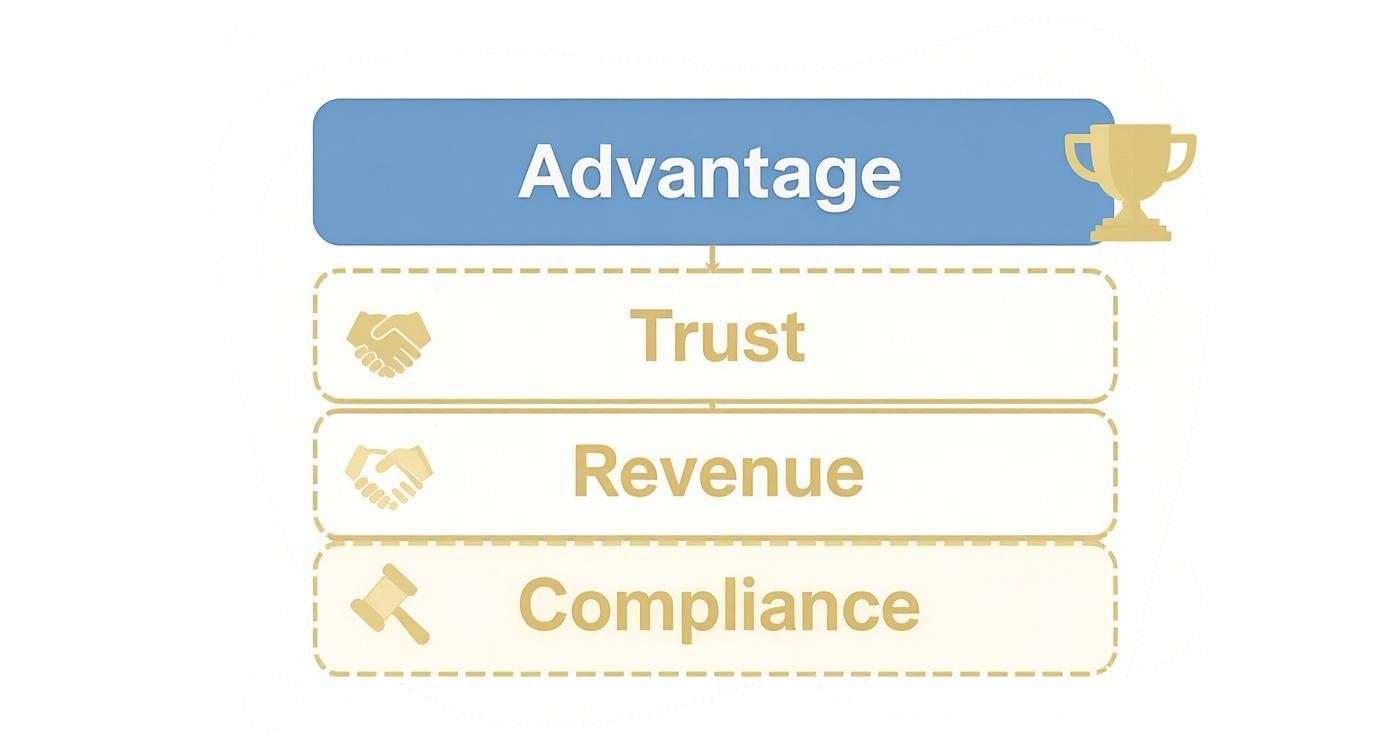
As the infographic makes clear, the payoff from certification goes way beyond just security—it directly impacts your bottom line.
The Management Clauses: Your ISMS Blueprint
The real foundation of the ISO 27001 standard is found in Clauses 4 through 10. These aren't technical instructions; they're the high-level, strategic rules for how you build, run, and maintain your ISMS. They give your security program its structure and rhythm.
Mastering these clauses is fundamental to a solid data security management practice, turning a chaotic process into a systematic one.
Let's translate a few of these clauses from "standard-speak" into plain English:
- Clause 4: Context of the Organisation: This is all about knowing your business. It forces you to look at internal and external factors (like new regulations or aggressive competitors) and understand what stakeholders (customers, staff, investors) expect from your security. It’s your strategic ground zero.
- Clause 5: Leadership: This one is non-negotiable. It demands that your top brass are fully on board and actively involved. They need to set the security policy, allocate the budget, and champion a security-conscious culture from the very top. An ISMS without leadership buy-in is doomed to fail.
- Clause 6: Planning: Here’s where you get proactive about risks. You'll run a formal risk assessment to figure out what threatens your information and then build a treatment plan to deal with those threats. This ensures you're spending your time and money on the vulnerabilities that matter most.
- Clause 8: Operation: This is the "get it done" phase. It’s all about implementing your risk treatment plan and the security controls you've chosen. This is where your policies and procedures come off the page and into your team’s daily work.
These clauses create a continuous loop of improvement—the famous Plan-Do-Check-Act (PDCA) model. It's what keeps your security sharp and resilient, not just a one-and-done project.
Annex A: Your Flexible Toolkit of Security Controls
If the management clauses are the blueprint, then Annex A is your toolbox. It’s a comprehensive catalogue of security controls organised into four themes: Organisational, People, Physical, and Technological. Now, here’s the most important thing to remember: you do not have to implement every single control.
This is one of the biggest myths about ISO 27001. Annex A isn’t a rigid checklist; it’s more like a menu of options. You only pick the controls that are relevant to the specific risks you uncovered back in your Clause 6 risk assessment.
Your risk assessment dictates your control selection. You apply the right tool for the job based on the actual threats you face, not because a list tells you to. This makes the standard incredibly flexible and scalable for businesses of all sizes.
For example, a small software company will likely lean heavily on technological controls like secure coding and cloud access management. A healthcare clinic, on the other hand, would place a much greater emphasis on organisational controls around patient confidentiality and physical controls for securing paper records.
This tailored approach is all documented in a critical file called the Statement of Applicability (SoA). Your SoA lists every control in Annex A and requires you to justify why you have (or have not) implemented it. It’s the document that bridges the gap between your risks and your real-world defences, and you can bet an auditor will review it with a fine-toothed comb.
Mapping ISO 27001 Clauses to Business Functions
To really drive this home, let's translate the formal ISO clauses into the business goals they actually serve. This table helps demystify the standard and reveals its direct relevance to what you do every day.
| Clause Number | Official Title | What It Really Means for Your Business |
|---|---|---|
| Clause 4 | Context of the Organisation | Understanding your business, your stakeholders, and their security expectations. |
| Clause 5 | Leadership | Getting the executive team to own the security strategy and fund it properly. |
| Clause 6 | Planning | Figuring out what could go wrong with your data (risk assessment) and making a plan to stop it (risk treatment). |
| Clause 7 | Support | Ensuring you have the right people, skills, awareness, and documents to make your security program work. |
| Clause 8 | Operation | Putting your security plans into action in your day-to-day operations. |
| Clause 9 | Performance Evaluation | Regularly checking if your security is actually working through monitoring, internal audits, and management reviews. |
| Clause 10 | Improvement | Using what you learn from incidents and audits to continuously strengthen your security over time. |
Once you break it down into these core components—the management blueprint and the flexible control toolkit—it becomes obvious that ISO 27001 isn't some abstract compliance headache. It’s a logical, business-first framework for building a more resilient and trustworthy organisation.
Your Strategic Roadmap to Achieving Certification
Getting started with ISO 27001 certification can feel a bit like planning a major expedition. It looks overwhelming from the outside, but once you have a clear map, it breaks down into a series of manageable stages. This isn't a mad dash to the finish line; it's a structured journey built around a powerful cycle of continuous improvement.
Think of this roadmap as your guide. It turns a massive project into achievable milestones, walking you through the key phases from initial planning to the final audit. It’s all about having a clear vision of the path ahead.
This strategic approach means every step you take is deliberate and builds on the last, guiding you straight to your certification goal.
Phase 1: The Plan Stage
This first phase is all about laying a rock-solid foundation for your Information Security Management System (ISMS). A common mistake is rushing this part, but getting the planning right makes everything that follows so much smoother. This is where you really nail down the 'why' and 'what' of your security project.
Your first job is to define the scope of your ISMS. You need to be crystal clear on which parts of your business it will cover. Are we talking about the whole organisation? Or just a specific team, office, or product line that handles sensitive information?
Once you've got the scope sorted, you absolutely must get leadership commitment. This is non-negotiable. Your executive team needs to be fully on board, ready to commit the right resources—both money and people—to see this through.
The final piece of the 'Plan' stage is the absolute cornerstone of the standard: the risk assessment.
- Identify Assets: Start by listing your critical information assets. This could be anything from customer databases and financial records to your unique intellectual property.
- Identify Threats and Vulnerabilities: Next, brainstorm all the things that could possibly harm these assets. Think cyber-attacks, system failures, and even simple human error.
- Analyse and Evaluate Risks: For each threat, you’ll figure out the likelihood of it happening and the potential damage it could cause to your business.
This process gives you a prioritised to-do list of your biggest security headaches, making sure you focus your energy where it’ll have the biggest impact.
Phase 2: The Do Stage
With your plan locked in, it’s time to get your hands dirty. The 'Do' stage is where you start building your defences based on the risks you’ve uncovered. This is where you turn all those strategic decisions into real, tangible security practices.
Your main task here is to create a Risk Treatment Plan. For every significant risk from your assessment, you'll decide on a plan of attack. You've generally got four options:
- Treat: Implement security controls (from Annex A) to bring the risk down to an acceptable level.
- Tolerate: Formally accept the risk. This usually happens when the cost of fixing it is way more than the potential damage.
- Terminate: Get rid of the risk completely by stopping the activity that causes it.
- Transfer: Share the risk with someone else, like by taking out a specific cybersecurity insurance policy.
After deciding how to handle each risk, you’ll start putting those security controls into practice. This might mean writing new policies, running security awareness training for your team, or setting up new technical safeguards. The crucial part? Document everything. Auditors will want to see solid proof that your controls are not just designed well, but are actually working.
Phase 3: The Check Stage
Now that your ISMS is up and running, you need to make sure it's actually doing its job. The 'Check' stage is all about monitoring and measuring how things are going. It’s how you confirm your security controls are effective and that everyone in the organisation is sticking to the plan.
This isn't a one-off check-up; it's a continuous process of observation. You’re on the lookout for any deviations from your policies and for chances to make improvements before they blow up into major problems.
A key activity here is conducting internal audits. An impartial internal auditor (or an external consultant you bring in) will review your ISMS against the ISO 27001 standard's requirements. Think of it as a "friendly" audit designed to spot any weaknesses before the official certification auditor shows up.
You’ll also hold regular management reviews. In these meetings, your leadership team will look at how the ISMS is performing, go over the internal audit results, and analyse any security incidents. This keeps the higher-ups in the loop and ensures the ISMS stays aligned with the company’s bigger goals.
Phase 4: The Act Stage and Certification
The final phase, 'Act', is all about fixing what’s broken and pushing for continuous improvement. Using the findings from your internal audits and management reviews, you’ll make the necessary tweaks to your ISMS. This closes out the Plan-Do-Check-Act cycle, which then starts all over again.
Once you’re confident your ISMS is mature and working well, and you've ironed out any issues from your internal audits, it’s time for the formal certification audit. This is the main event, and it's handled by an accredited external certification body.
The certification audit is split into two parts:
- Stage 1 Audit: The auditor reviews all your documentation—your scope, policies, risk assessment, and so on—to make sure your ISMS is designed correctly and meets the standard's requirements on paper.
- Stage 2 Audit: The auditor comes back for a deeper dive. They'll interview staff, watch processes in action, and check records to confirm your ISMS is fully implemented and working effectively in the real world.
If the auditor doesn't find any major issues, they’ll recommend your organisation for certification. Hitting this milestone is a massive validation of your commitment to information security and marks the successful end of your strategic journey.
What's the Real Cost and Timeline in Australia?
So, you're considering ISO 27001. It’s a smart move. But two questions are probably front of mind: "How much will this actually cost?" and "How long is this going to take?"
There's no single price tag. Think of it like building a house—the final cost depends on the size, complexity, and materials. A small bungalow has a very different budget and schedule to a multi-storey mansion. Your ISO 27001 journey is the same.
What’s important is to see this as a strategic investment, not just another line item on the expense sheet. Understanding the time and money involved from the get-go helps you build a strong business case and sets the project up for success. You're not just buying a certificate; you're investing in your company’s resilience and reputation in a tough Australian market.
Key Factors That Shape Your Investment
A few key variables will directly influence your budget and project plan. Getting a clear picture of these is the first step to figuring out what this will really look like for your business.
-
Company Size and Complexity: It's a simple equation. A 20-person startup with a straightforward network has a much shorter path than a large corporation with hundreds of staff across multiple locations. More people, more processes, and more systems naturally expand the scope, which means more work to implement and audit.
-
Your Current Security Posture: Where are you right now? If you already have solid security policies, conduct regular staff training, and have your procedures documented, you’ve got a serious head start. If you're starting from scratch, the initial gap analysis will reveal just how much ground you need to cover. This is often the biggest driver of both cost and time.
-
The Scope of Your ISMS: Are you aiming to certify the entire organisation, or just a specific, high-risk team that handles sensitive client data? Sharpening your focus on a smaller scope is a popular strategy. It can dramatically cut down the complexity and resources needed, getting you to the finish line faster.
Breaking Down the Main Costs
Your ISO 27001 budget will typically fall into three main buckets. Each one represents a different stage of the journey, from getting expert advice to earning that final, official stamp of approval.
-
Consultancy Fees: Most Australian businesses, particularly smaller ones, bring in an expert consultant to navigate the process. These specialists have been through it all before. They help you sidestep common mistakes, simplify your documentation, and get you ready for the audit. It’s an upfront cost, but a good consultant almost always saves you time and headaches in the long run.
-
Software and Tools: You could manage your Information Security Management System (ISMS) with a mountain of spreadsheets, but dedicated Governance, Risk, and Compliance (GRC) software makes life a lot easier. These platforms help with risk assessments, document control, and tracking your progress, giving you a central dashboard for your whole security program.
-
Audit and Certification Fees: This is the non-negotiable part. You pay an accredited, third-party certification body to conduct the Stage 1 and Stage 2 audits. After you’re certified, you’ll also need to budget for annual surveillance audits to keep your certification active, plus a full recertification audit every three years.
When you're adding it all up, remember to look beyond the direct expenses and think about the return, like measuring the ROI on training initiatives which is a core part of the standard.
Realistic Timelines and Budgets
Okay, let's talk numbers. While every project is different, we can give you a realistic idea of what to expect in Australia. For most small to mid-sized companies, the journey from start to certification typically takes three to six months. This gives you enough time to plan properly, roll out new security controls, and gather the evidence the auditor will need to see.
In Australia, the cost and process for ISO 27001 certification are shaped by a company's size, complexity, and industry. Typical certification costs here range between AUD 30,000 and AUD 80,000. This is higher than in some other regions, reflecting Australia's stringent regulatory and audit standards.
This investment covers the entire cycle: the initial certification, the yearly check-ins, and the recertification every three years. It's the price of doing business securely and meeting client demands in 2025 and beyond. You can get a deeper dive into what drives these figures by reading about the factors that determine ISO 27001 certification cost.
Think of It as a Strategic Investment, Not a Cost
It’s easy to get fixated on the price and view ISO 27001 as just an expense. But that’s missing the forest for the trees. This certification is one of the smartest investments you can make in your business’s future. It's not just about stopping bad things from happening; it’s about making great things possible.
Consider what it unlocks:
-
New Revenue Streams: For many large contracts, especially with government and big corporations, ISO 27001 isn't a "nice-to-have"—it's a deal-breaker. The investment can pay for itself with a single new client.
-
A Stronger Brand: In a world where data breaches are front-page news, your certificate is a powerful signal of trust and professionalism. It immediately sets you apart from the competition.
-
Better Efficiency: The process forces you to map out and streamline how you do things. Many businesses discover this leads to better, more efficient operations and fewer mistakes across the board.
Ultimately, figuring out the cost and timeline for ISO 27001 isn't about justifying an expense. It's about building a rock-solid case for an initiative that will protect your business, enhance your reputation, and set you up for long-term growth.
Common Questions About ISO 27001 Certification
Diving into the world of information security standards can feel like learning a new language. As you start to think about what ISO 27001 certification could mean for your business, it’s completely normal to have a few questions.
Let's clear the air. This section is all about tackling those frequently asked questions head-on, so you can walk away with a clear understanding of what this certification is all about and the value it can bring.
Is ISO 27001 a Legal Requirement in Australia?
This is probably the most common point of confusion, so let's get straight to it. The short answer is no, ISO 27001 is not a law that every single Australian business must follow. But that’s only half the story.
While the government hasn't made it mandatory across the board, it has very much become a contractual necessity. If you want to work with federal or state government departments, or even land a contract with a large corporation, having ISO 27001 certification is often the ticket to the game. It’s the proof they need that you take security seriously.
Think of it this way: laws like the Privacy Act 1988 say you must take "reasonable steps" to protect personal information. An ISO 27001 certificate is the gold standard for showing that you’ve done exactly that. So, while it might not be legally compulsory, it has become a powerful commercial must-have for any business looking to grow.
How Does ISO 27001 Differ from Other Frameworks?
It’s easy to get lost in an alphabet soup of security frameworks. Many of us in Australia are familiar with the Australian Cyber Security Centre's Essential Eight, so where does ISO 27001 fit in?
The best way to think about it is that ISO 27001 is the "how" and "why" of your security program, while a framework like the Essential Eight is the "what."
ISO 27001 gives you the strategic foundation—the overarching management system—to figure out which technical controls actually make sense for your business. It’s the brain that directs the body’s actions based on a real understanding of your risks.
Basically, ISO 27001 helps you build your Information Security Management System (ISMS). This is the whole shebang: the policies, the risk assessments, the processes, and the culture of continuous improvement. This system then gives you the clarity to decide which specific technical controls—like those in the Essential Eight—are the right fit for your unique situation. It gives you the strategy to manage all those technical details effectively.
Here’s a simple breakdown:
| Aspect | ISO 27001 | Essential Eight |
|---|---|---|
| Focus | Strategic management system (ISMS) | Specific, technical mitigation strategies |
| Nature | Risk-based and flexible | Prescriptive and technical |
| Goal | To build a holistic, continuously improving security program. | To prevent malware delivery, execution, and intrusion. |
| Analogy | The security command centre. | The specific tools used by the guards. |
Can a Small Business Realistically Achieve Certification?
Absolutely. This is probably the biggest myth out there. The truth is, ISO 27001 was designed from the ground up to be scalable. It's just as relevant for a 15-person tech startup as it is for a multinational bank.
The beauty of the standard is that it doesn't force a one-size-fits-all set of expensive tools or complicated procedures on you. The entire process is tailored to your business—your size, your complexity, and your appetite for risk.
A small business’s ISMS will naturally be far simpler and less resource-heavy than a major corporation’s.
- Simpler Documentation: Your policies and procedures will be shorter, sharper, and to the point.
- Smaller Scope: You can choose to certify just the part of your business that handles the most sensitive data.
- Fewer Controls: Your risk assessment will likely flag fewer high-priority risks, which means you’ll need to implement fewer of the controls from Annex A.
For a growing business, the return on investment is often even greater. The boost in client trust, a genuinely stronger security posture, and a serious competitive edge make it more than worthwhile.
What Happens After We Get Certified?
Getting that certificate is a huge milestone, but it's not the finish line. It's actually the starting line for an ongoing commitment to keeping your security sharp. The certificate isn't just a plaque for the wall; it’s a living testament to your dedication.
After you pass your initial audit, your certification is valid for three years. But to keep it active, you’ll need to complete annual surveillance audits.
These are much less intense than the first one. Think of them as a "health check" where the auditor confirms your ISMS is still running, you're following your own rules, and you're keeping an eye out for new risks.
Then, at the end of the three-year cycle, you'll go through a full recertification audit. This is a more comprehensive review, similar to your initial audit, to renew your certificate for another three years. This cycle ensures your security practices never get stale and continue to evolve right alongside the threats and your business goals, keeping you resilient for the long haul.
Ready to build trust and unlock new opportunities with ISO 27001 certification? Expert consultants can guide Australian businesses through the entire process, simplifying the complexities so you can focus on what you do best. Visit our ISO 27001 information page to learn how we can help you achieve certification and gain a powerful competitive edge.
Recent Comments