

Quick Summary: ISO accreditation is the formal recognition of a certification body's competence and impartiality by an authority like JAS-ANZ. It ensures the auditors are qualified. This is different from ISO certification, which is what your business receives after a successful audit, proving your management systems meet a specific standard.
When you first start looking into standards like ISO 27001, you'll hear two words thrown around a lot: accreditation and certification. They sound alike, and it's easy to mix them up, but they mean very different things. Understanding the definition of ISO accreditation from the start is crucial for making sure your eventual certificate is credible and holds real value for your business.
Think of it this way: accreditation is for the auditors (the 'testers'), while certification is for your business (the one being 'tested'). This separation is what gives the entire ISO system its integrity and answers the core question: what is ISO accreditation?
Decoding ISO Accreditation vs Certification
So, what’s the real difference between these two key terms? Let's use a simple analogy.
Imagine you need to get your driver's licence. You don't just ask a friend to sign you off; you have to go to an authorised testing centre that's been officially approved by the government to conduct driving tests.
- Accreditation is for the Testing Centre: A national accreditation body (like the government transport authority in our example) formally recognises that an organisation is competent, impartial, and qualified to carry out assessments.
- Certification is for the Driver: The authorised testing centre (the certification body) then assesses you. When you pass the test, they issue your driver's licence (your certification).
In the world of ISO, your business is the driver. Your ISO 27001 certificate is your licence, proving you meet the high standards for managing information security.
The Key Players in This System
This structure creates a clear hierarchy of trust and ensures an ISO certificate isn't just a piece of paper. It involves three distinct players:
- The Accreditation Body: This is the top-level authority that audits the auditors. They assess certification bodies to ensure they have the expertise and impartiality to do their job properly. In Australia and New Zealand, the main player here is JAS-ANZ.
- The Certification Body (or Registrar): This is the company you'll hire to audit your business against a specific ISO standard, like ISO 27001. Critically, they must be accredited by an official body like JAS-ANZ.
- Your Organisation: The business seeking certification to prove its commitment to security, quality, or other international standards.
To get a clearer picture, let's break down the core differences in a simple table.
Accreditation vs Certification: Key Differences
| Aspect | ISO Accreditation | ISO Certification |
|---|---|---|
| Who Gets It? | Certification Bodies (the auditors) | Your Organisation (the business) |
| What Does It Prove? | Competence & Impartiality: Proves the auditor is qualified to conduct audits against a specific standard. | Conformance: Proves your business management system meets the requirements of a specific standard. |
| Issued By | A national or international Accreditation Body (e.g., JAS-ANZ). | An accredited Certification Body. |
| Analogy | The government authorising a driving test centre. | The driving test centre issuing a driver's licence. |
Ultimately, this structure ensures a 'chain of trust' from the highest international authority right down to your certificate.
Choosing a certification body that holds accreditation is non-negotiable. An accredited certificate demonstrates that your business has been audited by a competent, impartial third party, which significantly boosts its credibility with clients, partners, and regulators. This is a core part of achieving genuine ISO compliance.
Who Audits the Auditors? A Look at Accreditation Bodies
So, who keeps the whole system of standards honest? That’s where accreditation bodies come in. Think of them as the ultimate referees in the world of quality and security. If a certification body is the expert who audits your business, the accreditation body is the one that audits the auditors.
Their entire job is to make sure the organisations handing out ISO certificates are competent, impartial, and follow the rules to the letter. This crucial oversight prevents the system from becoming a chaotic free-for-all where anyone with a printer can issue a worthless certificate. It builds a powerful chain of trust, giving an accredited ISO 27001 certificate real authority and respect worldwide. For any business leader, getting this distinction right is the difference between a meaningful achievement and an expensive piece of paper.
How They Keep the System Trustworthy
Accreditation bodies don't just give a thumbs-up based on a friendly chat. They operate under a strict global standard called ISO/IEC 17021, which lays down the law for any organisation that audits and certifies management systems. It's an incredibly thorough, almost forensic, look into a certification body's people, processes, and ethics.
This isn't a quick check-in. They dig deep into critical areas, asking tough questions like:
- Are the auditors actually experts? Do they have the right technical background and industry smarts to properly evaluate a complex Information Security Management System (ISMS)?
- Is the process free from bias? Are there strong safeguards to stop financial or other pressures from influencing an audit's outcome? Impartiality is non-negotiable.
- Is every audit consistent? Does a business in Perth get the same rigorous audit as one in Brisbane? The process must be fair and repeatable for everyone.
- Are records managed properly? Is sensitive information from audits handled securely and professionally?
By putting certification bodies through this wringer, an accreditation body gives you the confidence that your chosen partner operates with total integrity.
The Big Names in Australia and Beyond
Here in Australia and New Zealand, the main player is the Joint Accreditation System of Australia and New Zealand (JAS-ANZ). They're the official authority responsible for accrediting the certification bodies that operate locally. When you see that JAS-ANZ logo, it’s a clear signal that the certifier has been formally vetted and recognised for its competence under a framework trusted by both government and industry.
This layered system of oversight is what makes global trust possible. A certificate from a JAS-ANZ accredited body isn't just valid in Melbourne; it carries genuine weight in London, Tokyo, and New York.
How does that happen? Through organisations like the International Accreditation Forum (IAF). The IAF is basically the global club for accreditation bodies like JAS-ANZ. They create agreements ensuring that an accreditation in one country is recognised by all other members. This is the machinery that powers international trade, allowing your Australian business to show an ISO 27001 certificate to a client in Germany and have them instantly understand and trust its meaning. The IAF ensures a standard is truly standard, everywhere.
This gets to the heart of what ISO accreditation really is: it’s the bedrock of credibility for the entire certification system. Without it, an ISO 27001 certificate is just a document. With it, it’s a globally recognised symbol of verified security. Sure, you might find a cheaper, unaccredited certifier, but you’ll end up with a certificate that lacks the very authority you were trying to earn in the first place.
Your Roadmap to Accredited Certification
Deciding to pursue ISO 27001 is a major step in maturing your business's information security. It’s more than just a project; it’s a commitment to a structured, internationally recognised way of protecting your data. Let's walk through what that journey actually looks like, step-by-step.
It all starts with getting your house in order. Before an auditor ever walks through your door, you need to do the groundwork. This means preparing your internal systems, clearly defining the scope of your Information Security Management System (ISMS), and pulling together all the necessary documentation. This preparation is what makes or breaks the audit process down the line.
Once you feel ready, the next move is a big one: choosing an accredited certification body. It's absolutely crucial that you select a certifier recognised by a national accreditation body like JAS-ANZ here in Australia. This ensures the entire process is legitimate and that the certificate you earn at the end carries genuine, global authority.
This hierarchy of trust is what gives the whole ISO framework its weight. The diagram below shows how it all fits together, from the global oversight of the IAF right down to the certification body that will audit your business.
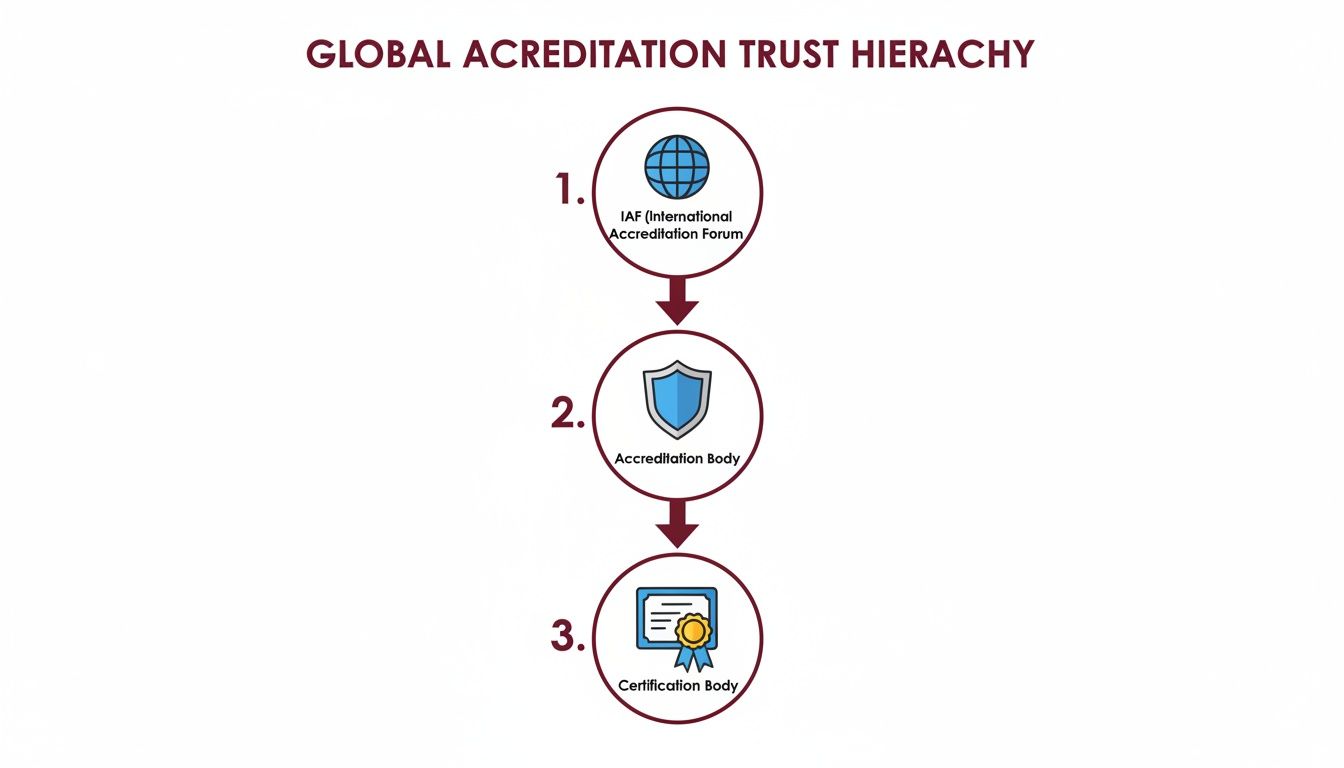
This top-down structure is precisely what gives your accredited certification its integrity. With an accredited partner chosen, you're ready to tackle the formal two-stage audit.
The Two-Stage Audit: A Closer Look
The certification audit isn’t a one-and-done event. It’s a two-part process designed to first check your readiness and then validate your real-world implementation. Each stage has a clear purpose, guiding you toward a successful certification without any nasty surprises.
Stage 1: The Documentation Review
Think of this as a ‘readiness review’. The auditor's main job here is to confirm you have a documented ISMS that, on paper, seems to meet all the requirements of ISO 27001. They aren't testing your controls in action just yet; they're making sure your plans and policies are all present and correct.
During this first stage, the auditor will be looking at key documents, including:
- Your Information Security Policy: This is the high-level document that signals your organisation's commitment to security.
- The Scope of your ISMS: A crystal-clear definition of which parts of your business the ISMS actually covers.
- Risk Assessment and Treatment Plan: The proof that you’ve identified your information security risks and have a plan to manage them.
- Statement of Applicability (SoA): The all-important document listing the controls you’ve implemented and why you’ve excluded any others.
After the Stage 1 audit, you’ll get a report that highlights any potential gaps. This isn't a pass-or-fail exam; it's constructive feedback designed to help you ace the main event.
Stage 2: The Implementation Audit
Once you’ve addressed any findings from Stage 1, it's time for the deep dive. In the Stage 2 audit, the focus shifts from reviewing documents to verifying that your ISMS is fully implemented and actually working in your day-to-day operations. They're looking for proof that you do what your documents say you do.
Auditors will interview your team across different departments, from IT and HR to the C-suite. They’ll also be collecting hard evidence that your security controls are effective. This could mean looking at access control logs, checking incident reports, reviewing staff training records, or seeing the minutes from management review meetings.
An auditor's mantra is often "show me, don't just tell me." They need to see real, tangible evidence that your policies aren't just sitting in a folder on a shelf—they're embedded in how your business runs.
If the auditors find any issues during Stage 2, they’ll raise them as 'non-conformities'. It’s important to understand what these are and not to panic.
Understanding Non-Conformities and Corrective Actions
A non-conformity is simply a case where your organisation hasn’t quite met a requirement of the ISO 27001 standard. They aren’t failures; they are opportunities to improve, and they are categorised by how serious they are.
- Major Non-conformity: This points to a significant problem in your ISMS, like a complete failure to implement a mandatory process. A major non-conformity has to be fixed and verified by the auditor before you can be issued a certificate.
- Minor Non-conformity: This is a smaller slip-up or an isolated incident that doesn’t threaten the whole system. You’ll need to submit a plan for corrective action, but it generally won't stop you from being certified.
For any non-conformity, you'll be required to create a corrective action plan. This means digging in to find the root cause of the problem and putting a solution in place to make sure it doesn’t happen again. This focus on constant improvement is at the very heart of all ISO standards.
For a detailed walkthrough of the entire certification journey, you can explore our guide on how to get ISO certified. Getting through this process confidently doesn't just get you the certificate; it sets you up to maintain and benefit from it for years to come.
Gaining Your Competitive Edge in Australia
Let’s be clear: getting an accredited ISO 27001 certification isn't just about ticking a compliance box. For Australian businesses, it's a strategic power-play. It’s an investment that builds rock-solid trust, unlocks real growth, and gives you a serious advantage in a very crowded market.
When you have that accredited certificate, you're sending a clear message. You're telling the world that your organisation doesn't just talk about information security—it lives and breathes it, with validation from the highest global authorities. This commitment opens doors to tangible commercial opportunities, especially here in Australia where it's fast becoming the price of entry for major supply chains. It's no longer a 'nice-to-have'; it's a 'must-have' to even get in the room.

Unlocking New Markets and Government Contracts
For many small and medium-sized businesses, the most immediate payoff of an accredited certification is market access. Big corporations and government departments are increasingly making ISO 27001 a non-negotiable requirement for their vendors. Why? Because they need absolute certainty that their sensitive data is safe in your hands, and an accredited certificate is the impartial proof they trust.
Without it, you might find your business shut out of tenders before you even get a chance to pitch, no matter how good your product is. But with it, you suddenly qualify for a whole new tier of clients who demand proven security excellence.
This is especially true when it comes to government contracts. As public sector agencies sharpen their focus on cybersecurity, they lean on established international standards to vet their suppliers. An accredited ISO 27001 certification shows them you have a robust Information Security Management System (ISMS) that aligns perfectly with their own strict risk management policies.
Building Unbreakable Client Trust and Brand Reputation
In today's business world, trust is everything. Your clients and partners are more aware than ever of the dangers of a data breach, and they need to know you're a responsible custodian of their information.
An accredited certification provides that confidence in a way a simple self-assessment never could. It's independent, third-party proof that your security practices have been put through their paces against a globally respected framework.
The impact on your brand is huge:
- It Makes You Stand Out: In a sea of competitors, it immediately sets you apart from those who haven't made the same commitment to security.
- It Smooths Out the Sales Process: It proactively answers crucial security questions, shortening sales cycles and overcoming hesitation from cautious prospects.
- It Forges Stronger Partnerships: It signals to potential collaborators that you are a reliable and secure partner, laying the groundwork for more resilient business relationships.
Ultimately, accredited ISO 27001 certification turns information security from a back-office expense into a powerful marketing asset. It becomes a compelling reason for clients to choose you over anyone else.
The strategic advantages are clear, touching every part of your business from sales to operations.
Strategic Benefits of Accredited ISO 27001 Certification
| Business Area | Specific Benefit | Impact on Small Businesses |
|---|---|---|
| Market Access | Qualify for tenders and contracts requiring certified security | Unlocks access to larger corporate and government clients that were previously out of reach. |
| Brand & Reputation | Builds demonstrable trust and enhances brand credibility | Creates a powerful competitive differentiator, making it easier to win new business. |
| Sales & Marketing | Overcomes security objections early in the sales cycle | Shortens sales cycles and provides a tangible marketing asset to promote. |
| Operational Efficiency | Streamlines processes and clarifies security responsibilities | Reduces errors and creates a more organised, predictable operational environment. |
| Risk Management | Establishes a formal framework for identifying and mitigating threats | Dramatically lowers the risk of a costly and reputation-damaging data breach. |
| Partnerships | Attracts high-quality partners seeking secure collaborators | Fosters stronger, more resilient business-to-business relationships built on mutual trust. |
Achieving accredited certification is a strategic move that delivers measurable returns across the board.
Enhancing Operational Efficiency and Resilience
Beyond winning new business, the journey to accredited certification brings about profound improvements inside your organisation. The process of implementing an ISMS forces you to take a hard look at your own operations, identify weak spots, and put clear, effective security procedures in place.
This structured approach naturally leads to better operational efficiency. By defining roles, standardising processes, and fostering a security-aware culture, you minimise the risk of human error—a leading cause of security incidents. The result is a more resilient and predictable business.
What's more, a certified ISMS gives you a solid framework for cybersecurity governance. It ensures security isn't just an IT issue but a core part of your strategic planning. This proactive approach significantly cuts the risk of a devastating data breach.
The market demand is undeniable. The Australian ISO Certification market is set to grow at a compound annual growth rate (CAGR) of 16.7%, projected to reach a market size of USD 122.7 million. This boom shows just how essential Australian businesses believe certification is for staying competitive. You can explore more insights about the broader Asia-Pacific ISO certification market to see the full picture.
This trend makes one thing clear: investing in an accredited ISMS isn't just about meeting today's requirements. It's about preparing for tomorrow's expectations and building a foundation for sustainable, long-term growth. You're not just getting certified; you're future-proofing your business.
The Future of Australian Business Compliance
It’s becoming clearer every day: accredited ISO 27001 certification is shifting from a nice-to-have to a non-negotiable for Australian businesses. What was once a way to get a leg up on the competition is fast becoming the standard price of entry for any company that takes security and growth seriously. This isn't just an internal shift; it's being driven by the very clients and partners you want to work with.
Major corporations and government departments are leading the charge. They're increasingly making accredited ISO 27001 a baseline requirement for their suppliers and contractors. It makes sense, doesn't it? They need to know their supply chain is secure, and an accredited certificate is the most reliable, independent proof that a partner can be trusted with sensitive data. For Australian businesses, this means the road to landing those big, lucrative contracts now runs straight through verified compliance.
The New Standard for Government and Enterprise
The trend is undeniable: ISO 27001 is cementing its place as the bedrock of cybersecurity governance in Australia. Getting certified now isn't just about ticking a box for today's tenders; it’s about future-proofing your business for the regulations and requirements that are just around the corner. Acting now puts you ahead of the curve, ready to jump on opportunities while your competitors are still scrambling to catch up.
The Australian government has been a major force here, pushing for wider adoption of robust Information Security Management Systems (ISMS). The results speak for themselves. Queensland Government organisations, for instance, reported an incredible 68% growth in ISMS adoption across its departments up to 2024, thanks to a focused cybersecurity uplift program. You can get a deeper understanding of this by reading about the master framework for Australian ISMS governance.
This government-led push sets a powerful precedent. It’s a strong signal that by 2026, ISO 27001 will likely be standard practice everywhere, making it an essential credential for staying in the game.
A Proactive Strategy for Long-Term Success
This leaves business leaders with a pretty clear choice. You can wait until compliance is mandatory, which almost always means rushing to meet deadlines under pressure—a stressful, costly, and disruptive process. Or, you can embrace the standard now. Taking that step demonstrates foresight and a real commitment to security that high-value clients and partners notice and respect.
When you start the journey to accredited certification today, you’re doing more than just getting ready for future rules. You're building a fundamentally more secure, efficient, and trustworthy organisation from the inside out. It's a strategic investment that will pay dividends for years to come, strengthening your place in the market and ensuring you remain a go-to partner in an economy that values security more than ever.
Integrating ISO with Broader Compliance Duties
Of course, ISO 27001 is just one piece of the puzzle, albeit a very important one. It gives you a world-class framework for managing information security, but it needs to sit on a solid foundation of your broader business obligations.
A truly resilient company knows that specific certifications need to be supported by general regulatory and legal adherence. Beyond ISO, you still need to have all your other ducks in a row. You can explore a general small business compliance checklist to make sure you've got the fundamentals covered. This holistic approach—marrying a specific standard like ISO 27001 with your general business duties—is the sign of a mature, well-run organisation. It ensures that while you’re aiming for global security standards, you never lose sight of your local responsibilities.
Achieve ISO 27001 Success with a Proven Partner
Getting your head around ISO accreditation is one thing, but actually turning that knowledge into an ISO 27001 certificate is the real mountain to climb. Going it alone can be a massive drain on your time and resources, pulling you and your team away from what you're actually meant to be doing—running your business.
This isn't about just handing off the responsibility. Partnering with an expert is a strategic move. It's an investment in getting it done efficiently, with certainty, and without the headaches.
With over two decades in the trenches and a 100% success rate, we've honed a methodology that works. We’ve seen it all, and we guide Australian businesses smoothly from that first "where do we even start?" meeting right through to holding the certificate in their hands. We wrangle the complexity so you don't have to.
Your End-to-End Certification Journey, Simplified
The path to ISO 27001 isn't a straight line; it's a series of crucial stages, each demanding specific expertise. Our job is to be your guide on that path. We don't just send you a map and wish you luck—we walk it with you, becoming a genuine extension of your team.
Here’s what that partnership looks like in practice:
- Initial Gap Analysis: First things first, we get under the hood of your current security setup. We measure it against the ISO 27001 standard to create a clear, no-nonsense roadmap of exactly what needs to happen.
- Documentation and ISMS Development: This is often the most dreaded part. Our team rolls up their sleeves and helps you craft all the necessary policies, procedures, and the overarching Information Security Management System (ISMS) itself.
- Implementation Support: A plan is useless if it just sits on a shelf. We provide practical, hands-on guidance to help your team embed the new security controls and processes into their daily work.
- Internal Audits: Before the big day, we put your system through its paces with a tough internal audit. This is our chance to find and fix any potential issues before the official auditors even walk through the door.
- Certification Body Liaison: We’ll help you choose the right JAS-ANZ accredited certification body for your business and then handle the communication throughout the entire two-stage audit process.
It’s all structured to take the stress and guesswork out of the equation.
The Anitech Advantage
Our deep experience means we get the unique pressures Australian businesses are under. We know how to translate the dense, jargon-filled compliance standards into practical steps that actually make sense for your company culture and how you operate. For any business serious about this, mastering compliance, risk, and governance in ITSM is non-negotiable, as it’s the very foundation of a robust security system.
Our goal isn’t just to get you a certificate for the wall. It’s to help you build a truly resilient security framework that protects your business, earns your clients’ trust, and opens doors to new opportunities.
Ultimately, working with a seasoned expert turns a daunting compliance hurdle into a real strategic advantage. If you're ready to lock down your security and stand out from the competition, our dedicated ISO consultants have the expertise to make it happen. Don't leave your certification to chance; start your journey with a partner who guarantees you'll get there.
Your Top ISO Questions Answered
Diving into the world of ISO standards can feel a bit overwhelming at first. It's only natural to have questions. Here, we tackle some of the most common queries we get from Australian businesses just like yours, giving you the clear answers you need to get started.
How Long Does The ISO 27001 Certification Process Take?
There's no single answer here, but for a small to medium-sized business, you're typically looking at a journey of between 6 to 12 months.
What makes the timeline shorter or longer? It really boils down to three things:
- Your starting point: Do you already have some solid security practices in place, or are you starting from scratch?
- The complexity of your business: A single-office operation will have a more straightforward path than a multi-site company with intricate processes.
- Your team's availability: How much time can your people realistically dedicate to the project?
This timeframe covers everything from the initial gap analysis and building your documentation, right through to the final two-stage audit.
What Is The Real Difference Between Accredited And Unaccredited Certifiers?
This is probably one of the most important questions you can ask, and the difference is massive. Think of it like this: an accredited certifier is like a university-qualified surgeon, while an unaccredited one is like someone who just claims they can do surgery.
Accredited certifiers have been rigorously vetted by an official, independent body (in Australia, that's JAS-ANZ). This process confirms they are competent, unbiased, and follow strict international auditing rules. It’s your guarantee of quality.
An unaccredited certifier, on the other hand, operates without any of that oversight. They might be cheaper, but the certificate they issue is often not worth the paper it's printed on. When it comes to winning government tenders, satisfying major clients, or building genuine trust, an accredited certificate is the only one that truly counts.
What Is The Typical Cost Of ISO 27001 For A Small Business?
The total investment for ISO 27001 certification is made up of a few parts: the certification body's audit fees, your team’s time, and any expert consulting fees if you bring in a partner to help.
While it’s tempting to ask for a single number, the cost varies quite a bit depending on your business's size and complexity. The auditor's fees alone are often calculated based on things like your employee count.
But looking at it purely as a "cost" misses the bigger picture. This is an investment. It’s an investment in your company’s resilience, your reputation, and your ability to win bigger and better contracts. The return you get from that is far more valuable than the initial outlay.
Ready to turn compliance into a competitive advantage? Anitech has guided hundreds of Australian businesses to ISO 27001 success with a proven, stress-free methodology. Start your certification journey with a partner who guarantees results. Learn more at https://iso-27001.com.au.
Recent Comments