

For any Australian business that accepts credit or debit card payments, understanding PCI compliance is not merely a recommendation—it is a fundamental requirement. Compliance involves adhering to the Payment Card Industry Data Security Standard (PCI DSS), the global rulebook for safeguarding customer card information. Viewing PCI DSS not as a regulatory burden but as the cornerstone of customer trust is crucial for success and longevity in today's digital economy.
Why PCI Compliance is Critical for Your Australian Business

Whether you operate a small café in Perth or a large e-commerce platform based in Sydney, card payments are integral to your operations. This convenience, however, carries a significant responsibility: the protection of your customers' sensitive financial data. This is where PCI compliance transcends being a simple checkbox exercise and becomes the very foundation of your business's reputation and credibility.
Consider for a moment the catastrophic consequences of a data breach. The impact extends far beyond immediate financial penalties; it can lead to a complete and often irreversible erosion of customer loyalty. Once that trust is broken, rebuilding it is an arduous, if not impossible, task. Demonstrating robust PCI DSS compliance signals to your customers that you take their security seriously—a commitment that consumers increasingly value and expect.
The Foundation of Data Security
The Payment Card Industry Data Security Standard (PCI DSS) was established in 2004, creating a unified global benchmark for the protection of cardholder data. Australian businesses have been integral to this ecosystem from the beginning. With the number of credit card users in Australia exceeding 12.52 million and approximately 43.77 million active debit cards in circulation as of 2025, the imperative for stringent security measures has never been more pronounced.
The standard is structured around 12 core requirements, meticulously designed to protect card data from fraud, theft, and unauthorized access. These comprehensive rules govern every aspect of the payment ecosystem, from constructing and maintaining a secure network to implementing robust access control measures and regularly testing security systems. Together, they create a multi-layered defence system that envelops every transaction.
Navigating the New Rules of PCI DSS 4.0
The cybersecurity landscape is in a constant state of flux, and to remain effective, PCI DSS must evolve in tandem. The latest iteration, PCI DSS 4.0, became the mandatory standard on 31 March 2025, introducing some of the most significant changes in the standard's history. This new version is designed to be more flexible, shifting towards an objective-based approach. This allows organizations to customize their security controls to better fit their specific technological environments and risk profiles, provided they can demonstrate that the underlying security objectives are met.
Here is a summary of the key changes introduced in PCI DSS 4.0:
- Stronger Authentication Controls: Multi-factor authentication (MFA) is now a mandatory requirement for all access into the cardholder data environment, without exception.
- Enhanced E-commerce Security: New requirements have been introduced to specifically address modern threats such as digital skimming on payment pages.
- Increased Flexibility: Organizations now have more autonomy in determining how they achieve security outcomes, rather than being prescribed a rigid set of controls.
- More Frequent Testing: The standard now mandates more regular and thorough validation of security controls to ensure their ongoing effectiveness.
PCI DSS 4.0 represents more than just an update; it signifies a fundamental shift in the security mindset. It encourages businesses to view security not as a static, annual audit, but as a continuous, risk-managed process that is woven into the fabric of their daily operations.
Let's delve deeper into some of the most critical changes in PCI DSS 4.0 and their practical implications for your business operations.
PCI DSS 4.0 Key Changes for Australian Businesses
| Requirement Area | Key Change in PCI DSS 4.0 | Impact on Australian Businesses |
|---|---|---|
| Authentication | Mandated multi-factor authentication (MFA) for all access to the cardholder data environment (CDE). | Businesses must implement and enforce MFA solutions across all systems that store, process, or transmit card data, extending beyond just remote access. This often necessitates investment in new technology and comprehensive user training. |
| Password Policies | Increased minimum password length to 12 characters and implemented enhanced complexity requirements, moving away from simple time-based rotation. | You will need to update your organization's internal password policies and configure systems to enforce these more robust rules for all user accounts, service accounts, and system credentials. |
| E-commerce Security | New requirements to manage all scripts running on payment pages and implement technical mechanisms to protect against skimming attacks (e.g., Magecart). | E-commerce businesses are now required to actively inventory, authorize, and control all scripts on their payment pages, adding a significant new layer of web application security management. |
| Vulnerability Scanning | Authenticated internal vulnerability scans are now required. This is in addition to the previously mandated unauthenticated scans. | Your IT security team or external security provider must now conduct more in-depth internal scans that can identify vulnerabilities from the perspective of an authenticated user, providing a much deeper view of potential security weaknesses. |
| Risk Analysis | A formal, targeted risk analysis is required for any control where the new "customised approach" is utilized. | If you opt for the increased flexibility of the customised approach, you must meticulously document how your chosen control meets the standard’s objective and why it is appropriate for your specific risk profile, which increases the documentation burden. |
These changes compel Australian businesses to adopt a more proactive and strategic approach to cybersecurity, moving away from a reactive, compliance-focused posture.
The Steep Cost of Non-Compliance
To be clear: ignoring PCI DSS is a direct path to significant business disruption and financial loss. The financial penalties for non-compliance can be severe, with fines reaching as high as USD 100,000 per month for major data breaches. These penalties are not imposed by government bodies but are levied by the major card brands (such as Visa, Mastercard, and American Express) through your acquiring bank.
And the direct fines are just the beginning. The cascading effects of a breach can be even more damaging:
- Forensic Investigation Costs: You will be required to fund a detailed investigation by a PCI Forensic Investigator (PFI) to determine the cause and extent of the breach.
- Card Re-issuance Fees: The banks will pass on the substantial costs associated with reissuing compromised cards to affected customers.
- Increased Transaction Fees: Your payment processor may increase your transaction rates as a penalty for the increased risk you represent.
- Loss of Your Merchant Account: In the most severe cases, you could have your merchant account terminated, effectively losing the ability to accept card payments entirely.
While maintaining focus on PCI DSS, astute Australian businesses also integrate broader data protection principles into their governance frameworks. It is often beneficial to consider regulations like those outlined in a GDPR compliance checklist to cultivate a truly comprehensive and resilient data governance strategy.
Ultimately, investing in robust compliance is not an expense—it is a critical investment in the long-term viability and survival of your business.
Accurately Defining Your Compliance Scope
Before you can construct a secure fortress, you must have a precise blueprint of the assets you are protecting. In the context of PCI compliance in Australia, this blueprint is your Cardholder Data Environment (CDE). The CDE is not limited to technology; it encompasses every person, process, and system that stores, processes, or transmits customer cardholder data or sensitive authentication data.
Defining this scope accurately from the very beginning is the single most impactful action you can take to make your compliance journey smoother, faster, and more cost-effective. A well-defined, tightly segmented CDE translates to fewer systems that require stringent controls, a reduced number of controls to implement and maintain, and a much clearer and more manageable path to validation.
Conversely, an poorly defined scope leads to the dreaded "scope creep." When the boundaries of the CDE are unclear, every connected system can potentially be dragged into scope, causing your compliance costs and workload to spiral out of control.
Mapping Your Cardholder Data Environment
It is time to become a data detective. Your primary mission is to meticulously trace the entire lifecycle of cardholder data as it flows through your business. You must identify every point of entry, every system it touches, and every point of exit.
Begin by identifying every single touchpoint where you accept payments. This could be a physical EFTPOS terminal at your retail counter, a payment gateway integrated into your website, a mobile app, or a virtual terminal used for processing phone orders. Once these entry points are identified, you must map every system, application, and network segment that this sensitive data interacts with.
Your data flow map must be exhaustive. Ensure you include:
- Point-of-Sale (POS) Systems: This includes the physical terminals, tablets, mobile devices, or software applications used for face-to-face transactions.
- E-commerce Platforms: Your website’s shopping cart, payment processing pages, and any third-party plugins or APIs that handle payment information.
- Network Infrastructure: The routers, switches, firewalls, Wi-Fi access points, and other network devices that carry payment traffic.
- Servers: Any web servers, application servers, or databases where cardholder data might be processed or stored, even if only for a brief moment in transit.
- Third-Party Integrations: This includes payment processors, fraud detection services, analytics platforms, and even accounting software that connects to your payment systems.
The following graphic illustrates the core pillars of the PCI DSS framework, all of which are built upon the foundational step of accurately defining what needs to be protected.
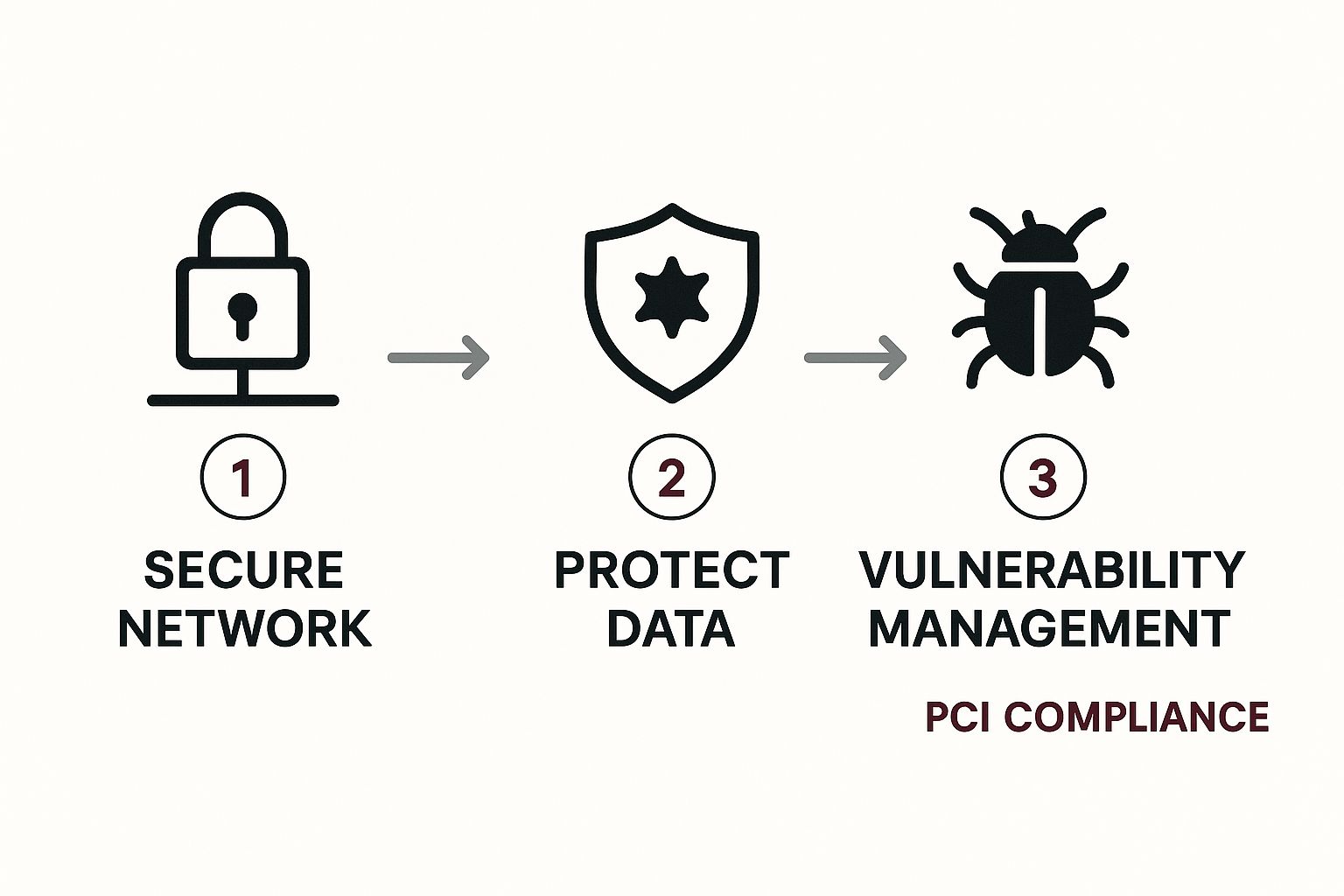
As this illustrates, every security effort, from building a secure network to protecting stored data, originates from a clear and accurate understanding of your CDE.
Real-World Scenarios and Common Mistakes
Let's examine two common Australian business scenarios to understand how dramatically the compliance scope can vary.
Scenario A: The Sydney Cafe
A small, popular cafe in Sydney uses a standalone EFTPOS terminal provided by their bank. This terminal connects directly to the payment processor using its own dedicated cellular (4G) connection. They never manually key in card details into any other system, and the receipts they print correctly mask the full card number.
- Their CDE is extremely small. It consists solely of the EFTPOS terminal itself. Because all payment processing is completely isolated from their other business systems, their internal office network, staff computers, and the free guest Wi-Fi network are all safely out of scope. This makes their compliance validation process incredibly straightforward, likely requiring only a simple SAQ.
Scenario B: The Melbourne Online Retailer
A growing e-commerce fashion brand in Melbourne operates a more complex environment. They use a popular e-commerce platform but have developed a custom integration that synchronizes payment data with their inventory management and CRM systems. Additionally, their customer service team frequently takes phone orders, entering card details into a web-based virtual terminal on their office computers.
- Their CDE is significantly larger and more complex. It now includes their website, the web server hosting it, the virtual terminal application, and every single workstation used by the customer service team. Critically, if these workstations are on the same network as other office computers without proper segmentation, the entire office network could be considered in-scope for PCI DSS.
A classic and costly mistake for the Melbourne retailer would be operating their entire business on a single, "flat" network. This lack of segmentation means their entire office IT infrastructure—from the marketing team's computers to the finance department's servers—could be deemed part of the CDE, dramatically increasing their compliance burden, security risks, and overall costs.
The primary strategic goal of scoping should always be to minimize the size of the CDE. Every system, network, or process you can effectively isolate from cardholder data is one less asset that needs to be subjected to the rigorous and costly controls of PCI DSS.
The Power of Network Segmentation
This leads us to one of the most powerful and effective tools in your compliance arsenal: network segmentation. In simple terms, this involves using firewalls and other access control technologies to build digital walls that completely isolate the CDE from the rest of your business network.
Think of it as constructing a high-security vault within your main office building. The vault (your CDE) has extremely strict access controls, surveillance, and fortified walls. Meanwhile, day-to-day business activities can continue safely outside the vault. An employee browsing the internet on their computer in the main office cannot inadvertently create a pathway for a threat to enter the secure payment environment.
When implemented correctly, network segmentation can:
- Drastically Reduce Scope: By isolating payment systems, you ensure that only a small, well-defined, and manageable part of your IT infrastructure is subject to the full set of PCI DSS requirements.
- Lower Compliance Costs: Fewer systems in scope mean less expenditure on audits, penetration tests, file integrity monitoring, and other specialized security tools and services.
- Improve Overall Security: Segmentation is a core security principle that helps contain threats. A security breach in a less sensitive area, such as a marketing server, cannot easily propagate to your critical payment systems.
Don't Overlook Third-Party Connections
Finally, a critical and often overlooked aspect of scoping involves your network of third-party service providers. Your CDE does not end at your firewall if you have integrations with external services that handle, store, or process card data on your behalf. You must account for every payment gateway, software-as-a-service (SaaS) provider, cloud hosting provider, and managed IT service provider in the payment chain.
You are ultimately responsible for ensuring that these third parties are PCI compliant and that your connection to their services is secure. This requires conducting due diligence before entering into contracts and regularly verifying their compliance status. Effective third-party risk management is essential for protecting your business and your customers, as a vulnerability in a partner's system can all too easily become your next catastrophic data breach.
Getting Hands-On with PCI DSS 4.0 Technical Controls

With your compliance scope accurately defined, it’s time to delve into the practical implementation of key technical controls. The transition to PCI DSS 4.0 has significantly sharpened the focus on modern web-based threats, particularly those that target the checkout and payment pages of e-commerce sites. These are not theoretical risks; they are the active threats responsible for some of the most widespread and damaging data breaches in recent years.
For many Australian businesses I've worked with, especially those in the online retail sector, two new requirements have presented the most significant challenges: managing payment page scripts (Requirement 6.4.3) and deploying automated tamper detection mechanisms (Requirement 11.6.1). Let's break down what these requirements truly entail and provide practical guidance on how to implement them effectively.
Nailing Requirement 6.4.3: Payment Page Scripts
This requirement is a direct response to the surge in digital skimming attacks, often referred to as Magecart-style attacks. In this scenario, cybercriminals inject malicious JavaScript code into a website's payment page. This code then surreptitiously captures credit card details in real-time as the customer types them in, sending the stolen data to a server controlled by the attacker. It is a stealthy, sophisticated, and highly effective method of data theft.
Requirement 6.4.3 is unequivocal: you must maintain a complete and accurate inventory of every single script that is loaded and executed on your payment pages. But it doesn't stop there. You must also have a documented justification for why each script is absolutely necessary for the payment process to function.
So, how do you begin?
- Build Your Script Inventory: The first step is to conduct a thorough audit to identify every script running on your checkout pages. This includes scripts for analytics, marketing pixels, customer support chat widgets, A/B testing tools, and, of course, the primary payment processing script. You can start by using your browser’s built-in developer tools, but specialized security solutions will provide a much more comprehensive and continuous view.
- Justify Every Single Script: Critically evaluate each script on your list by asking a simple, uncompromising question: "Is this script absolutely essential for the payment page to function correctly?" If a script's primary purpose is marketing analytics, user behavior tracking, or any other non-essential function, it has no place on the page where sensitive card details are entered.
- Document and Authorise It: Formalize your findings in a dedicated policy document. This document should list every authorized script, its purpose, and the justification for its presence on the payment page. This document becomes your authoritative baseline. It must be approved by management, and any request to add a new script to the payment page must go through a formal review and approval process.
The strategic goal here is simple: minimize your attack surface. Every additional script on your payment page represents another potential entry point for an attacker. By stripping it down to the bare essentials, you dramatically reduce your risk profile.
Remember, this is not a one-time task. This inventory and justification process must be repeated regularly, especially after website updates, the introduction of new features, or changes to third-party integrations.
A Real-World Example
Imagine an online retailer based in Brisbane. Their development team uses various scripts across their product pages for Google Analytics, a customer feedback tool, and a social media tracking pixel. Historically, these same scripts were also loaded on the final checkout page.
Under PCI DSS 4.0, this configuration is a major compliance violation. To meet Requirement 6.4.3, they had to re-architect their website to prevent these non-essential scripts from loading on the payment page. Their final, compliant inventory for that critical page now looks something like this:
- The primary JavaScript file from their payment gateway (e.g., Stripe.js).
- A dedicated script from a specialized fraud detection service.
- A core JavaScript library essential for the page's basic functionality.
Everything else is strictly blocked from this highly sensitive zone. This single change makes them a much more difficult target for digital skimming attacks.
Implementing Requirement 11.6.1: Tamper Detection
While script management is about preventing malicious code from being introduced, Requirement 11.6.1 acts as a vigilant watchdog, designed to detect unauthorized changes if they do occur. This control mandates the implementation of an automated system to detect any modifications to your payment pages.
It focuses specifically on two key areas:
- HTTP Headers: The mechanism must monitor for any unauthorized changes to critical security headers, particularly the Content Security Policy (CSP), which acts as a bouncer, defining which resources are permitted to be loaded on your page.
- Payment Page Content: The system must actively monitor for any tampering with the HTML and scripts on the live payment page as it is rendered in the user's browser.
The standard requires that this check be performed at least once every seven days, or more frequently if indicated by your organization's risk assessment. Attempting to manually check your site on a weekly basis is neither feasible nor reliable. This is a clear case where automation is no longer a "nice to have"—it is an absolute necessity.
Picking Your Tamper Detection Method
You have several different approaches you can take to meet this requirement, each with its own set of advantages.
| Method | How It Works | Best For |
|---|---|---|
| Client-Side Monitoring | A security script runs within the end-user's browser, monitoring the page in real-time for any malicious activity, unauthorized DOM changes, or script modifications. | Businesses seeking immediate, real-time alerts and the ability to detect and potentially block in-browser threats as they occur. |
| Server-Side Scanning | An automated tool periodically scans your live website from an external perspective, comparing the current state of the page against a known-good, trusted baseline version. | Businesses looking for a simpler, agentless solution that effectively fulfills the requirement for periodic compliance checks without modifying the client-side experience. |
| File Integrity Monitoring (FIM) | Software installed on your web server continuously monitors your website's source code files, generating an alert if any file is added, modified, or deleted without authorization. | Businesses with direct server access who want to detect unauthorized changes at the source, potentially before they are deployed to the live environment. |
Regardless of the tool or method you choose, it must be automated, and it must generate an alert immediately upon detecting an unauthorized change. This alert must be directed to the appropriate personnel who are responsible for and capable of initiating an immediate incident response.
With PCI DSS 4.0 becoming mandatory in Australia from 31 March 2025, local businesses have had to rapidly adapt to these new technical requirements. Requirements 6.4.3 and 11.6.1 became prominent topics of discussion following industry roundtables in Melbourne and Sydney, which highlighted the significant challenges organizations faced in securing modern web payment channels. These controls are a direct and necessary response to the evolving threats targeting Australia's digital economy. You can gain further insights by reviewing industry discussions on PCI compliance discussions in Australia.
Ultimately, these technical controls form non-negotiable layers in your defence-in-depth security strategy. Regular system assessments are vital, and for many businesses, this means engaging experts for formal security testing. It is often prudent to explore how professional penetration testing services can validate your controls and identify vulnerabilities before malicious actors can exploit them. This proactive security mindset is the very essence of maintaining robust PCI compliance in Australia.
Securing Card Not Present Transactions in Australia

As Australian commerce has decisively shifted towards digital channels, Card Not Present (CNP) transactions have become the dominant mode of payment. Every time a customer makes a purchase on your website, places an order over the phone, or pays a recurring invoice, they are conducting a CNP transaction. While this digital transformation has been incredibly beneficial for business growth, it has also created a fertile ground for fraudsters.
Let's be direct: in the absence of a physical card and the established security of chip-and-PIN technology, CNP payments are inherently riskier. A criminal no longer needs to physically steal or clone a card; they only need to obtain the cardholder's data. This fundamental difference has elevated CNP fraud to the top of the threat list for any organization serious about achieving and maintaining PCI compliance in Australia.
The Rising Tide of CNP Fraud
The explosive growth in e-commerce and remote payments has necessitated a stronger regulatory and security response. Consequently, the stricter PCI DSS 4.0 rules, which came into full effect from April 2025, place a significant emphasis on mitigating the vulnerabilities associated with CNP transactions. Given the historically higher rates of fraud in CNP channels, this focus is both logical and necessary. It serves as a clear directive that Australian businesses must continuously adapt and enhance their security measures to keep pace with evolving digital payment trends and the sophisticated tactics of fraudsters.
For the small and medium-sized businesses that constitute the backbone of the Australian economy, mastering CNP security is non-negotiable. It is about preserving the hard-earned trust of your customers and avoiding the financially devastating consequences of a data breach.
The core vulnerability in any CNP transaction is authentication. How can you be certain that the individual on the other side of the transaction is the legitimate cardholder? This element of uncertainty is precisely the gap that criminals are adept at exploiting.
Fraudsters employ a diverse playbook to steal card data, ranging from large-scale data breaches that compromise millions of records to highly targeted phishing scams aimed at individuals. This means that a basic firewall and antivirus software are no longer sufficient. You need a multi-layered defence strategy that is specifically designed for the CNP environment.
Virtual Terminals: A Smarter Way to Take Payments
One of the most effective tools in your security arsenal for handling CNP transactions, particularly for orders taken over the phone or via mail, is the virtual terminal.
A virtual terminal is essentially a secure, web-based version of a physical EFTPOS machine. Instead of swiping a physical card, your authorized staff members log into a secure online portal provided by your payment processor and manually key in the customer's payment details.
The security advantage of this approach is immense. The cardholder data is entered directly into the payment processor's highly secure, PCI DSS compliant environment. Crucially, this sensitive data never touches your own internal systems, your local network, or even the hard drive of the workstation it was typed on. This single architectural choice can dramatically reduce your PCI compliance scope and overall risk profile.
Here’s why virtual terminals are so effective:
- Shrinks Your Scope: By ensuring cardholder data never enters your network, you significantly simplify your PCI DSS obligations and reduce the number of systems that need to be secured.
- Boosts Security: The data is encrypted at the point of entry and transmitted directly to the processor, protecting it throughout its journey.
- Offers Flexibility: Authorized personnel can securely process payments from any internet-connected computer, enabling remote work and operational agility.
However, a virtual terminal is not a panacea. You must still ensure that the computers used to access it are secure (e.g., patched, running antivirus software), that staff are properly trained on secure procedures (e.g., never writing down card details), and that you have implemented strong access controls to prevent unauthorized use.
Layering Your Defences: MFA and Tokenization are Non-Negotiable
Relying on a single security control is a recipe for failure. To adequately secure your CNP transactions, you must layer multiple, complementary technologies. Two of the most powerful and essential technologies are multi-factor authentication (MFA) and tokenization.
Multi-Factor Authentication (MFA) is a cornerstone of modern cybersecurity and is now a mandatory requirement under PCI DSS 4.0 for all user access into the cardholder data environment. In the context of online payments, you have likely encountered this as 3D Secure (e.g., Verified by Visa, Mastercard SecureCode, American Express SafeKey). This is the extra verification step at checkout where the customer must provide a second factor of authentication, such as entering a one-time code sent to their mobile phone or approving the transaction within their banking app.
Implementing MFA makes a criminal's job exponentially more difficult. Simply possessing stolen card details is no longer sufficient to complete a fraudulent transaction; they would also need to have compromised the cardholder's second authentication factor, such as their physical mobile phone.
Tokenization is the other critical component. This ingenious technology replaces the actual 16-digit card number (the Primary Account Number, or PAN) with a unique, algorithmically generated, non-sensitive value called a "token." This token is useless to criminals if stolen but can be safely stored in your systems to facilitate recurring billing, subscription services, or one-click checkouts for returning customers.
Think of it like a casino chip. Inside the casino (the secure payment processor’s network), the chip has value. However, if a thief steals the chip and takes it outside the casino, it becomes a worthless piece of plastic. The real currency—your customer's actual card data—remains securely locked away in the processor's vault. By storing tokens instead of PANs, a breach of your local systems yields no valuable payment data for attackers to exploit.
Building a Resilient CNP Security Strategy
Securing your CNP transactions requires more than just implementing new technologies; it involves weaving robust security practices into the very fabric of your daily operations.
A comprehensive and resilient strategy must include:
- Strict Access Control: Implement the principle of least privilege. Only authorized personnel with a legitimate business need should have access to virtual terminals or any system that handles payment information.
- Continuous Employee Training: Your team is your first and most critical line of defence. They must be regularly trained to recognize suspicious activity, understand the dangers of social engineering, and follow secure data-handling procedures. Enhancing their knowledge on phishing prevention and how to spot email scams is an excellent investment.
- Vigilant Monitoring: Continuously monitor your systems for any unusual activity or anomalies that could indicate a potential attack or security weakness.
- Leveraging Processor Tools: Your payment processor offers a suite of security features for a reason. Ensure you are utilizing all available tools, such as the Address Verification Service (AVS) and Card Security Code (CVV) checks, to their full potential.
For Australian SMEs, providing a secure and trustworthy payment experience is not merely a feature—it is a significant competitive advantage. By combining smart architectural choices like virtual terminals with powerful security controls like MFA and tokenization, you can build a formidable defence against fraud, protect your revenue, and demonstrate to your customers that their security is your top priority.
Don't Just Pass the Audit—Live and Breathe Compliance Every Day
Achieving your first Attestation of Compliance can feel like crossing a finish line, but in the world of cybersecurity, it is merely the starting line. A common pitfall I have observed is businesses investing immense effort to pass their annual audit, only to let their security posture degrade over the subsequent eleven months. This cyclical pattern of last-minute scrambling is not only stressful and inefficient but, for businesses navigating the complexities of pci compliance in australia, it represents a significant and unnecessary risk.
True, sustainable security is not achieved by focusing on an annual checklist. It is cultivated by embedding compliance and security principles into the very DNA of your day-to-day operations. This requires a fundamental mindset shift from a reactive, audit-driven approach to a proactive, security-first culture that protects your business and your customers continuously, 365 days a year.
It All Starts With Your People
You can invest in the most advanced security technology on the market, but your people will always be your true front line. A strong security culture is what transforms your team from a potential vulnerability into your most powerful defensive asset. This culture must be championed from the top down and reinforced at every level of the organization.
It begins with effective, ongoing training. Anyone who has any interaction with your Cardholder Data Environment (CDE), no matter how brief, must understand their personal responsibility in protecting it. This is not a one-time, passive induction seminar. It requires regular, engaging updates on the latest threat landscape, with a particular focus on prevalent tactics like phishing, social engineering, and business email compromise.
An effective security awareness program includes:
- Role-Specific Training: The security risks faced by your call centre team are different from those faced by your system administrators. Training should be tailored to the specific roles and responsibilities of different employee groups.
- Crystal-Clear Policies: Everyone must have access to and understand the precise procedures for handling cardholder data, from processing a payment to securely disposing of sensitive documents. There should be no ambiguity.
- Constant Reinforcement: Keep security top-of-mind through various channels, such as posters in common areas, security tips in company newsletters, and brief discussions in regular team meetings.
The ultimate goal is to make secure behaviour an instinct. When a team member receives an unexpected email or a suspicious request, their immediate reaction should be to pause, verify, and report, not to click or comply.
You Can't Secure What You Can't See
The annual audit provides a valuable but limited snapshot in time. To maintain genuine security, you need a continuous, real-time view of your security posture. This is achieved through a program of continuous monitoring, which allows you to identify and remediate weaknesses before a malicious actor can discover and exploit them.
Regular, automated security checks are the foundation of this approach. These are not just best practices; they are fundamental PCI DSS requirements. Your ongoing security rhythm should include:
- Vulnerability Scans: These are automated tools that scan your systems for known security flaws and misconfigurations. PCI DSS requires you to run internal scans at least quarterly, as well as external scans conducted by an Approved Scanning Vendor (ASV).
- Penetration Testing: This is a controlled, simulated attack where ethical hackers attempt to breach your environment using the same techniques as real-world attackers. It is the most effective way to stress-test your defences and identify complex vulnerabilities.
- Log Monitoring: Your systems generate vast amounts of log data, recording every action and event. Analyzing these logs (ideally with an automated Security Information and Event Management (SIEM) tool) helps you detect the early warning signs of an attack, such as a sudden increase in failed login attempts or unusual data access patterns.
To manage these ongoing tasks effectively, many Australian businesses leverage dedicated tools like compliance automation software solutions. These platforms can streamline the process by scheduling scans, centralizing evidence collection, and providing a real-time dashboard of your compliance status.
Hope for the Best, Plan for the Worst
Even with the most robust defences, you must operate under the assumption that a breach is possible. A well-documented and regularly tested Incident Response Plan (IRP) is your playbook for when a security incident occurs. Having this plan established before a crisis is the critical difference between a managed incident and a full-blown catastrophe.
A comprehensive IRP must clearly define:
- Who is in charge? Clearly outline the roles, responsibilities, and authority of your incident response team members.
- What is the immediate reaction? Detail the initial steps to contain the breach, such as isolating affected systems from the network.
- Who needs to be notified? Maintain an up-to-date contact list for your acquiring bank, the card brands, legal counsel, and any regulatory bodies.
- How do you recover? Outline the process for eradicating the threat, restoring systems from secure backups, and safely returning to normal operations.
- What did we learn? A post-incident review is non-negotiable. You must conduct a thorough root cause analysis to understand what went wrong and implement corrective actions to prevent a recurrence.
Crucially, you must test your plan. A plan that exists only as a document on a server is useless. Conduct regular drills and tabletop exercises to ensure your team understands their roles and can execute the plan effectively under pressure.
The Annual Assessment, Demystified
Even within a continuous compliance framework, the annual assessment remains a key milestone. For the majority of Australian businesses, this validation process takes one of two primary forms, determined by your transaction volume and how you handle card data.
| Assessment Type | Who It's For | What It Involves |
|---|---|---|
| Self-Assessment Questionnaire (SAQ) | The vast majority of small to medium-sized businesses that do not store electronic cardholder data and have outsourced payment processing. | You complete a detailed questionnaire that is tailored to your specific payment environment. It is a process of self-validation, formalized by signing an Attestation of Compliance (AOC). |
| Report on Compliance (ROC) | Larger merchants and service providers, typically those processing over six million card transactions annually. | This is a formal, on-site audit conducted by an independent, third-party Qualified Security Assessor (QSA), who performs in-depth testing and produces a detailed report of their findings. |
Determining which validation path is required for your business is the first step. Your acquiring bank is the definitive source of information and can provide clear guidance on their specific requirements for your merchant account.
By embracing security as a continuous, year-round discipline, the annual assessment is transformed from a dreaded, high-stress event into a straightforward validation of the robust security practices you already perform every single day.
Got Questions About PCI Compliance in Australia? You're Not Alone.
Navigating the intricacies of PCI DSS can often feel like an overwhelming task. I understand this completely. Throughout my career, I have seen countless Australian business owners and IT professionals grapple with the same complex questions. Let's cut through the confusion and provide some clear, direct answers to common queries.
What’s the Real Difference Between PCI DSS 3.2.1 and 4.0?
The transition from version 3.2.1 to 4.0 was far more than a simple version update; it represented a fundamental evolution in security philosophy. The previous standard was often criticized for being overly prescriptive and encouraging a rigid, checkbox-compliance mentality. Version 4.0, which became the sole mandatory standard from 31 March 2025, is designed to be far more dynamic and risk-focused.
The most significant change is the introduction of the "customised approach." This is a game-changer. It allows organizations to design and implement security controls that are tailored to their specific technology stack and risk profile, rather than being forced to adhere to a one-size-fits-all solution. This provides flexibility for businesses using modern technologies like cloud services and containerization.
In addition to this flexibility, there are several major new requirements. Multi-factor authentication is now mandatory for all user access into the cardholder data environment (CDE), not just for remote access. There are also entirely new controls specifically designed to combat the growing threat of e-commerce skimming attacks, and a much greater emphasis on conducting frequent, targeted risk assessments to guide security decisions.
In essence, PCI DSS 4.0 compels organizations to understand and articulate the why behind their security controls, not just whether a box has been ticked.
I Use a Third-Party Payment Processor. Am I Off the Hook?
No, not entirely, but your compliance burden is significantly reduced. Utilizing a validated third-party payment provider such as Stripe, Square, or your bank's own hosted payment page is the most strategic decision a small or medium-sized business can make. This approach effectively outsources the most complex and high-risk aspects of PCI DSS—you never store, process, or transmit sensitive cardholder data on your own systems.
This typically allows you to validate your compliance using the shortest and simplest form, the Self-Assessment Questionnaire SAQ A.
However, do not mistake this simplification for a complete absolution of responsibility. Your obligation does not disappear. You are still responsible for ensuring that your chosen provider is and remains PCI compliant, and that your own website, business processes, and employee actions do not inadvertently bring cardholder data into your environment.
For example, it remains your responsibility to ensure that your website's checkout process securely redirects the customer to the third-party payment page. You must also ensure that your systems are never configured in a way that allows you or your staff to see or access raw card details, even for a brief moment.
I’m a Small Business. Where on Earth Do I Start?
If you are just beginning your PCI compliance journey, avoid the temptation to try and tackle everything at once. Put aside the intimidating technical jargon and focus on these critical first steps.
- Talk to Your Bank: Your first and most important point of contact should be your acquiring bank (the financial institution that provides your merchant account). They are the ultimate authority on your compliance obligations and will tell you exactly which requirements apply to your business and which specific Self-Assessment Questionnaire (SAQ) you need to complete.
- Check Your Provider's Credentials: Ensure that any payment application software or third-party processor you use is officially listed on the PCI Security Standards Council's list of Validated Payment Applications. Do not simply take their marketing claims at face value; verify their status independently.
- Fill Out the SAQ Honestly: Treat the questionnaire as more than just a bureaucratic hurdle. It is a genuinely valuable self-diagnostic tool that can help you identify security gaps in your processes and technology that you may not have been aware of.
- Plug the Gaps: If the SAQ process reveals any areas where you are not meeting the requirements, you must develop a plan to remediate these issues. Non-compliance is not an option.
- Lodge Your Paperwork: Once you have completed the SAQ and are confident that you meet all applicable requirements, you must sign the Attestation of Compliance (AOC) and submit all required documentation to your bank.
How Much Is This Going to Cost Me?
The cost of achieving and maintaining PCI compliance in Australia is a classic "how long is a piece of string?" question. The cost can range from almost nothing to tens or even hundreds of thousands of dollars. It is entirely dependent on the complexity of your environment and how you handle cardholder data.
For a small cafe using a single, isolated EFTPOS terminal provided by their bank, the only real "cost" is the time it takes to complete the SAQ A annually. Some payment providers may also charge a small monthly or annual compliance fee (or a non-compliance fee if you fail to validate).
However, for a large e-commerce business that processes millions of dollars in transactions and has a more complex environment where card data might be handled, the costs begin to accumulate. You will need to budget for expenses such as:
- Annual external vulnerability scans by an Approved Scanning Vendor (ASV).
- Regular penetration testing to proactively identify and fix vulnerabilities.
- In some cases, a full on-site audit by a Qualified Security Assessor (QSA), which can be a significant expense.
- Ongoing investment in security technologies, software, hardware, and continuous staff training.
Ultimately, regardless of the direct cost, the investment you make in compliance is a tiny fraction of the potential cost of a data breach. The financial and reputational fallout—including crippling fines, forensic investigation costs, loss of customer trust, and potentially losing your ability to accept card payments—can be an existential threat to your business.
At Anitech, we specialise in demystifying complex standards like ISO 27001, which shares many principles with PCI DSS. If you're ready to build a rock-solid security posture that protects your business and earns customer trust, explore our expert consulting services at https://iso-27001.com.au.
Recent Comments